When I began the year I decided my “word of the year” was Fortitude. One of the practices I have incorporated in each new year, inspired by many authors and retreat leaders, has been to spend time asking questions and reflecting on the predominant quality or theme I want to grow in during the new year. I feel I lack discipline in many ways, so Fortitude came to mind. However, February has been a month of transitions and new learning, so it doesn’t feel right any longer. So, what word will it be? This week Freedom keeps coming to mind.
Last week I wrote about reflecting on the grace we seek before times of prayer, reflection or meditation. I am excited to begin Lent this week. I see Lent as a time of prayer, fasting and almsgiving that allows us to search our hearts. I have several practices that I hope to incorporate and new teachings to reflect upon. I have found that each of them touch on freedom (physical, emotional and spiritual) in some way, shape or form.
Yesterday was my monthly Creative, Visual Journaling class. Lisa invited us, as she gave us prompts to journal about, to be free of what we think is possible, from what has been part of our past experience and imagine the life we wish to live. We have to start with our mindset, Lisa challenged us. We have to change our minds to think about what is possible. Lisa believes that journaling helps us navigate change and transition, it “gives our subconscious mind the problem to solve”. So I embraced the freedom to imagine the life I want – the who, what, how of a life of using my authentic gifts, boldly and with joy.
Another teaching that has been weaving its way into my daily life and practice has been the desire to live more mindfully. The practice of mindfulness helps us be in the present moment, aware of what we are feeling, setting aside the scattered and distracting thoughts of “later”, “what if”, “how will I be able to?”, “why can’t I”, “should I?”, “how could they”… I am sure you have had similar lists. These thoughts do not serve us. A better way is to be in the moment, aware of the only thing we can be sure of, the present moment. I have read and studied many authors and teachers of mindfulness, Christian and Zen, but a review of mindfulness impacted me in a new way this month.
I shared in a Facebook post this month, that some of you may have seen, that I just began the third year of a Wisdom/Mystics program. The first year was Women Mystics and last year, Celtic Wisdom and Mystics. This year we are studying Modern Mystics. On the first Saturday of February we were blessed with the teaching of Thich Nhat Hanh, Zen Master and Buddhist teacher, by his student Kaira Jewel Lingo. Kaira Jewel is a teacher in her own right, given authorization to teach by Thich Nhat Hanh, after spending 15 years at Plum Village living and studying with him. Kaira Jewel is an author and teaches many programs, which you can find online or on apps, like Insight Timer.
A simple practice, one of many Kaira Jewel shared with us during our class, is to set the intention (i.e. in the language of my blog last month, name the grace) to be present for yourself. During our slow breath work as part of meditation, or you could do as part of Christian Centering Prayer, is to inhale “I have arrived” and exhale “I am home”. Kaira Jewel shared that we have to first come home to ourselves, to get to the root of our own suffering and to find unity and inter-being with all other persons and species. If “suffering” seems foreign to you, simply think of it as areas we have opportunities to be more aware of, to grow and let go of.
There have been a multitude of ways that the simple practice of returning to the breath, to the home of my body and spirit, has helped me this month. Has it been perfect? No! But I am learning. I tried to be more present listening to others. Instead of thinking of something outside the moment like a “to do” list, I tried to be attentive to what a person was saying to me. I have tried to be present to my physical pain, instead of reacting in anger or fear of it. Physical therapy seemed to go better this week! I have tried to think about why I am eating what I am eating, especially when it is an attempt to stuff down some other feeling or issue I would prefer to avoid. In a moment when I found myself reacting to someone, I came home to my anger and judgement and wondered why I was reacting to their words, then tried to have compassion and understanding for the person speaking, why they might be saying what they were saying.
Again, was it perfect? No, but perfection isn’t the goal, freedom is. Freedom from worry, anxiety, anger, judgment, etc is. All of those feelings do not change the situation so why do I view them as helpful? It was as if I learned that I had left my home unattended for years, just kept the heat on but the dust accumulated.
The leper in today’s Gospel for the Sixth Sunday in Ordinary Time desired to be made clean, had the faith that Jesus could do it by his act of will. At that time the man’s leprosy was viewed as an outcome of his sin. So Jesus’ act of healing brought him back into his community, it freed him. Doesn’t our sin, judgment and separation from others do the same for us? We are saying, what I want is more important than what God wants for me or how I might be here for others. Our own need and desire trumps everyone else, including God. Desiring to be made whole, desiring freedom from sin and the accumulation of dust, moves us back into community, with God and others.
Author and dear friend, Judith Valente’s Sunday blog (found on Medium and on Facebook), reflecting on Lent and looking at it in a new way, asks us to examine similar questions, “can I take a hard look at the habits I’ve acquired over the past year that don’t serve me or others well? Can I make a conscious effort to let go of them, to make a fresh start?” Again, freedom, freedom to move beyond the habits of my past with a desire to live with more awareness of and for love for self and others. These questions will be part of my daily examen during Lent!
In her weekly email, and in preparation for our Lenten Retreat, “A Different Kind of Fast”, author Christine Valters Painter discusses the Three Renunciations of theologian of the early Christian Church, John Cassian. Christine says the third renunciation was one she found most powerful, and I would agree, as I read her description of them. The third calls us to “renounce even our images of God so that we can meet God in the fullness of that divine reality beyond the boxes and limitations we create.”
This renunciation challenges me to be free to sit with, be gazed upon by the God who desires to be with me. I can be home with God exactly as I am, knowing that I am loved. I can look at the areas that I hope to grow in greater love and compassion for others. I can desire a purging of old ways with the desire to make more room for God and love of others.
So this Lent, where do you desire greater freedom? What grace do you seek for these 40 days of “retreat”, a time to free yourself of habits that prevent you from listening to and responding to God’s call in your life? May it be a time of growth and greater freedom to love and serve with our lives.
May it bring you greater peace, Deena
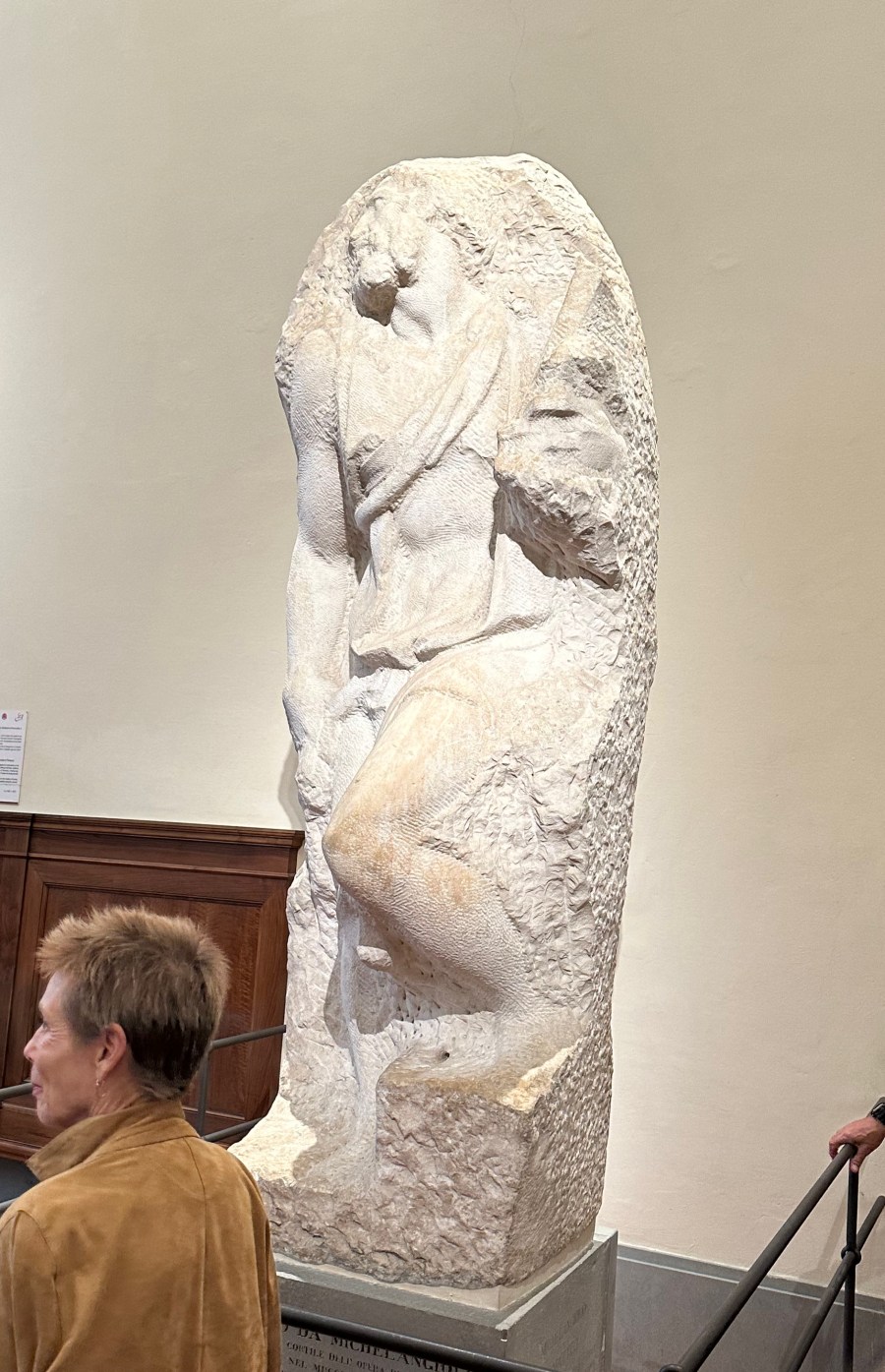
Photo: One of the unfinished marble pieces, never freed from the stone, of Michelangelo in Florence.
 Deena Pavinato - Journeys