I have been so inspired this weekend by services, celebrations, and writings regarding our nation’s 250th anniversary that it seemed more fitting to write my “Sunday blog” today, Saturday, the 4th of July. As I drove on the highway Friday evening, traveling home in the rain, watching nature’s fireworks in the form of lightening, I reflected on the Interfaith Service that I watched on Friday morning. I was so moved by the content I wanted to revisit it this morning, sharing thoughts on it, as well as Pope Leo XIV’s letter to the American people. You can watch the entire service from Washington National Cathedral on YouTube. It is worth the time to watch, as you are able. I will provide the link, along with one to Pope Leo’s letter, below.
Today on July 4th, Pope Leo XIV, issued a letter to the American people on the semiquincentennial. He said this anniversary “marks that defining moment in the history of the United States of America, July 4, 1776, that gave enduring voice to the ideals of liberty, equality, the pursuit of happiness, justice and democratic self-government. For two and a half centuries, generations of Americans have worked together to carry these principles forward — through sacrifice, service, innovation and civic participation. This anniversary stands as an invitation not only to celebrate the nation’s remarkable journey, but also to reflect upon the responsibilities that the sons and daughters of this country bear to one another, and to the generations who will inherit the nation that is being shaped today.” Pope Leo spoke of the importance of our many rights and freedoms, the right to religious freedom, the right to and support of the dignity of all human life, and continued efforts in support of the common good, building a world where there is a “commitment to the promise of freedom, justice, opportunity and democracy.”
Pope Leo also said, “Defending human life also includes welcoming, protecting and assisting immigrants, whose hopes, sacrifices and contribution have formed part of the history of this country from its very beginning. In every generation, those who have arrived seeking freedom, opportunity and a place to belong have helped to shape the nation’s character. To receive them with compassion and generosity is not only an act of charity, but also a recognition of the dignity that belongs to every human person.”
I am not naive to the fact that there have been issues with open borders in our country. I respect the fact, and the process, that allowed my grandparents and great grandparents come through and register at Ellis Island. But I cannot comprehend situations like the Venezuelan couple, who both worked at Amazon, whose son learned martial arts last summer, being detained and deported. They applied for asylum in the US and complied with the US Immigration check-in and processes. In June, they were advised to leave, by August 15, or be detained. They opted to leave but then were detained anyway during a check-in last week. The husband was sent to a separate detention facility than his wife and son, in Venezuela. That building was destroyed in the earthquake and he was killed. We must continue to fight for a more just and charitable way to support those seeking a better life in the United States. We are so much better than this!
Reverend Randolph Marshall Hollerith, the Dean of the Washington National Cathedral, said in his opening of the Interfaith Service on July 3, 2026, that the service seeks to celebrate 250 years of the American experiment, “to lift up the hope and promise of our nation, and to remember those who have given so much for the freedoms we now enjoy but to be honest about the promises of this nation that are still unfulfilled.” He said that “the American experiment is an ongoing project and that all of us together have work to do.” The entire service was a commemoration of good as well as less than desirable moments in our country’s history and treatment of others. It reflected with hope on the dreams that we began with and the goals that we continue to fight for.
I was moved by the opening entrance with a woman playing a moving Native American flute composition. It was acknowledged that the Cathedral was built on land that belonged to Native peoples and the Great Spirit prayer was offered that we “seek strength, not to be superior to my brother, but to fight my greatest enemy, myself.”
The majestic Star Spangled Banner, along with other prayers and speeches or written documents by Americans over the course of 250 years were poignant, not avoiding difficult topics in our history, but by remembering them celebrating our constant pursuit of justice and a better way for all in our continual quest for life, liberty and pursuit of happiness.
I was moved deeply by segments of the speech by Lyndon B. Johnson to Congress, on March 15, 1965, called “The American Promise.” I remember vividly this time in our history, my young moral and social conscience being formed by what I was hearing in the news. But I did not have a sense of the depth of the change that President Johnson was calling for in our country. President Johnson began, condemning the violent acts in Selma, and said, “Our mission is at once the oldest and the most basic of this country: to right wrong, to do justice, to serve man. In our time we have come to live with moments of great crisis. Our lives have been marked with debate about great issues; issues of war and peace, issues of prosperity and depression. But rarely in any time does an issue lay bare the secret heart of America itself. Rarely are we met with a challenge, not to our growth or abundance, our welfare or our security, but rather to the values and the purposes and the meaning of our beloved Nation.”
It reminded me that in our 250 years we have had many times of upheaval, times of despair and hardship, and yet, a call to seek a nobler way of living together and living up to the ideals on which we were founded. What we do, together as a nation, has so much more to do than personal gain, national economic success, or superiority over other countries. We set a standard for others, personally and internationally. Johnson said in this speech, “For with a country as with a person, ‘What is a man profited, if he shall gain the whole world, and lose his own soul?'”
The founding words of our country still stand as a test for us today. We may have moved past the (to some degree) of North/South, black/white problem of the 1960’s that LBJ was addressing but we must move beyond right/left and Democrat/Republican, hostilities of our own day, in support of “a promise to every citizen that he shall share in the dignity of man. This dignity cannot be found in a man’s possessions; it cannot be found in his power, or in his position. It really rests on his right to be treated as a man equal in opportunity to all others. It says that he shall share in freedom, he shall choose his leaders, educate his children, and provide for his family according to his ability and his merits as a human being. To apply any other test–to deny a man his hopes because of his color or race, his religion or the place of his birth–is not only to do injustice, it is to deny America and to dishonor the dead who gave their lives for American freedom.”
If we each desired to live our lives to the ideals that we remember today, to each of the goals that President Johnson ended his speech with (“I want to be a President who…”), and with a continued hope in freedom for all, I hope and believe we will see a change in the mood in our country and a unity that we have experienced in the past. Idealistic? Perhaps. But I would rather live my life with that hope and dream. I hope we can join together in that pursuit.
Happy 4th of July! Deena
Link to Interfaith Service at Washington National Cathedral: https://www.youtube.com/live/zunAWyeyYVw?si=8FuB3nkZ9LORe1ds
Link to Pope Leo XIV’s letter to the American People: https://www.vatican.va/content/leo-xiv/en/letters/2026/documents/20260625-lettera-anniversario-usa.html
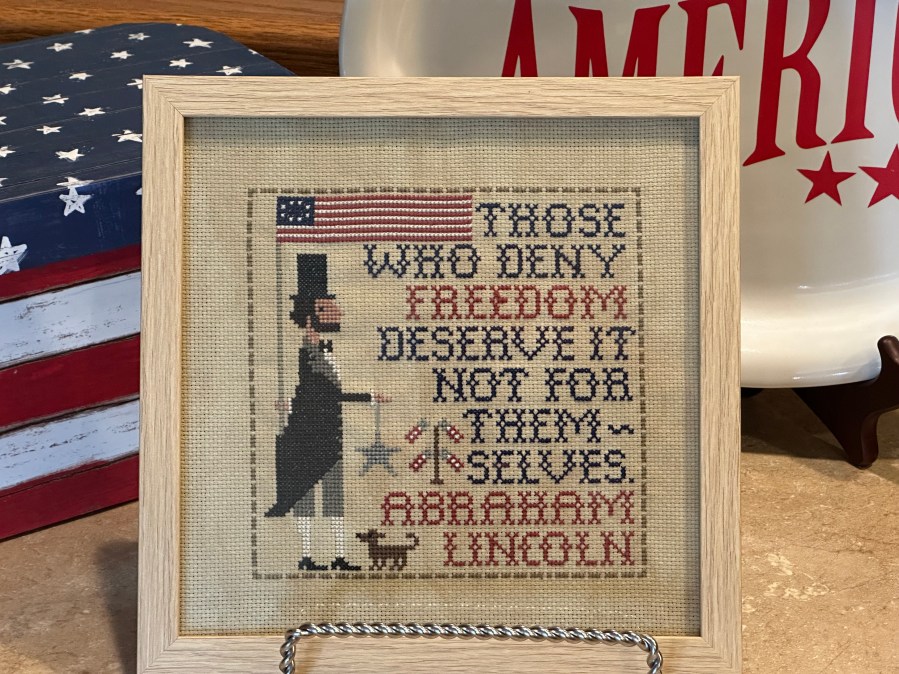
Image: One of my finished blocks in a 9-month patriotic stitch-a-long project, designed by Teresa Kogut. I am currently working on the Liberty Bell.