This morning at 3 a.m. I woke to a sudden brightness in the room. It was as if someone walked in and turned a light on. As I relaxed into the moment I realized the bright light was coming from outside. Rather than resisting and pulling the covers over my head, I got up, opened the blinds and enjoyed the brilliant beauty of the almost complete full moon (it’s actually full tonight, Sunday, October 25, at 11:11 p.m. and promises to be another gorgeous night for gazing upon her).
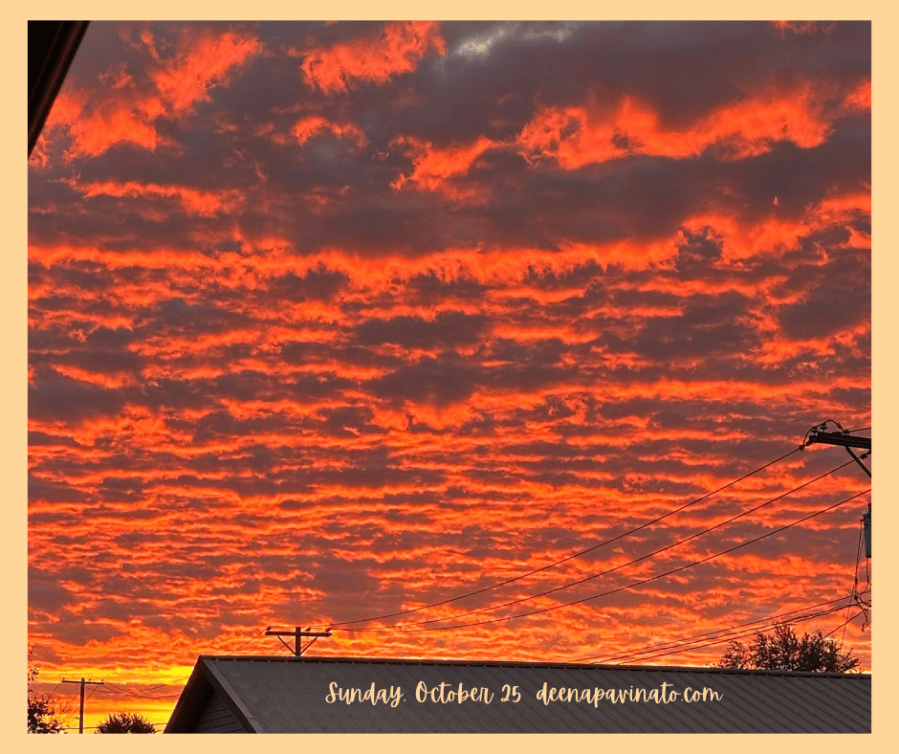
I did fall back to sleep eventually, but as usual, was up before dawn. After feeding the cat and sitting quietly for a bit, I decided to open the windows and let some of the fresh, but chilly, air into the house. As I moved to the windows by the patio I caught a glimpse of amazing colors in the sky and captured today’s photo as the sun began to rise. I watched as the colors turned from orange and dark blue to pinks and light blue. Then it was gone, transformed into a “normal” beautiful fall morning sky. I turned to see my tree full of bright color, although the leaves are falling from it faster than I prefer.
As I enjoyed my coffee, the birds were busy chirping and flying back and forth between the tree and bushes.
Do you slow down enough to catch those moments?
Last night I learned of the passing of a woman in town, younger than me, found in bed by her sister. I am sure she thought she would see plenty more sunrises. Rest in peace dear heart.
This week is one of my favorites, not because October is ending. October doesn’t last long enough for me. I love Halloween and the preparations to move into November celebrating All Saints and All Souls Day. Hallowtide is a very special three days for the Western Christian church, but more about that next weekend!
For now, enjoy these lovely days. Take time to breathe in the fresh air, watch the colors change (if they change where you live) and enjoy the sunrises and sunsets. Each one of them is precious.
As I began reflecting about this week’s blog earlier this week I was looking forward to our annual Oblate Day at the monastery, St. Mary’s Monastery, in Rock Island IL. This year we are studying Dilexi Ti: On Love for the Poor, written by Pope Leo XIV ( begun by Pope Francis during his pontificate). Our speaker is involved in many activities that serve those in need in the Quad Cities and is well-versed to speak on this topic. I suspected that it would be a wonderful presentation and that there would be content to share. However, that will be for another day. His talk was deeply disquieting and a profoundly altering experience for me. I need more time to process what we heard and what we are called to be, as Christian people, reflecting the love of Christ in the world.
In many ways it was exactly what I needed after a week of deep heaviness and melancholy. Rev. Dr. Ford’s talk jolted me out of the funk I was in.
Last week I shared with a friend that I began exploring ways that people live their lives as urban hermits. I find it so appealing and could easily envision living a life in seclusion. What I was experiencing during the week was a good example of why being alone isn’t always a good thing. Darkness can become even more consuming. Little things begin to look like huge issues. Tears flow even more quickly in response to minor inconveniences. It’s easy to lose perspective.
The enemy wants us to believe we are in it alone.
Evil exists in the world. I mean more than the evil we see in politics and the news. This week was another example of the dismantling of the spiritual core and moral fiber of our country as we see images of individuals that attempt to harm children with guns. There are people with deep hatred and evil in their hearts. That level of evil exists for sure.
I am speaking of evil on a more personal, spiritual, level. There is an evil that attempts to lie to us and deceive us as we attempt to grow in faith and love. For most of us it’s not to the extent that requires professional assistance, or an exorcist, although I am personally aware of two individuals trained to recognize and confront this level of evil. It’s more subtle than that. This enemy tells us things won’t ever get better or change. Situations and thoughts become temptations to ignore prayer or assistance from friends, or spiritual advisors. The experiences become things that attempt to lead us away from God’s will for us.
Last summer I took a virtual retreat with the John Paul II Healing Center and one of the evenings was dedicated to a guided healing session. The evening included prayers of deliverance. Prayers seeking freedom from situations that bind us, whether past events, or current beliefs that need healing and restoration. Remembering those prayers, seeking spiritual deliverance from negative thoughts and feelings, was helpful as I began to climb my way out of the gloom.
Small sacramentals, like creating a small prayer altar with statues and prayer cards, using holy water, or saying the rosary, can be helpful too. This week I also found the novena prayers to Our Lady, Undoer of Knots, especially helpful.
The Ignatian Discernment Institute and Fr. Timothy Gallagher’s daily posts on LinkedIn are often a source of great encouragement and support to me. The posts offer reminders such as, “Employed together, prayer of petition, meditation on truths of faith, careful examination, and suitable penance supply a formidable assault on discouragement and lies of the enemy’s desolations.” (Post on LinkedIn but from Setting Captives Free by Fr. Gallagher.)
Tell a friend. One friend reminded me that during times of depression or gloom are exactly the times to reach out, not go within. Another friend said some of the things I shared were what she needed to hear this week too. We don’t know who else might need support, and in the process, we can receive spiritual consolation
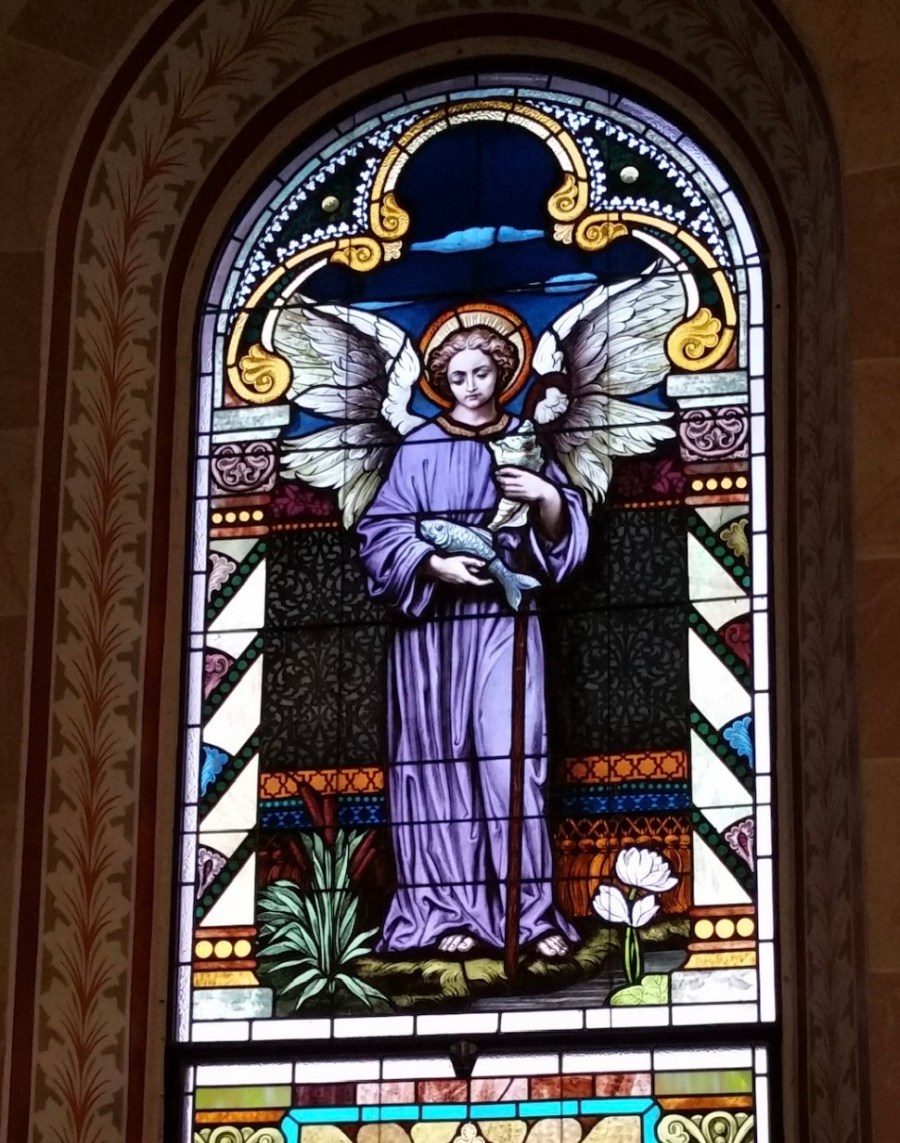
Today’s image is of St. Raphael the Archangel. It is a photo of a church window I visited in Arkansas. St. Raphael is often depicted holding a fish. In the book of Tobit, St. Raphael assists young Tobiah. He instructs him to catch a fish that will help in the healing of his father, Tobit. The fish’s liver and heart will drive away a demon (ch 8). Later, he is instructed to smear fish gall on his eyes to peel away cataracts and heal his father’s vision (ch 11).
St. Raphael, help open our eyes and hearts.
Wishing you a week of abundant peace and heavenly support, Deena
This weekend celebrates 800 years since the transition of St. Francis to eternal life. It is such a momentous event that Pope Leo XIV began a year of celebration on January 10, 2026, concluding on January 10, 2027. During this Jubilee Year, we are encouraged by the Church to visit Franciscan churches, shrines or other places of worship. In his Angelus address today, on the Feast of St. Francis, in Rome, Pope Leo said Francis’s charism continues to bear fruit. He invites us to “perseveringly ask for the gift of peace and sincerely commit ourselves to building harmony among peoples”.
Growing up with a Franciscan sister as my aunt I learned much about the impact of Francis on the world. Once I began considering colleges, I was given a personal tour of the College of St. Francis (now University) by my aunt and fell in love with the smaller size and personality of the campus. I began college making all the mistakes of a young person finally away from home but, over the course of those four years, was transformed by my involvement in Campus Ministry, guided by a Franciscan priest and religious sister, instructors, and the special friends I made, and continue to communicate with, made easier by social media platforms then when we graduated in 1978.
When I began to explore lay religious communities, in the 1990s, of course, Franciscan Lay Associates were examined and prayerfully evaluated. I think if there had been a community closer to my home, or someone I knew that was an Associate, I would likely have pondered it more seriously. The Benedictine sisters that were living on the grounds of St. Bede Academy, operated by Benedictine monks, in a neighboring town, held monthly group sessions that encouraged me and supported my three-year inquiry, candidacy and oblation.
There are many similarities between the Franciscan and Benedictine communities and I am sure if there was an official blend of the two, I would be part of it. Both spiritualities raise up the virtues of simplicity, stability, humility, and stewardship of the earth. They each live and practice prayer, and faith in action, in ways that promote being faithful laborers in the Lord’s vineyard, either building up the Church or damage it, by the way we live and encounter others.
Due to a busy weekend, my brother and sister-in-law were staying here for many activities celebrating his 50th high school reunion at St. Bede, and a wedding we all attended out of town, I attended Mass in a neighboring town this morning instead of my home parish. It was a privilege to finally attend a Mass celebrated by, and hear a sermon given by, a recently ordained priest in our Diocese. His eloquent sermon spoke of the force of renewal that St. Francis was during his life. He shared that St. Francis continues to attract and inspire us because he reveals Christ to us. Francis “preordered creation” by putting Christ first. He introduced a new peace that can be found as we open and bare ourselves to Christ, renewing our own spirit, so that we can demonstrate the same love to others that St. Francis did.
Pope Leo said “Saint Francis repaired the Church by virtue of his faith in the Lord Jesus healing the rifts of discord through the witness of fraternal love.” If there ever is a time to help repair the rifts of division and separation, it seems to be needed now. We begin with inner renewal and then allow it to flow out from us. The spiritual focus of this Franciscan Jubilee year is peace, simplicity of life, care for creation, and love for the poor. These fruits of inner renewal are ones I seek as we celebrate the Feast of St. Francis and continue during these final months of 2026 and the Jubilee year.
Wishing you abundant peace, Deena
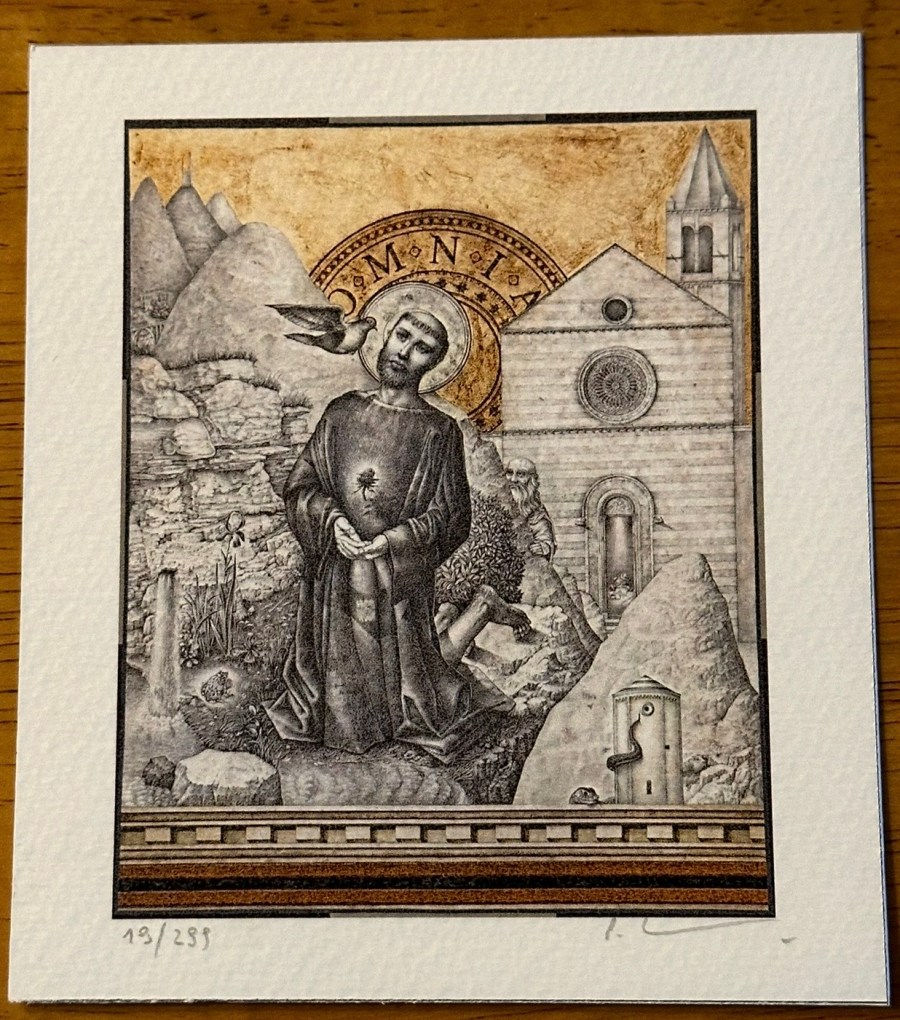
Image: artwork of St. Francis purchased in Assisi, Italy.
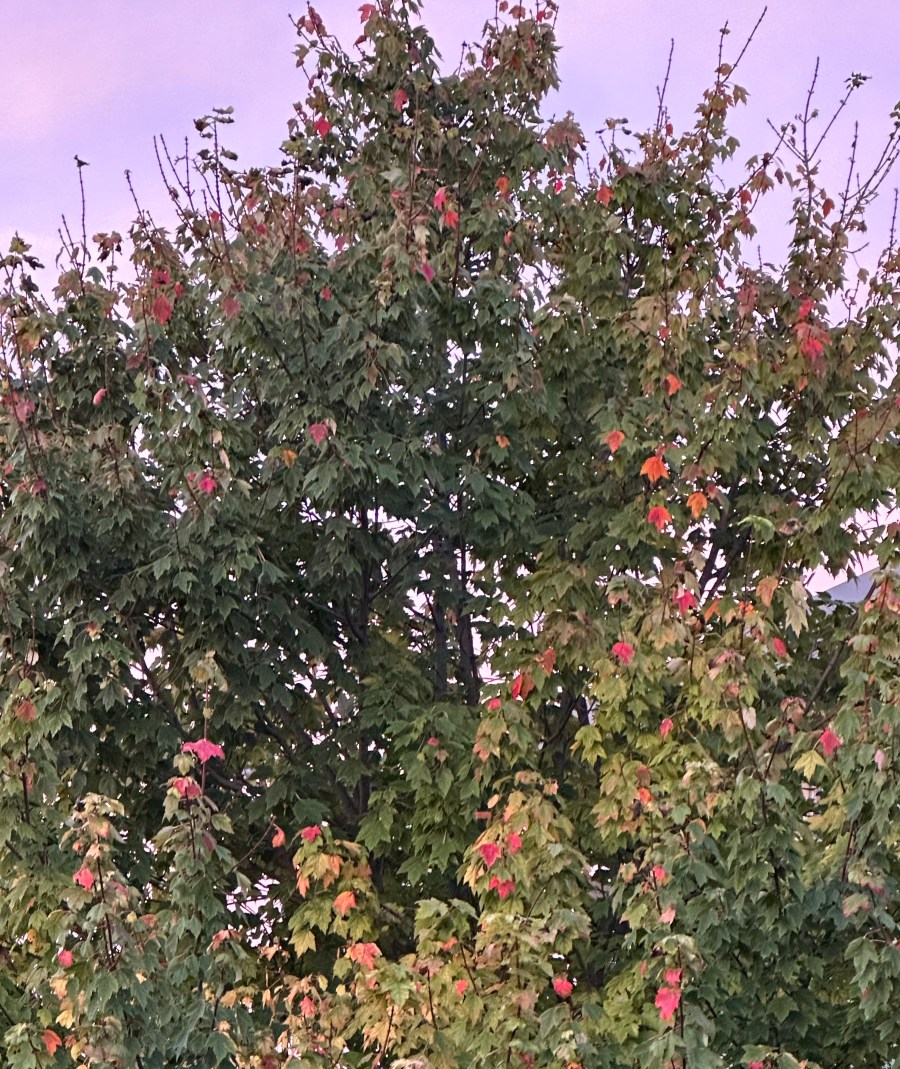
I was taking a picture of the sunrise this morning and turned to notice that the leaves on the tree in the backyard were beginning to change. The days have been cooler, the morning and nights magnificent, so the changes into Fall are beginning to take place. The purple flowers on my Ruellia Brittoniana (Purple Showers) have been decreasing in number each day. But the mum is beginning to open and show its color. I leave the windows open longer in the morning and open them back up again for most of the evening. Pretty soon our Illinois Valley will be aglow with vibrant oranges, reds and yellow leaves.
I have been tackling a large project in the house, projects I have put off a long time. Earlier this week I couldn’t even breathe as I began to think of the enormity of the task. It would literally take my breath away, paralyzing me instead of motivating me into action. I told myself to begin with one small task. That moved to another. Pretty soon I felt like I was making progress. Cleaning and getting rid of items is a big enough challenge but when there are emotions tied to them, it can become oppressive.
This week we celebrated the Beatification of Blessed Archbishop Fulton J. Sheen in our Peoria Diocese. The pre-Mass talks were excellent and some quite moving for me. The Mass was amazing! Growing up watching Blessed Sheen on TV, and then more recently with talk of his beatification in our Diocese, and path to sainthood, I am very familiar with stories of Sheen’s life. I have visited and prayed at his tomb, since it came to St. Mary’s Cathedral, many times. The events leading up to this week certainly renewed an understanding of the faith life of this holy man. Fulton Sheen has often said that his knowledge and insight can be attributed to his prayer life. He prayed a Holy Hour, in front of the Blessed Sacrament, every day.
To see so many faithful people attending the events in Peoria and St. Louis has been spirit-reviving. But it has also been a bit overwhelming, just like my household project. I desire to live a more faithful, and prayer-filled, life than I already do. It feels like there is such a huge gap between what I desire and the way I live my faith life.
As I have been writing this, Stephanie at Lindy Stitches, the host of the virtual stitching retreat I am attending, read an essay she wrote, during our virtual coffee hour. She affirmed the topic of this blog for me! Talk about synchronicity! Here are a few tidbits. I hope she shares it in a PDF for us. If so, I will share.
“…Good things take time. Really big things like Douglas Firs take decades to grow… Lovely things take time, they don’t happen overnight, you can’t pay for them to hurry up. Slow things made with intention are valuable things… Cross Stitch is being productive in a way that is slow, but man, that way is slow! … I don’t have to be productive all the time, that’s not the way I want to live anyway… What’s the point of all the time saving devices, just to work more? … Real beauty requires a human mind, a human hand and a human’s precious time.”
AMEN to all of that.
Just as the season are changing slowly and we relish it, this post is a reminder to myself, to go slow and have faith that the changes are happening, albeit slower than I prefer. I hope this reminder speaks to you too.
Wishing you abundant peace this week, Deena
Today’s image – my tree in the backyard this morning.
Being honest about the thoughts we have, and the beliefs they represent within, can be challenging. It’s probably easier to ignore them with other thoughts like – it’s just a bad day or I’m not that different than everybody else. But if we really want to grow spiritually, personally or emotionally, it’s not a good idea to ignore looking at thoughts and reactions as they come up.
This week I’ve had some challenging invitations to go a little deeper.
Earlier this week I took a seminar with Reform Wellness and one of the introductory comments was “If Christ isn’t the center of your life, something else is.” There can be a million “something else’s” for each of us. It can be other people, jobs, opinions, status, fear or anxiety, money… I am sure you can think of some that are, or have been, true in your life. I definitely had to spend some time thinking about all the things I let guide my decisions or reactions that are not my relationship with God. Instead of looking outside for answers, we were invited to take those concerns we have and sit down for an honest conversation with the Lord. Seems simple, right? But am I willing to hear the answer that may come?
There were scripture passages that challenged me this week as well – Simon and his judgement of the woman with the alabaster jar, the parable of the sower and the seed that falls among the thorns and is choked by anxieties, riches and pleasures in life, and finally, today’s Sunday’s gospel parable of the harvest workers being paid, by the landowner, the wage for an hour of work as the workers who toiled all day.
Diana Butler Bass wrote an insightful article, in her Sunday Musings, regarding envy versus jealousy. She wrote “Envy is a murderer — of our own souls, of others, and of the possibility of communion and community. Envy drives us to have more, to take what we think we deserve, to beat others at the game.” I looked at my own reactions to others or events, desiring to be honest about them. But what surprised me even more was what it brought up about my feelings about injustice I see in our country and my constant, daily, plea, “Why are they getting away with this? God, when are you going to do something about it?” Sure, I have my vote (and that’s important), but how else might I be called to look at, and deal with, those feelings of anger and disgust?
There were a long list of items I would have preferred to write about today. I read emails and commentaries that responded and reacted so much better than I could, so I will leave that to more proficient writers than me. As a quick note, if you haven’t read Maria Shriver’s Sunday Paper post, How We Fight, I would encourage you to do so. I think it might be my favorite article of all her articles that I have read. Maria has great insights on approaching the battles we fight, personally or as a society. I agree and want to try harder to implement this approach.
Besides being open and vulnerable, as Shriver suggests, I think it is also important to look for the wondrous moments that present themselves each day – the rain, the moments in between the rain, the cooler temps… simple, little moments can become moments to pause and be grateful.
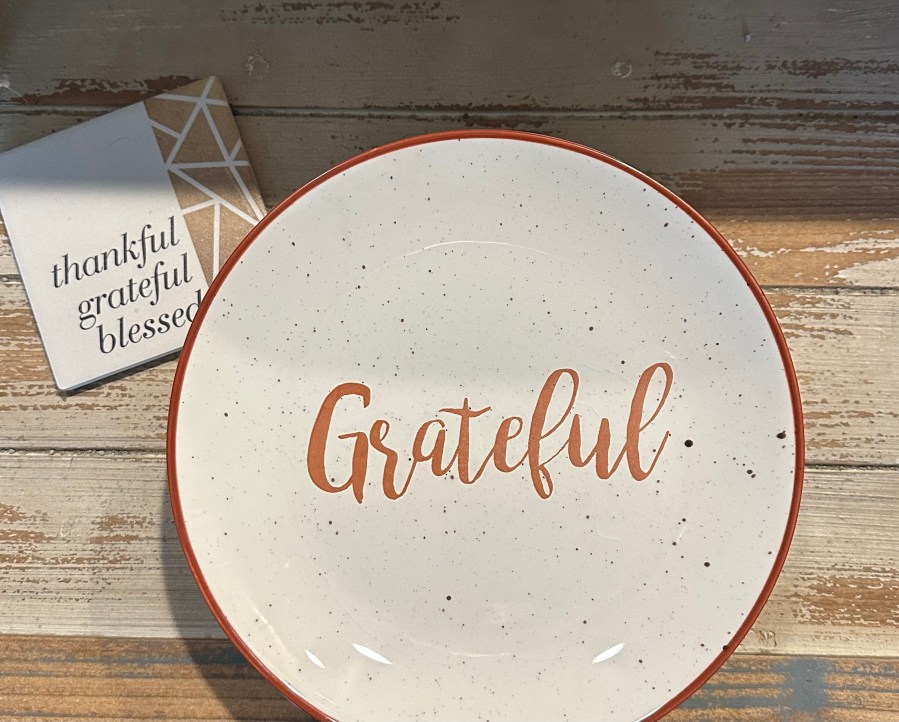
Today’s photo image is a “grateful” plate I set out this time of year. I purposely left the dark shadow in the photo as I took it, because I think worry, stress, judgement, etc can be an “opposition voice” that gets in the way of our gratitude if we let it.
This week, if moments to look within and be honest arise, approach them gently and then look for ways to be grateful for the insights they are providing.
I have been on many amazing vacations and business trips that have taken me to beautiful locations and scenery. It would be difficult to select one from them. But if I had to pin down a reason that some rank higher than others, it might be because of water. Coronado Island, CA and the Pacific Ocean. Towns along Lake Michigan on the Michigan side. Florida’s Gulf Coast. Lakeside homes. The sea at Nettuno, Italy.
Traveling the Inside Passage from Vancouver, British Columbia up to ports such as Ketchikan, Alaska is definitely on the top 5 list. I was reminded of this trip this week seeing posts of a similar cruise being taken by a former colleague and his wife, especially Friday as they also journeyed the Inside Passage. Suddenly I was transported to the top of my cruise ship.
Mom and I were settling in our cabin, as were our traveling companions, Pat and Laurie, in the cabin next door. We had a balcony but as I looked outside and saw the trees and water, I needed to see more. I told her I was going to run up to the top deck to explore. The trees felt close enough to touch and I wanted to experience more of it. Many others were coming up to the top deck as well. But no one was talking out loud, everyone was whispering. Reverent of the landscape. It was as if we would break the scene if we spoke aloud. I suddenly had tears in my eyes and was captivated by the magnificent beauty and the silence. The large cruise ship moved slowly. You could hear the water beneath us. I saw trees sway and a small waterfall here and there. It was breathtaking! The phrase “God’s country” came to mind.
The slow, relaxed pace of a vacation, or the good sense to be mindful of a stunning location, help us experience the beauty of our world. A glimpse of a deer in a backyard. Geese or ducks slowly navigating on the water. An eagle overhead. The hummingbirds at my purple flowers this week. All moments that say “slow down, take it in, it may be gone in a moment.” When we allow ourselves to slow down and be conscious, we experience that moment with a heightened sense of presence, focus and intentionality.
We are currently in the “Season of Creation”, an annual global celebration to care for the Earth, which runs from September 1 through October 4, ending on the Feast of St. Francis. First proposed by the Eastern Orthodox Church, it was welcomed into the Catholic Church by Pope Francis and has been promoted by the Laudato Si Movement. The Season of Creation is “a time to renew our relationship with our Creator and all creation through celebration, conversion, and commitment together. During the Season of Creation, we join our sisters and brothers in the ecumenical family in prayer and action for our common home.” The theme for this year is Living Water. The vision drawn from the scripture passage of Ezekiel 47: 1-12, encourages us to look at the ways we use water and to consider our human responsibility to care for it and ensure fair and equitable access to clean water to all the citizens of our world.
When you visit the ocean or a large lake it seems impossible to imagine that 2.1 billion people in the world lack access to clean, safely managed drinking water. Pope Leo XIV’s September prayer invites us to pray for the resource of water, to care for it, and for equal access to water for all. I have added a YouTube link to the prayer below.
We are invited to show our concern for water, by fixing pipe leaks, taking shorter showers, not running water when not in use (comment from me, for me, not keeping the water running while the toothbrush is in my mouth and not under the water!) and avoiding the pollution of drains and rivers. I can reflect on the inconvenience of not having water when a city pipe bursts or hydrants are being cleaned. I have to wait a bit, but I certainly don’t have to walk to fill a bucket to bring home for use for the day.
Fr. Cristóbal Fones, International Director of the Pope’s Worldwide Prayer Network, reminds us, in a press release, that water is one of the great essentials of life. The Pope’s September prayer intention “invites us to think deeply about creation, to safeguard it, and to look with God’s eyes on those who today have to walk for miles to obtain a bit of clean water, and to convert what we see into concrete actions that demonstrate moderation, care, and solidarity.” “No one should live without water, and no one should die because they lack water.”
This week, or perhaps continuing through the remainder of September until the Feast of St. Francis, I invite you to be mindful of your use of water, appreciating the gift of choosing hot or cold running water, or savoring a refreshing glass after coming in from the heat.
Wishing you a week of gratitude and abundance, Deena
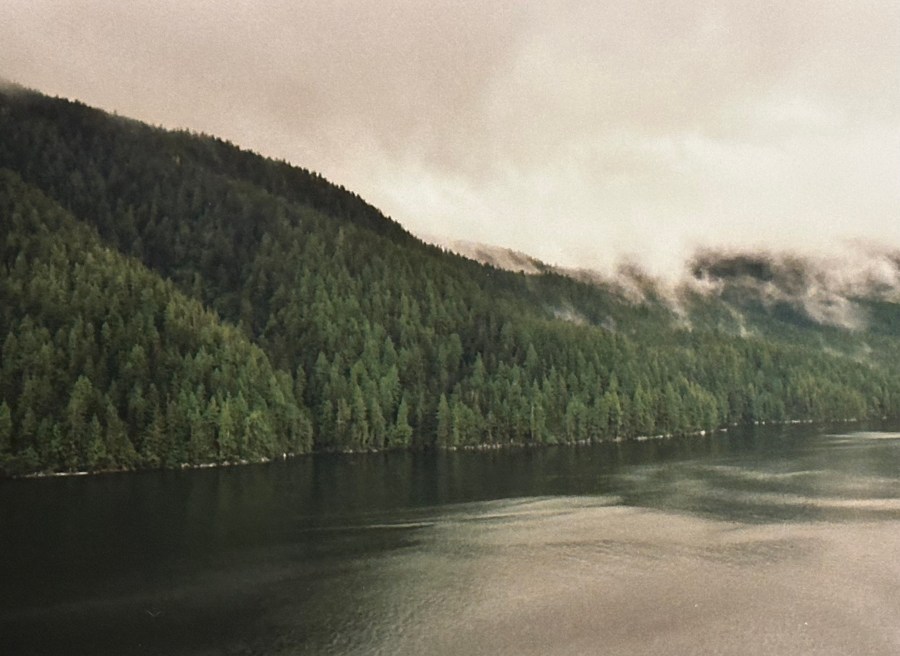
Images: A side view from top deck of cruise ship moving through the Inside Passage.
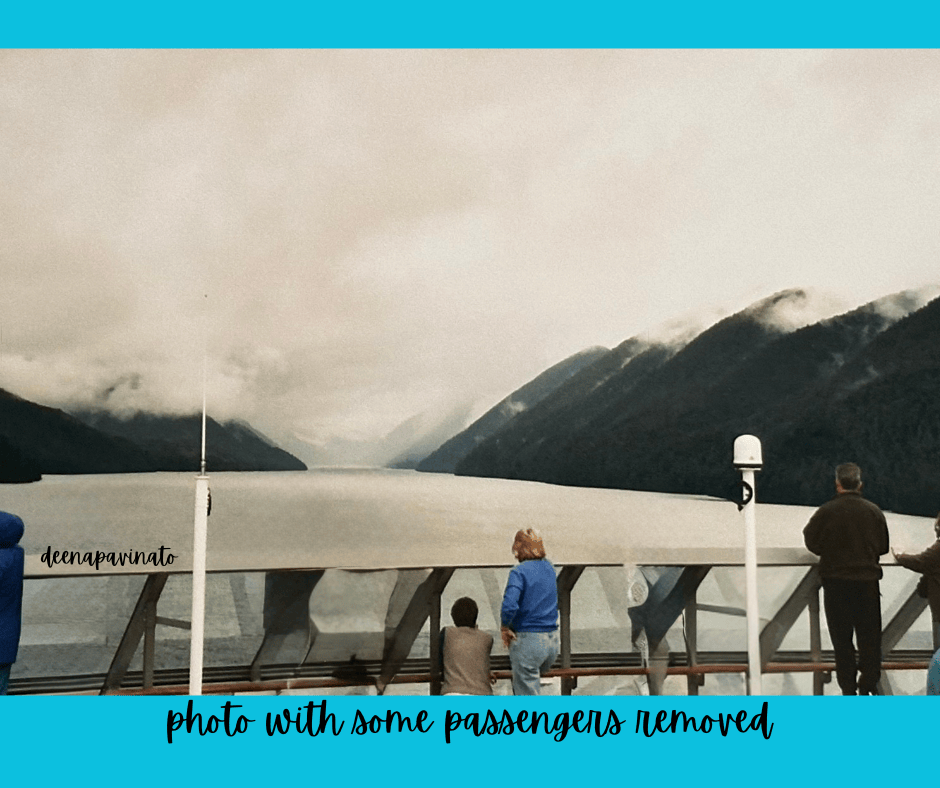
Another below, with passengers whose faces could be seen removed, looking straight ahead through the Passage.
Idleness is the enemy of the soul. Therefore the community should have specified periods for manual labor as well as for prayerful reading. Chapter 48 – Daily Manual Labor, The Rule of St. Benedict
The purpose of work in the monastery is to serve the community and fulfill all the tasks for the daily operations of the monastery. Tasks such as kitchen duty and being porter of the door are outlined by St. Benedict. But in all aspects of The Rule, there is always room for adaptation due to weather, the season of the year, or the age or “fainthearted” nature of the person performing the work. I love this about The Rule. There are guidelines but a wise abbot or prioress knows we all have different capabilities and endurance levels.
There have been times that I have viewed my work as fulfilling a purpose and serving a common good. Perhaps I was helping people by making their work lives easier by offering customer support or solving problems for them. Honestly, there are also times that I questioned what the value of that work was in the larger scheme of things. How I viewed the value of my work was probably closely correlated to how happy I was in the role. I would definitely make different decisions about work I was engaged in given the chance to do it over again.
But it’s also important to remember that I might not see the entire picture or purpose for the work I was doing, or the lives I might have impacted, by my presence there.
I read a newsletter earlier this week by an author I follow, Laura Kelly Fanucci, “Work Without End, Amen”, that reminded me of this important perspective. Fanucci offered a new piece of information, to me, about Bishop Ken Untener that I admired during my years living in Michigan. Laura shared that these lines written by Bishop Untener are often attributed to Bishop Oscar Romero because of a Christmas address given by Pope Francis, and a paper written by Cardinal Basil Hume. The lack of clarity ended up aligning the words with Romero.
Untener wrote: “We may never see the end results, but that is the difference between the master builder and the worker.”
Fanucci concluded, “I can picture both brother bishops shrugging. Who cares? What matters is the work. What matters is the mystery that Jesus called the Kingdom of God or the Kingdom of Heaven or the life of the world to come. What matters is that we got to be here at all. What matters is that we get to roll up our sleeves again and dig into the dirty dishes of being human. What matters is the work without end. Amen.”
This week I lamented the passing of poet, novelist and environmental activist, Wendell Berry. I am so grateful for his extensive writing and recorded talks, but his voice will be missed. In light of Labor Day, and the subject of my blog this week, I share these words by Berry:
“Teach me work that honors Thy work, the true economies of goods and words, to make my arts compatible with the songs of local birds.
Teach me patience beyond work and, beyond patience, the blest Sabbath of Thy unresting love which lights all things and gives rest.“
Let us seek to find value in our labor each day, whether it is caring for our families (and pets) at home, serving our parish community, assisting as a volunteer at an agency helping others, or still actively engaged in paid employment. Our work becomes an extension of our prayer when we try to serve and praise God in how we view those daily tasks. May we also seek to refresh and nourish our spirits by taking time to rest in the Love that is surpasses all of our human endeavors.
Wishing you deep and soulful rest this Labor Day weekend. Deena
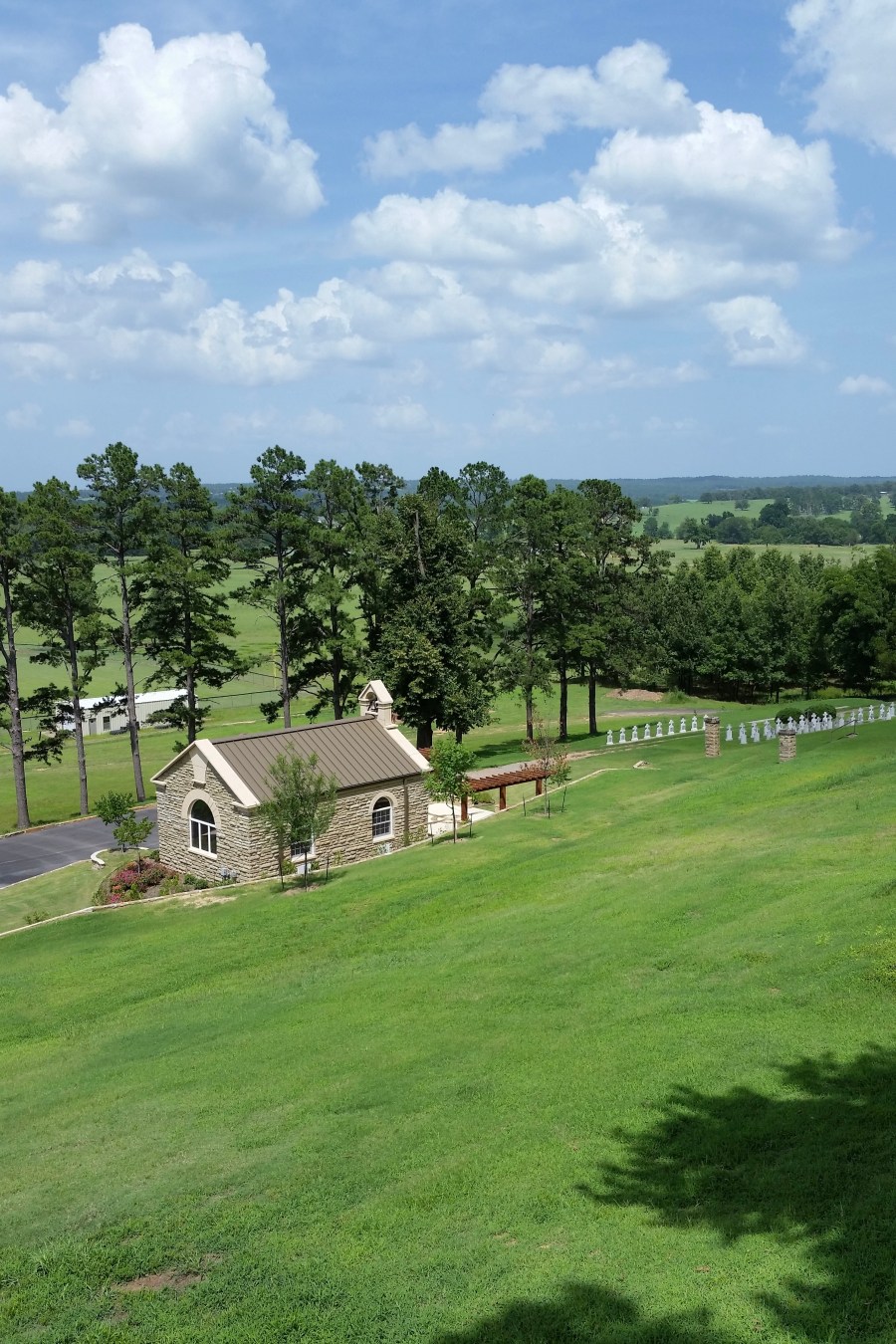
Image: a small chapel on the grounds of Subiaco Abbey, Arkansas
Turning 70 can definitely have an impact on your perspective in life.
It has given me the opportunity to reflect and be grateful for the friendships I have and the ability to spend more time with and appreciating them. I have, for the most part, everything I need and have decided I want to simplify in many areas of life. I can also relax the longing to figure out “what I want to do with my life”.
It makes each day seem even more precious.
I have been impacted, as so many of you have, by the images from Nepal. People who were sitting on a bus at the border crossing, or walking in the streets of their village, swept away by the flash flooding. Fortunately, there are stories of survival but for so many the loss is inconceivable. Friday night we also learned, in our Illinois Valley area, of the tragic loss of a young boy in a car accident, with the mother and brother surviving. Again, lives changed in an instant.
Regardless of our age or situation, each day is a gift.
This morning I read an article by a needlework artist who shared some thoughts after attending a Vince Gill concert. She’s a big fan so is aware of the goals he has, such as 50 years into his career, taking on a project to create 12 extended play releases. One might ask Gill, why not relax and begin to take it easy? She wrote that when Gill was questioned about it, he replied that “he doesn’t have as many years left to be creative — so it matters to him more than ever. And then he said he’s having the time of his life, just having a ball with it.” She used his story as an analogy, encouraging us to “learn a new stitch” or “start a new canvas” or “become the artist you’ve always wanted to be”.
I have always had the tendency to put off things – I can’t do this until … one more class, one more book, one more technique, etc “before I am ready”. My friend Kate taught a class this week, The One More Thing Trap, that encouraged us to look at all the “one more things” we tell ourselves that have to happen before we can be the person we want to be. When we do that we lose the ability to feel present and connected to where we are right now. Note: you can still access the replay to this free class by registering for Kate’s class here.
My cross stitch, and other art projects, have become a beautiful metaphor for living life. They have become a living reflection of my journey. Taking life more slowly and deliberately. Living and acting with intention. Trying bold new projects. Simply having fun. Each day is like a project, taking it one stitch at a time.
Regardless of your age, 30 or 80, my wish is that this week you enjoy the moments as they come along. Be present. Be adventuresome. Savor them.
Wishing you abundant joy, Deena
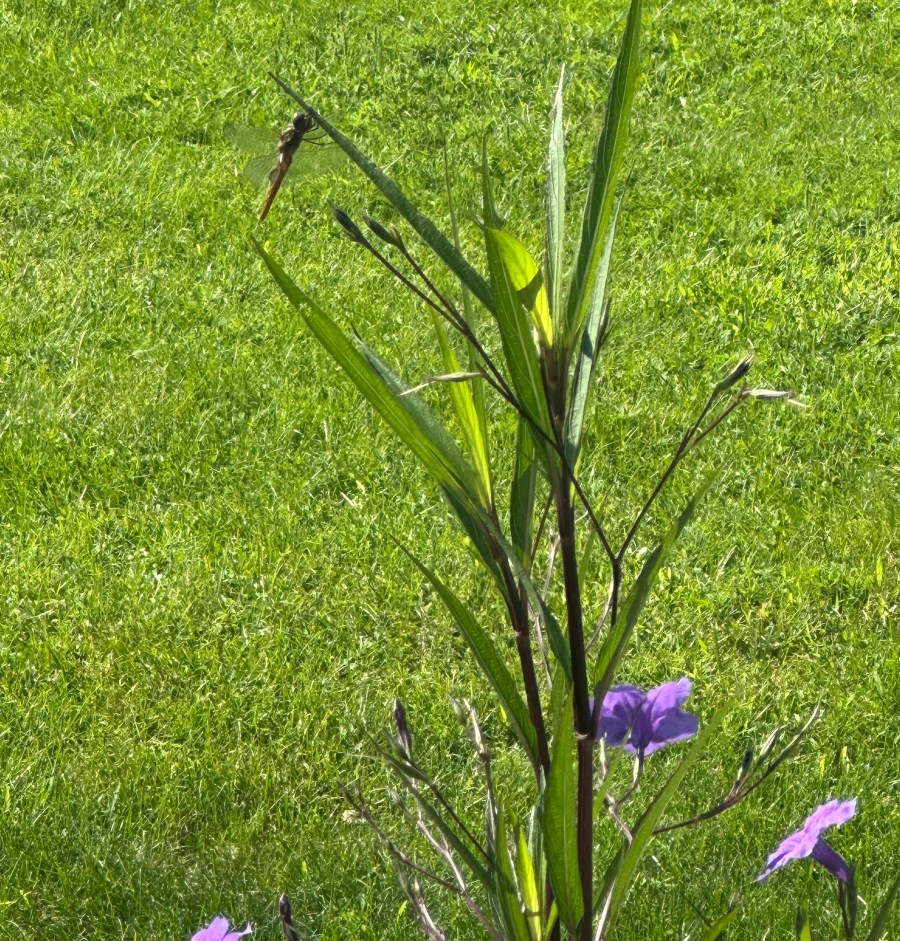
Today’s image: I noticed a dragonfly on my “purple showers” the other day. He was simply sitting on to the edge of the leaf. Moving with the wind as it swayed. I wondered if he was stuck. After several minutes, he flew away. He reminded me to land lightly, settle softly, and enjoy the moment.
One of the things I am most enjoying about my new hobby and passion for cross stitch is that there is so much to learn. Groups I am in share tips and tricks for stitching on various fabrics or ideas and ways to mix colors for floss (thread) that you don’t have in your “stash” or to make a pattern your own style. I can’t think of a day in the past 11 months that I haven’t learned something from watching another stitcher.
One of my favorite designers, and floss tube creators, is Jacob de Graaf of Modern Folk Embroidery. He’s a multidisciplinary artist but an expert in traditional style, period reproduction, Quaker and Dutch/Frisian samplers. As we are journeying through a stitch-along for the month of August working on our Fast Frisian sampler, Jacob has been sharing his sampler collection and the research he has done to learn about the young girls that stitched the samplers, the schools or orphanages they attended, and the families and villages that they grew up in.
The past two weeks, in our daily stitching videos, he has taken us on a journey to various cities in the Netherlands to visit art museums, landmarks, and the quaint 600-year-old-city that he grew up in. It has an historic canal, a waterway that was a thoroughfare, that connected Friesland to Germany. Because of that, his town received their “city” status. Jacob took us to lakes, gardens and a lovely working windmill. I will probably never visit the Netherlands so I have been soaking up the sites and information he has shared with us.
In today’s image I have shared my progress on our sampler, as well as the desired end result showing Jacob’s chart and design. I am behind on my Frisian samplers as well as other “stitch-alongs”, due to a lot of birthday celebrating this week, for which I have no regrets and am grateful for the opportunity to celebrate with friends. Hopefully I will catch up this week. But as another floss-tuber said this week regarding her stitch-along, there are no stitching police, do what you can and have fun. Great advice for life as well.
Today, in his Angelus address for the Twenty-First Sunday in Ordinary Time, Pope Leo XIV reminded us to remain open and resist the temptation to think that we have learned all we need to about our faith. Pope Leo reflected on Matthew’s Gospel and Jesus’ question to the disciples, “But who do you say that I am?” Pope Leo suggested that Jesus calls us to give a personal response to this question, to continually rediscover our relationship with Jesus in the Gospels, reviewing and renewing the choices we make each day to be sure they are consistent with the faith we profess to believe.
If we attended Catholic schools, or religious education programs, we might be tempted to believe that we have learned everything we need to live a Christian life. I have found in the many books I read, or retreats I have attended, that my relationship with Christ is ever changing. My most common prayer during weekly Adoration is, “what do you want me to know or see today?” I am often surprised by the answers or insight I receive in prayer.
Pope Leo offered us these questions as suggestions to pray with: “Who is the Lord for me? Do I truly know him? What is his Gospel asking of me today? What steps and what choices am I called to make?”
Maybe there is a book you have seen that would offer some time for quiet reflection each day. Perhaps a retreat or Day of Reflection. Sometimes they are virtual, so you don’t actually have to take time to get away, although I do believe there is great benefit in removing ourselves from the daily distraction of being at home, with tasks to be done attempting to grab our attention. Our parish, as many do, will begin adult education programs for those interested in learning more about the Catholic faith, in preparation for receiving the Sacraments at Easter, but are open to those who want to rediscover and learn more about the practices of our faith. Check with your own parish, even if you have been away for a while, if that sounds interesting to you. Certainly you are welcome at Holy Family Parish if you don’t have a parish you call “home”.
This week think of an area of your life that you have grown complacent. How might you learn something new and gain some knowledge about it? Perhaps you are feeling called to grow deeper in your faith life.
I’d love to hear about it in the comments if you wish to share what that might be or what you learned.
Wishing you abundant peace and joy this week, Deena
I received Kate Bowler’s newsletter on August 12 titled “Why I’m Anti-Gratitude” and I have been on a gratitude practice recovery journey since. Now, first of all, if you have visited this blog before you know I am a fan of Kate Bowler. She’s a wonderful author, podcaster, speaker and professor at Duke University. I have her books and listen to her podcasts. So, this likely won’t change my overall opinion of Kate’s work. She began her newsletter sharing that she began a gratitude practice when she was recovering from a serious illness (Kate is a cancer survivor), and that it helped. But, she went on to say that the wellness industry has turned gratitude into a guaranteed cure for suffering and a “strategy for controlling life and our emotions. Another optimization project we can fail (or succeed!) at.” Simple, she suggests, write 3 blessings a day and you’ll never be sad again, concluding that it’s simply not true. She states that it has become a way to refuse that life is BOTH beautiful and hard.
Ok, I get that.
I paused. I questioned whether my daily practice was making a difference. I judged my current ongoing list of gratitude bullets (on that particular day my list was up to #1440) that I began after reading another author, Mary deTurris Poust’s practice of numbering and keeping the gratitude list going as a way to acknowledge the countless blessings in our lives. I wanted to go to Kate’s Substack account and comment that I don’t think most of us see gratitude simplistically, as a magic bullet for happiness. Instead I considered the study she quoted, that there wasn’t a positive benefit in those participants who journaled gratitude over those who did not. She teaches at Duke after all!
But it just didn’t settle with me. I couldn’t let it go. I believe being grateful does make a difference in our outlook and perspective in life.
Fortunately at the same time, one of the Facebook groups I am part of, facilitated by my Young Living Essential Oils manager organization and Brenda Schuler, our “Diamond” leader, began a 10-day Gratitude Reset Experience. Each day she has posted the benefits of practicing gratitude and rewiring our brains to focus on positive events and circumstances in our lives.
Our energy matches what we focus on. I believe this.
On July 12 Br. David Steindl-Rast turned 100 years old. He has long been a voice, known as the “Grandfather of Gratitude, for the transformative power of gratitude. His TED talk in 2013 tells us that it isn’t that happy people are grateful but rather grateful people that are happier. His 2017 YouTube video, A Grateful Day, has been one of my favorite reminders of the gift of each day. As founder of Grateful Living, Br. David and his organization, are committed to sharing the benefits, and practice, of gratefulness and the impact it can have on our lives and our world.
Dr. Arthur Brooks, a well-known author and podcaster, recently shared his 5 step process toward living a more grateful life. Also a professor (Vanderbilt University), Dr. Brooks says we are living in a “happiness crisis”. He writes and speaks extensively about finding happiness and meaning in today’s world by incorporating simple practices and attitudes into our daily way of thinking and being.
There are countless others. As I reminded myself of these respected teachers and scholars, I reflected that they aren’t suggesting we ignore the hardships in life. They aren’t saying do “this…” and your life will turn around and all difficulties will disappear. But I do believe they are suggesting that we are able to cope with and move through those times much easier when we have a foundation of gratitude for the blessings in our lives.
My faith does this as well. God doesn’t promise a life that is free from any worry or concern. However, I believe that I will be sustained during them. I was reassured as we prayed today’s Collect for the Twentieth Sunday in Ordinary Time: “O God, who have prepared for those who love you good things which no eye can see, fill our hearts, we pray, with the warmth of your love, so that, loving you in all things and above all things, we may attain your promises, which surpass every human desire.”
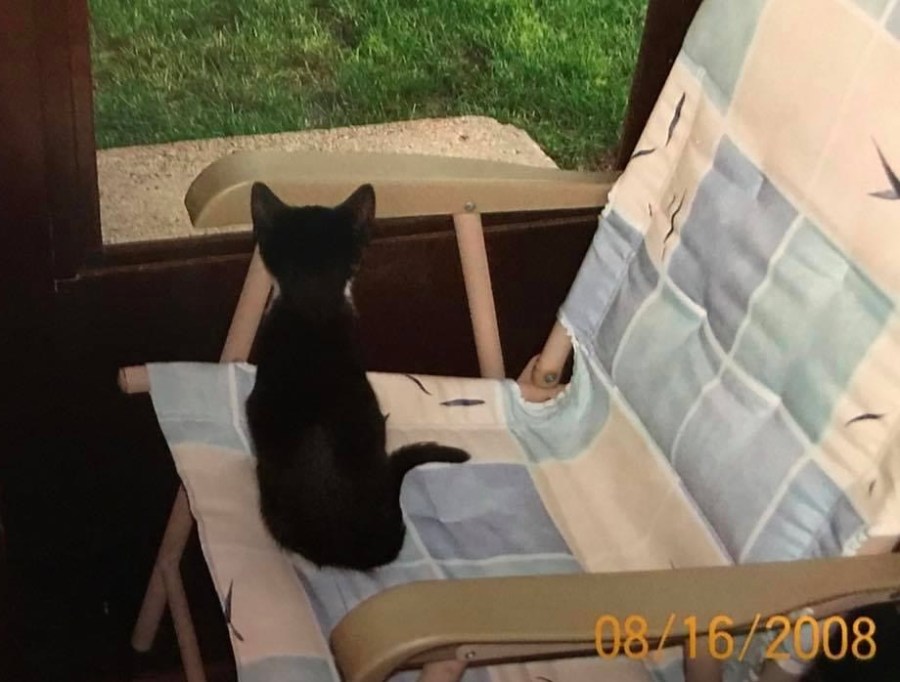
Today’s image is a picture of little Bela on the day he found me. While the pain of losing him this past February remains intense, I am grateful for the years we had together and all the joy and laughter he brought into my life.
Difficult and challenging moments will show up, that’s a given.