What seeds take root?

Gardening is such a great analogy for life. There are so many parallels in writing or motivational thinking. You reap what you sow. If you have a dream, you have to nurture and care for it to see it come to fruition. From the Gospel for today, the Fifteenth Sunday in Ordinary Time, the seed that falls on rich soil produces fruit.

In the Strangest Secret by Earl Nightingale, one of my favorite motivational talks, Mr. Nightingale reminds us that what we do in life, and how we think, determines what we accomplish. We all begin with the belief in the possibility of our dreams and our intentions. Why don’t we achieve what we set out to accomplish? Mr. Nightingale suggests most people conform to life, and the belief of others, around us. The successful person is not a specific job or title, but rather someone who progressively works toward their desired goal or outcome. Without specific intention, direction, and guidance, we don’t end up where we want. His secret – “we become what we think about” or what we give our attention to.

When I go to my favorite garden centers and buy plants for the year, I don’t come home and plop them on the ground or in a pot, as is, and expect it to grow. Annuals need some nourishing potting soil, occasional fertilizer and even more water than plants in the flower beds. The perennials need the right spot of sun or shade, soil that is amended, proper pruning for the plant and of course, water. I care for the plants and then watch them take root and grow.

Today’s photo is of Black-eyed Susan (Rudbeckia) in my flower beds. I didn’t plant them in that spot. They are now growing along side a day lily plant and some echinacea (which looks like I have to give more space this year because of the Black-eyed Susan). The Black-eyed Susan are around the corner on the other side of the burning bush. The seed scattered, the soil was rich and it’s a sunny spot, which they prefer, so the plant has grown beautifully there. Perhaps too abundantly!

As we listen to scripture each day, or at least weekly, we are hearing and giving the Word of God a place to take root and plant seeds. Our faith grows as we mature spiritually. I don’t hear the Word proclaimed as a sixth grader and expect that level of faith to carry me the rest of my life, giving me counsel in every difficult or trying situation. I have to keep tending it, listening and growing, at the various phases of life. A deeply rooted and established plant in my garden isn’t going to topple in a storm. When the challenging situations come, the faith life that has been attended to over the years, is going to provide the firm foundation to help me navigate the difficult times. In his sermon on YouTube for this week, Bishop Barron suggests that the Word of God is creative (vs. descriptive or performative) and changes things. I would agree.

As a Benedictine Oblate and someone desiring a deeper faith life and closeness to God, I was reading daily scripture and reflections. But from the time, four or five years ago, on retreat when I heard (internal) the invitation to attend daily Mass things have changed. Oh believe me, I argued with God about that invitation – I was working and traveling, busy, etc. But the invitation persisted. I negotiated and said I would do the best I could. Do I still need to let that Word take better root, absolutely! There are days that it definitely falls among the weeds and is choked out by worry or lack of faith. But I keep listening. Over time, that Word we hear changes us, changes our perception of things and reaction to things. There are a ton of options, rather than being physically present at Mass if you find that challenging or you aren’t Catholic, YouTube or Facebook live streams, sites and apps like Hallow that you can simply listen to the scripture readings, etc. If you can become easily distracted, I would recommend listening to vs. reading scripture each day.

Whether success in work, family or faith, we become what we listen to and think about. Are you giving your attention to the things you want in life?

Peace, Deena

Both talks mentioned today can be found on YouTube

Photo is from my photo album of the Black-eyed Susan in my garden that is mentioned in the post.
A Procession of Faith

After graduating from college, my friend Jane and I took a trip to Europe. Our first stop was London. The gentleman we sat next to on the flight from Chicago to London was quite kind and gave us lots of tips on what to do and see during our time in Europe. I am sure he saw these two naive young women and thought – they will either be afraid to explore or they will get in trouble. It was a different time then but his best advice, be adventuresome. He helped us mark our travel book with “must see” destinations. We arrived in London on a beautiful sunny day, I don’t think we saw one typical foggy English day during the several days we were there, so we dropped our bags off at the hotel and found “the Tube” and headed to Hyde Park. Hyde Park is the largest of the Royal Parks and has beautiful large gardens and a network of paths and sidewalks linking the gardens, fountains and places of interest in the Park. I remember all the sidewalks because as we arrived and looked around, I saw several religious processions around the Park with gold vestments and canopies. I remembered it was the Solemnity of Corpus Christi, the Most Holy Body and Blood of Jesus. It’s a memory that comes back to me each and every year on this beautiful feast day we celebrate today.

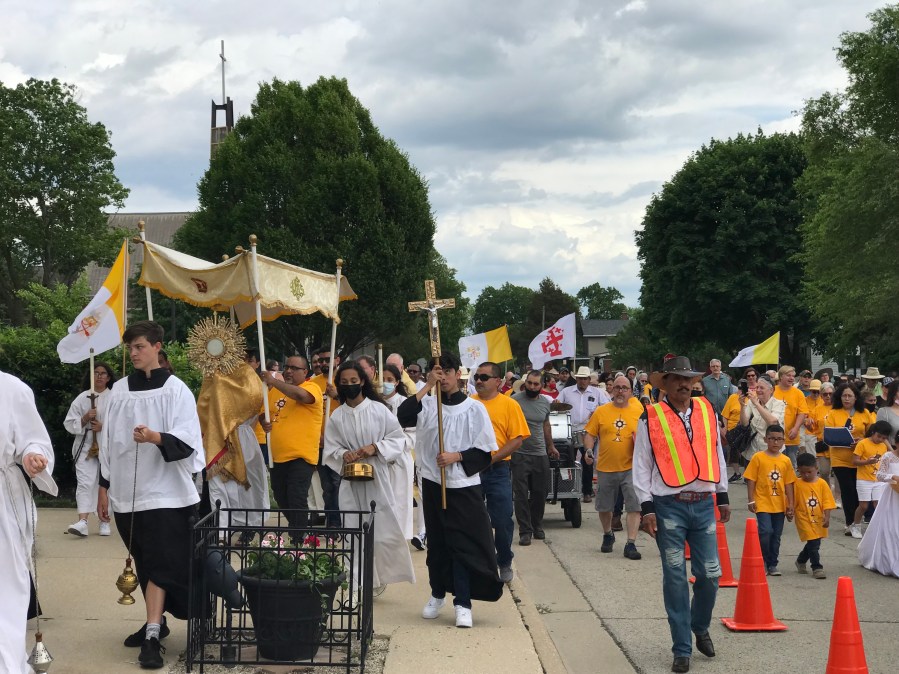
I don’t recall processions growing up. Growing up in the 60’s and spending several years in upstate New York, perhaps the age-old tradition had waned here in the Illinois Valley and in New York State but in more recent years I have seen a revival. My local parish began having processions around the church, or one year even inside the church because of rain, when Fr. Gary Blake was our pastor. The picture I used for today’s blog is an annual procession, that seems to get bigger each year, hosted by the LaSalle Catholic Parishes. It travels from St. Hyacinth’s church to Shrine of Our Lady of the Holy Rosary, just under one mile, through the streets of LaSalle. It includes the Eucharistic procession, music, horses, school children dressed in their First Communion outfits, parishioners with special t-shirts and concludes with Eucharistic adoration stops. It is amazing! I am moved each year but the devotion to our Lord in the Blessed Sacrament. It is a public statement, a profession and a procession, of faith to community members.

Today also marks the beginning of The Year of Parish Revival, the second phase of three, as part of the Eucharistic Revival movement. I am honored to be one of the two parish representatives for Holy Family Parish. The revival, grew from concern over the results of “pew studies”, and declining Catholic belief, that Jesus is truly present in the Blessed Sacrament. Two-thirds of Catholics reported that the Eucharist was merely a symbolic representation of Jesus’ presence. Bishop Robert Barron, Chair of the Committee on Evangelization and Catechesis at that time, shared with fellow bishops that there was a serious problem that needed to be addressed. Committees and meetings took place and the Revival was launched. Bishop Andrew Cozzens, now Chair of the Committee on Evangelization, has brought the fruit of those discussions to fulfillment. If your parish is involved, find out more. If not, ask your priest how to part of the parish-level revival. There are beautiful documents, parish kits and trainings to aid us during this special year of grace.

During graduate school, I attended a Newman Center for Mass and special liturgies. It was a wonderful Center, a peaceful place to study and a place of fellowship. At one point I found myself questioning my beliefs, particularly in the Eucharist, and asked to speak to one of the priests serving at the Center. I shared my concerns and questions. He asked me “Would you throw the Eucharist on the floor?” I said, “No! Of course not!” He replied then that I had a reverence for the Eucharist and that my questions were normal. I appreciated his help but now looking back I see it was misguided and perhaps the reason that many Catholics began to see the Eucharist as representing something holy, as reflected in the 2019 Pew Forum, but not actually the Body and Blood of Jesus. Our catechesis was lacking!

There are a couple of ways to look inward at your own belief, if you are Catholic, in the Eucharist. First, and most importantly, is to revisit the Church’s teaching on the Eucharist as the “source and summit of the Christian life”. Each week, or perhaps daily, at Mass, we witness the transubstantiation, bread and wine used for Communion, becoming the body and blood of Jesus. It is a miracle repeated each and every day. Another way is to spend some time researching the documented Eucharistic Miracles throughout the world. I had the great privilege of visiting the Church of St. Stephen in Santarem, Portugal and seeing the Sacred Host that has been enclosed in a reliquary since the miracle in (or around) 1247. It continues to liquify the Holy Blood over the centuries.

Blessed Carlo Acutis, an English-born Italian tech savvy teen, who died at the age of 15 in 2006, documented over 136 Eucharistic Miracles onto a website before he died. He was extremely devoted to the Eucharist, attending daily Mass and offering his sufferings from leukemia for the intentions of Pope Benedict XVI, who was the sitting pope during Blessed Carlo’s final years. He was like any other child in family videos singing at school plays or a typical teenager enjoying films, soccer, and video games. But Carlos also spent time after school volunteering to help the homeless of his city. He asked his parents to take him to many of the sites of Eucharistic Miracles in Europe. The website he created can be viewed or pdf’s downloaded to use in parishes. A traveling Eucharistic Miracle exhibition visited our area last year and exhibits continue to travel around country. He is one of the patron saints of the Eucharistic Revival movement.

St. Thomas Acquinas, Doctor of the Church and one of the greatest scholastic philosophers, said that “the Eucharist is the sacrament of love. It signifies love. It produces love.” To that I say, Amen.

Peace, Deena

Image used is from the Corpus Christi Procession in LaSalle, IL 2021

Why we do what we do

This morning, reading Maria Shriver’s Sunday Paper, I reflected on the question she and her team were asked by a facilitator brought in to conduct an offsite session to assess where they are and where they want to be, as writers for the Sunday Paper. They were asked “Why do you do this?” “To what end?”. Great questions for all of us. Why do we do what we do?

Many of you have shared in response to my posts from Maria that you started following her after I have shared her articles or that you admire her too. We post sunsets and flowers and graduation pictures. I have friends on “vacations”- one on a long trip to Israel visiting many of the holy sites I long to visit, others now returning from an incentive cruise to Norway as a result of great success with their stamp & paper crafting businesses and recently a group that traveled to Italy with my friend and author, Judith Valente, visiting lesser known Benedictine spiritual sites. I have enjoyed each and every picture they have shared from their journeys. I think we share those moments with each other to make a connection, to have companions for those special moments or to impart some information that we found helpful.

We recommend recipes and great restaurants because we want others to have the wonderful experience we had. We share the ordinary moments that make us smile, like my cats in their new cardboard box, which they won’t let me breakdown yet, or a friend who takes his dogs to establishments in Florida for lunch or refreshment and afternoon music. Are these things going to change the world? No, but they bring moments of happiness as we share them and as our friends participate, albeit virtually, in those moments with us. My morning posts of a coffee cup or an inspirational quote are not going to change your life, that’s for sure, but I hope it gives each of us a minute to pause and think about something pleasant in the world.

I share my love for essential oils, or a new system I have found to reduce pain and promote healing and restoration, because I want others to experience the same benefits I have found. Whether it’s health and well-being, kitchen items or jewelry, I believe that my friends are sharing these items because it brings them some delight or comfort. Maybe that’s what small communities used to be like. People set up their small businesses because they knew it was a trade they were good at and wanted to help others.

I am looking forward to reading a new book I found out about this week from author Kate Bowler, written by her former Yale professor Miroslav Volf, Life Worth Living; A Guide to What Matters Most. To be a complete fan girl of Maria Shriver today, she wrote opening comments to the book regarding her new venture, Open Field, and she said “We are all seeking the same things. We’re all seeking dignity. We’re all seeking joy….seeking to be seen, to be safe….We can all give each other these (spiritual) gifts if we share what we know-what has lifted us up and moved us forward.” Her new venture, Open Field, with Penguin Books is the publisher of this book. My initial sense of the book so far is that it asks all the Questions – questions that challenge us, inspire us to define what’s really important, face the limiting beliefs that prevent us from pursuing it and then start making the changes to get there.

Hopefully we do the work we do, paid or volunteer, because it brings us joy and fulfillment. At some point we must have reflected that it would be work we would enjoy or it is a gift or talent that we have. If it no longer does that, perhaps it’s a good time to ask why not and how we could change that activity to become more meaningful again. Or maybe it’s an opportunity to consider doing something new. It may be a stretch to think about a new venture. My transition from corporate life to ministry work has invited me to use a prayerful, discerning heart and mind over a rational, pragmatic one. It isn’t always easy to change but it may make a difference in each and every day of your life and potentially to the lives of those you impact on a daily basis.

Today is the Solemnity of Pentecost. We celebrate the birth of the Church with Mary and the Apostles but that continues to come alive each day in us. Ronald Rolheiser’s reflection in Give Us This Day for today, May 28, was poignant. He said “We are always dying in some ways, though never dead. We are always alive with new life. But we need to grieve what’s dead, adjust to the new, and let the old ascend. If we do this, Pentecost will happen in our lives. We will receive a new spirit for the life that we are, in fact, living.” Then he made a statement that perhaps is the answer I have been seeking for many years. He said that the Holy Spirit brings about the “dissatisfaction and restlessness” that we feel until our lives, and the spirit by which we are living them, is integrated and aligned. To that I say, Come Holy Spirit! Let us continue to pray for the gifts of the Holy Spirit in our lives: Wisdom, Understanding, Counsel, Fortitude, Knowledge, Piety, and Fear or Respect of the Lord.

Peace be with you, Deena

Image created with PicMonkey