A call to pause

As I prepared to write this, reviewing my notes and ideas, the bells rang calling those attending 10 a.m. Mass to hurry along and, then again, to mark the top of the hour. I hear the bells every day, from my parish church at the end of the block that I live on, but especially now with more windows open and time spent outside attending to my plants. They remind me of the bells at the monastery. They remind me of a call to pause and say a prayer. They remind me of some words of Sr. Joan Chittister in her book, The Monastic Heart, that were also used as part of a reflection a couple of weeks ago in our weekly email update from Sr. Joan.

Joan said, “The purpose of Benedictine bells is not to spell out the hour of the day at all; that task is left to horologists. Our bells, on the other hand, are there to wrench our attention back to what is really important in life: the memory of God in our midst. The memory of the purpose of life. The memory that time is moving on and so must we. The recognition that life today is different than yesterday, and we must not try to hold life back. The bells jog the memory that there are actually more important, more meaningful, more demanding dimensions of life than anything ordinary we can possibly be doing as they ring. The bells stop us in midflight to prod us to ask ourselves again if what we are doing is what we are really meant to be doing.”

It’s true that the bells also call us to remember the great concerns of life, such as caring for the poor and people in need, or comforting the sick or grieving. We must ask whether we aware of the concerns of our brothers and sisters in areas of the world ravaged by war, weather or persecution? But they also cause me to pause and look at what I am doing in the moment, is it important? Does it matter? Am I living my vocation in life?

This week I had several opportunities to pause and slow down, to look at my self-care, nurturing or self-compassion. My friend Kate Brown taught a workshop, “Nurture and Grow: Cultivating Self-Compassion in a Turbulent World.” We considered ways to be more compassionate to ourselves and that in doing so we build a reservoir to compassion to give to others. We discussed being more mindful vs mind full and the importance of finding a community of like-minded individuals that will support and encourage us and then we in turn for each other. We also discussed embracing our imperfections and the importance of accepting ourselves, where and who we are at this moment.

Speaking of imperfections, yesterday was my monthly creative journaling workshop and our topic was “Resistance, Joy and Self-Compassion.” Resistance and judgement in our creative endeavors is definitely the thief of joy! We experimented with drawing ovals, faces and a drawing ourselves from a selfie taken during class. Lisa encouraged us to break resistance by doing a little bit of creative art or journaling every day, to make little promises to ourselves to commit to our creativity. But it can be so hard to find and set aside the time for our own self-nurturing. Am I willing to commit to doing so?

Church, convent and monastery bells have provided this reminder to pause to countless men and women throughout the centuries. For some reason, the bells were a soothing reminder this morning of all of the women who have guided me throughout my life. When I remember my mother on this Mother’s Day, I remember a woman who worked harder than anyone I have ever met. I don’t know what she thought about self-nurturing or self-compassion, we never talked about it, at least not in those words. But I do know while she always gave of herself to others, she also knew how to relax and enjoy herself when the work was done, whether it was Saturday night dinners out with my father, their annual fishing trips to Minnesota or backyard gatherings with friends. I remember my “Noni” (Italian grandmother) and times spent with her, usually in the kitchen or the garden. I recall my aunt, a Franciscan sister, who encouraged me in ways that I didn’t realize fully at the time. The Benedictine sisters who invited me to learn more about the monastic life and community remain important witnesses to me of a life of purpose.

Pause for a few minutes today and consider the women who have influenced you in your life, whether mothers, grandmothers or nurturing women and role-models. Did they offer (or perhaps they are still alive and continue to offer) examples of self-care and compassion? Who does offer that reminder to you? Would you be willing, if you don’t regularly, to take a few minutes each day to find ways to embrace who you are and what you feel you need to live a life that supports your purpose and vision in life? Why not start now!

Wishing you abundant peace and compassion, Deena

Picture: of the bell tower at St. Mary Monastery in Rock Island, Illinois. I am an Oblate of this monastery.

Springing to life

It’s been a glorious week in Illinois, even with the times of rain, wind and storm. It is feeling like Spring, maybe even late Spring with the warm 70-80 temperatures during the day this week. Everything is growing and lush around my home. The lilacs are close to full bloom, I actually prefer the deep purple they are now. My hostas and perennials are gorgeous. It’s time to start thinking and planning the annuals I will put in pots by the doors and on the patio. I purchased my favorite plant of each year, Ruellia brittoniana (Purple showers or Mexican petunias) which I hope to get in pots today. The fresh air and beautiful blossoming that is springing to life around me reminded me of special days and women that I reflected on this past week.

Last Monday was the Feast of St. Catherine of Siena, Italian mystic, lay Dominican and Doctor of the Church (one of four women Doctors of the Catholic Church). The image I included for this week is a sculpture in Siena that I saw while on pilgrimage. I love it and another statue of St. Catherine we saw because they show her passion and fierce spirit. Most paintings depict Catherine as pale and sickly. It is true she practiced excessive “holy fasting” with a diet that consisted of only water and vegetables and was considered anorexic (anorexic mirabilis or holy anorexic). But Catherine had a strong and bold spirit, bringing about unity of the papacy and convincing the pope to return to Rome after almost a century in France. My favorite quote of St. Catherine, that reflects her passion for following what she believed in is “Be who God meant you to be and you will set the world on fire.” Catherine did this and lived her life with her eyes on God and with Heaven as the goal of her life.

Wednesday was May 1st, May Day or Beltane, one of the cross-quarter days of the Celtic Year. May Day symbolizes Spring to me, regardless of the weather. The sweet images of children bringing May Day baskets of flowers to neighbors symbolizes, to me, our coming outdoors from winter and sharing that joy with our neighbors and friends. May Day also reminds me of St. Hildegard of Bingen. Hildegard, another Doctor of the Church, was a medieval mystic, visionary, writer, herbalist, composer and artist. Hildegard was well-aware of the images of Beltane, the Green Man and used similar language when speaking of God and Earth images as a source of wisdom and power. Hildegard criticized the church, emphasizing that the criticism came from Spirit and not from her own perceptions. But after reviewing her writings and visions, Hildegard was encouraged to write her visions down by church leaders such as the Pope and St. Bernard of Clairvaux. She spoke of the goodness of the earth and God’s “greening power” or Viriditas, verdant “greenness”, and the creative power of life. Hildegard was another woman with deep faith, listening to God’s voice but, not afraid to move outside the constraints of her time on women. She was willing to speak boldly of her belief in the truth God was revealing to her. Similar to St. Catherine, Hildegard challenges us to “Dare to declare who you are. It is not far from the shores of silence to the boundaries of speech…you must be prepared to leap.”

In both of these women I also see their desire and commitment to, as Jesus speaks in the gospel for this Sixth Sunday of Easter, “remain in my love”. Both women, in their own way, remained true to the teachings of the Church but in sharing their wisdom, helped us see the truth of our relationship with God in an expanded way.

So I wondered what “remain in my love” means and how do I live that more fully in my life. Certainly it includes time of prayer and contemplation, listening and surrendering to the Word in the way God is calling me to live it and share my life in God with others. But it isn’t a passive love, it involves going forth, bearing fruit, and loving others. Those become the signs of remaining in God’s love.

I found a new website this morning, CatholicWomenPreach.org with a reflection on the gospel message. Meghan Larsen-Reidy shared that “love stems from a commitment.” She speaks of the commandment to form relationships and challenges us to look at whether we prioritize “the Divine and people over material possessions and appearances.” This commitment, she suggests, changes our actions, how we spend our time, money, how we care for others and for the planet.

Saints Catherine and Hildegard embody that commitment to God, to love, and to changing the world around us by the way we live the gospel invitation to remain in the love of the Divine.

My wish for all of us this week as we relish these days of Spring and new life around us are expressed in St. Hildegard’s poem, Viriditas.. I found this modern translation (fccucc.org) of Hildegard’s words, that keep to the meaning of her words but in a way easier for us to relate to.

Good people, Most royal greening verdancy,

Rooted in the sun,

You shine with radiant light, in this circle of earthly existence.

You shine so finely, it surpasses understanding.

God hugs you. You are encircled by the arms of the mystery of God.

With a grateful heart, Deena

Pruning the vine

This weekend I am attending an aromatherapy workshop/retreat in Northern Illinois. I stepped away from the evening social to write this so that it can post in the morning when we are in our first session. I was talking to my friend Kathy and said, “I don’t think I want to write about the retreat yet, there has been too much to process and I’m not sure what I want to say yet.’ The introvert in me was tired after a full day of being with others and ready to retire, so I stepped away to the quiet of my room. I opened the gospel reading for the Fifth Sunday of Easter, and saw that it is the discourse on the Vine and the branches. I quickly changed my mind about mentioning the retreat.

Jesus tells us, as he uses the analogy of the Vine and branches, that some pruning is required in order to bear fruit. Pruning will separate away the lifeless and dead parts of the vine plant so that the healthy branches can bear fruit. The rest is gathered together and thrown into the fire. If you have ever had a garden, especially if you have grown zucchini or cucumbers, you know that the vines that grow off the main plant can easily get entangled with weeds or with other plants if not cared for. It’s important to watch as the vines or branches begin to grow and produce fruit. If those branches mingle and get wrapped up in another plant or weed, it is possible that the vines will be choked and that the plant won’t produce the fruit that we desire. Jesus tells us a branch, connected to the Vine, will bear more fruit by pruning away the things we don’t want and by caring for the plant we want to grow and produce abundant fruit. The fruit of sharing the life-giving message of Christ with the world, or at least the world that we interact with, will grow with the same attention and proper care as we need to tend our gardens. If we ignore and hope for the best, we probably won’t accomplish the desired outcome.

Meditation and reflection on the Word of God is an important part of making sure we remain connected to that Truth. As a Benedictine Oblate, that daily reflection with the Word is called Lectio Divina, which I have talked about in previous posts. It is by reading, listening and reflecting on the Word that we open our hearts and minds to hear what God has to say to us, what gifts we should use and sometimes, where we should be using those gifts.

As I returned to my room and reflected on a day full of suggestions about self-compassion, rest and mindfulness, care and releasing the negative burdens of the past to make room for a life of joy and bringing that joy and light to others, I thought yes, this too is part of the pruning. Jesus often stepped away from his disciples and others to pray and connect with God, before or after doing his work in the world. That stepping away was life-giving to him as it can be to us.

During Lent I was more intentional in talking about, and integrating in my life, time for prayer, creating a sacred space for prayer, setting aside activities that are not life-giving and making time for the things that are, entering the cave of the heart to be able to listen and discern. I have wondered all weekend why those were activities I was more intentional about during Lent have faded into the background, and have seemed to be overtaken and strangled by weeds of busyness and disordered passions.

Why is it so hard to step away, to spend a few minutes in silence and self care, in order to connect more deeply with the Source of all things? Why will we say yes to endless requests from others but say no to ourselves when we need to nourish and fill our spirit with just a few minutes that might help us listen and respond to that which is most important? When will we realize just how life-giving that time is, and that replenished and nourished, we are able to be a better vehicle of love and light in the world?

Another retreat participant and I took a few minutes after lunch to walk to Stronghold Castle here on the grounds of the Stronghold Camp and Retreat Center. We found bluebells layering the ground on both sides of the path, we listened to the waters of the Rock River just beyond the castle, and our conversation was interrupted by the loud and persistent jabbing of a woodpecker hidden in the tall trees. We allowed ourselves to be renewed by the healing energy of nature and it only took us about 15 minutes!

Take a few minutes today and try to do the same, be nourished by a walk, ponder looking out the window, take a short nap, read the gospel reading cited above regarding the Vine and the branches, and in those activities, connect to God, the source of all goodness. Find time to step away from the routine activities of your day, even if it’s just for 15 minutes.

Be still and listen with hearts and ears open to hear and receive.

May you find abundant peace in your day! Deena

Image: a photo I took at Stronghold Camp and Retreat Center

The light of hope

Hope is being able to see that there is light despite all of the darkness. Desmond Tutu

I have been thinking about hope this week.

Easter is a season of hope. Hope at a deep level, a spiritual level. Hope is the second theological virtue, as opposed to a fruit or gift of the Holy Spirit. It allows us to trust and protects us from despair. But as with all gifts, we must accept it and make it a deliberate part of our lives.

It isn’t hope that a project turns out well or that my plants weren’t impacted by the frost last night. It isn’t hope that the weather will be nice next weekend, and that everything works out, for my friends Kate and Kathy as they host an aromatherapy retreat that I will be attending next weekend. It isn’t hope that the Chicago Cubs win again today. Although those are all great things to hope for! Perhaps they are hope at the level of a wish or a desire for a positive outcome.

Instead I think true hope is faith-filled. It is a trust in the promise of the Resurrection, that my Aunt Gina, who passed away this week, is now at peace and will be reunited with my Uncle Bill. I have hope that peace and justice ultimately triumph over violence and war. I hope that we will wake up and see what we are doing to the planet and begin to treat the earth with respect and love for the gift we have been given. I have hope in God’s love and mercy for all.

Christian author and speaker, Kate Bowler, has a new series, Words to Live By, on the Ritual – Wellbeing Practices app. I listened to her reflection on Hope a couple of times this week. I enjoy her books, her podcast and now these reflections because she looks at life as it really is, the “beautiful and terrible” of it all (Have a Beautiful, Terrible Day! Daily Meditations for the Ups, Downs and In-Between). I was captivated by a quote, by Martin Luther, that she referred to. “Hope changes the one who hopes into what is hoped for.” If we allow hope to change us, we then “lean into a possible future we can’t see yet.”

If I hope for peace, I become more peaceful in my own interactions with others. If I hope for and care for creation, then I make an attempt, in my own small way, to be more conscious of how I use resources, I recycle and buy less plastic. If I trust in God’s love and mercy for me, then I attempt to offer that love and forgiveness to others. I know I won’t do it perfectly but if I hope to see those things in the world, then I must be an active participant in bringing them about.

So I ask, as Kate did ending her reflection, ‘How well do we actively try to find hope in the world? Do we attempt to listen to its whisper and turn down the dial on fear?’

“Blessed are we when we make room for all of it.” (I also recommend Kate’s book of blessings, The Lives We Actually Have: 100 Blessings for Imperfect Days)

“May the God of hope fill you with all joy and peace in believing, so that you may abound in hope by the power of the holy Spirit.” Romans 15:13

Peace to you and days filled with hope, Deena

Image: Picture of a stone mosaic I took during a visit to a monastery.

PS. Before I started writing today’s blog, I looked back at a post last year, in the season of Easter, “Hold on to hope”. If you would like to read it and reflect further on hope, click the image below.

Endless, inexhaustible mercy

One of the things I am learning, and appreciate, about the Spiritual Exercises of St. Ignatius of Loyola is that it begins with the premise, in the First Principle and Foundation, that God’s love for each one of us, individually, is endless and unconditional. We have unique gifts and talents, along with our deepest desires, that God wants us to realize and fulfill, to the ultimate purpose of living with God forever. A person making the Exercises is invited to spend time in this First Principle and Foundation, considering this love, before moving on to the other “weeks”. It is only then that we look at how our response to God’s love has been impacted by the sin in our lives, how to follow Jesus more closely, a consideration of Jesus’ passion and death and then the joy of the Resurrection.

Today is Divine Mercy Sunday, the Second Sunday of Easter. I enjoy the gospel of Thomas’ encounter with Jesus, Jesus’ greeting of “Peace” in a room full of his frightened apostles, men that abandoned him, and the prayers of Divine Mercy, but I think I haven’t been approaching the day quite right. I hope it makes sense as you read this.

I found a quote by Thomas Merton to reflect on while trying to look at Mercy a new way. It’s from his book “No Man is an Island”.

“But the man who is not afraid to admit everything that he sees to be wrong with himself, and yet recognizes that he may be the object of God’s love precisely because of his shortcomings, can begin to be sincere. His sincerity is based on confidence, not in his own illusions about himself, but in the endless, unfailing mercy of God.”

Last week, on Holy Thursday, as I traveled to various parishes to visit their Altars of Repose, I found myself contemplating the prayer of Jesus before his arrest and the brutal treatment of sentencing and crucifixion. I prayed, “I am so sorry. Can you forgive us for how we treated you?” I instantly heard, in my mind, an answer to that prayer. “You are forgetting, I already have, that’s what Good Friday was all about.” Wow. It changed my prayers and reflections on Good Friday, Holy Saturday and Easter and I have been contemplating it all week.

Yesterday in the Modern Mystics class I am participating in, Fr. Ron Rolheiser gifted us with his presentation on priest, writer and theologian Henri Nouwen, “The Light of Tenderness”. During the presentation he said, speaking of Nouwen’s writing, that “the heart is stronger than our wounds”. He said that Nouwen believed that we have to live our wounds vs. think about them, we have to take them from our head to our heart and live them so they don’t destroy us. I understood this to mean, for me, that we accept and learn from our wounds instead of rationalizing them, finding people to blame for them or continuing to dwell in them.

We can do this, it occurred to me, only if we believe in that “unfailing mercy of God” that Merton spoke of. I can remain in the posture of constantly trying to understand why I did what I did, keep asking for forgiveness, for the mistakes I have made, over and over again, or I can accept that Mercy and move on. Instead of dwelling on the reason I seek Mercy, I can share the joy of experiencing that Mercy in my life. Otherwise, it seems, I haven’t truly believed in the gift of Jesus’ death and resurrection or the gift of God’s Mercy.

There is immense freedom in knowing that God knows exactly who I am and who I have been. I don’t have to pretend it was anything else. God’s mercy is inexhaustible, precisely because of God’s love and despite my failed attempts to live as a loving human person to others.

I am going to continue to spend some time with this as we celebrate the Feast of Divine Mercy. I invite you to also consider how we might accept that Mercy more fully and move on with the intention of living with more love and compassion, because that great love and mercy has been gifted to us.

Peace, Deena

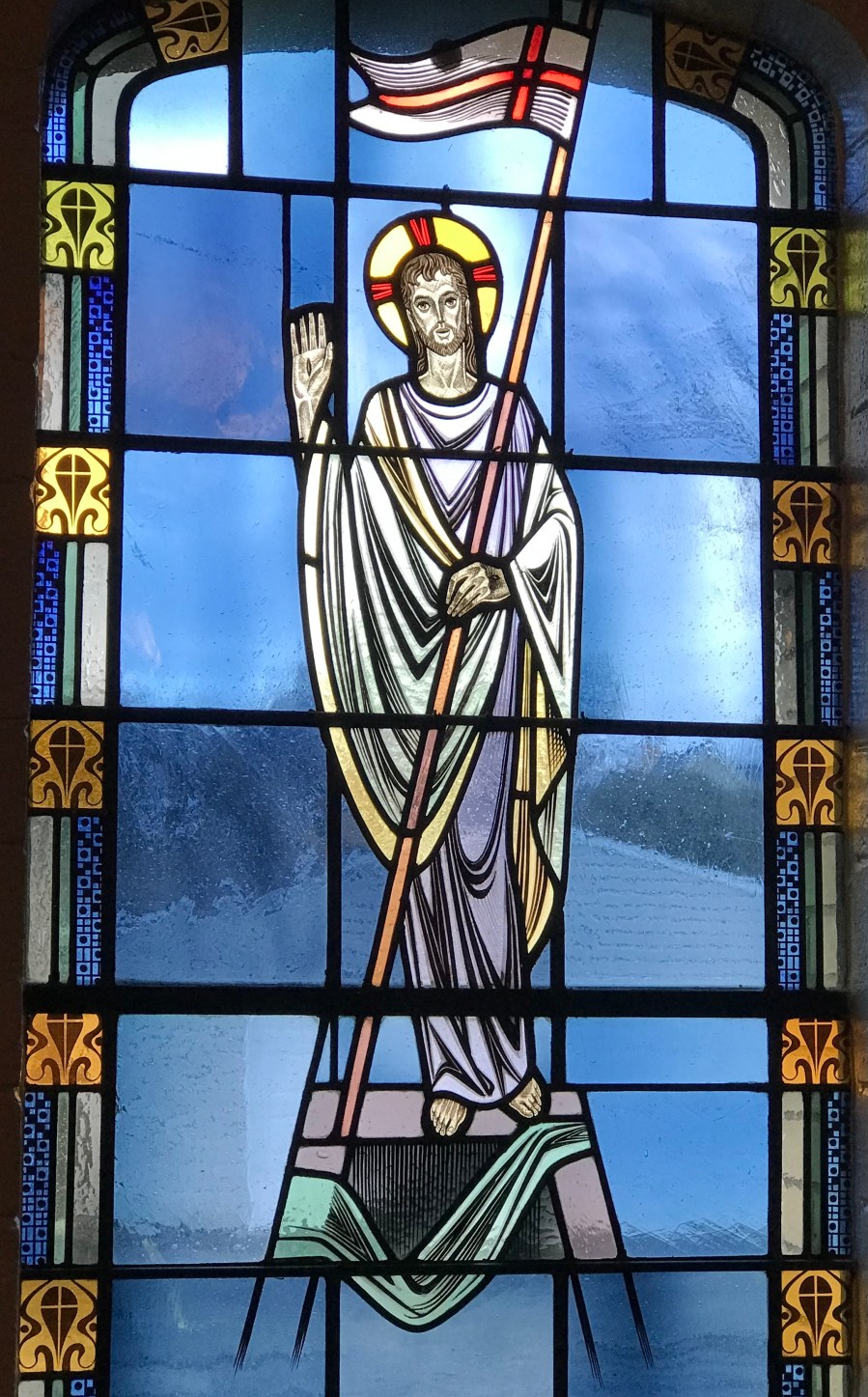
Photo: Our Resurrection Window at Holy Family Church, Oglesby.

O truly blessed night

O truly blessed night

when things of heaven are wed to those of earth

and divine to the human

I am writing this week on Holy Saturday before the Easter Vigil at our parish. The words above are from the Exsultet, or Easter Proclamation, that is sung during the Easter Vigil. It is usually sung by the priest or a deacon, in the dark with candles lit, after lighting the new Easter Candle representing the Light of Christ, before the Liturgy of the Word. If you didn’t listen to it, or read last week’s post, I included a link to a recording of the Exsultet being sung. It is a beautiful part of Easter Vigil.

It’s been a grace-filled Triduum, the holy days of Holy Thursday, Good Friday and Holy Saturday, for me this year. I hope for you as well and that you had a chance to participate in and savor the beauty of these special days. And so our Lent is concluded. We now rejoice!

The difficult days of Holy Thursday and Good Friday, the betrayal of Jesus and the sorrow of Jesus’ arrest, torture and crucifixion are behind us. As in life, we go through challenging times but eventually, I hope, we see things in a new light. It doesn’t always make it easier when we are in those situations, but we trust that we will get through it, that the “Good Fridays” end and the joy of Easter will come.

I read a post, for Holy Saturday, from Conception Abbey, written by Etienne Huard, OSB: “As we reflect on Jesus in the tomb, let us embrace this period of waiting with patience and faith. Let us trust in God’s promise of new life and resurrection, knowing that even in the darkest moments, His light shines through, bringing hope and renewal to all who believe. May this Holy Saturday deepen our appreciation for the Paschal mystery and prepare our hearts to rejoice in the resurrection of our Lord Jesus Christ.”

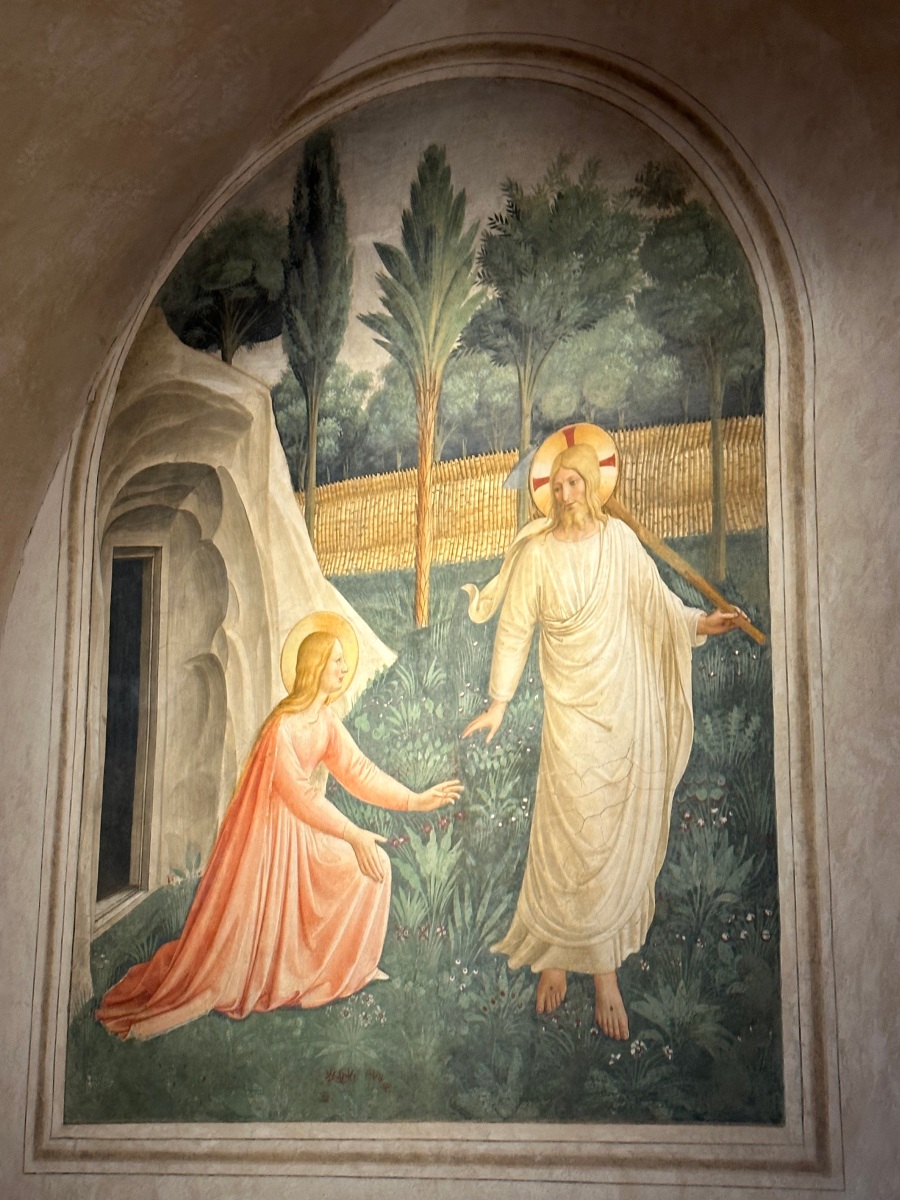
This week I included a photo of one of my favorite frescos from the Museum di San Marco in Florence, Italy painted by Fra Angelico in the rooms of the Dominican convent in the 1400’s. Mary Magdalene encounters Jesus in the garden. In her sorrow, finding the empty tomb, she pleads to know where Jesus’ body has been taken. But then he speaks to her and she sees him, she understands. She knows that the words he spoke, that he would die and rise again, have come to pass.

So on this glorious Easter Day, let us rejoice in the Light of hope that shines for each of us and keep our eyes upon that Light. Let us trust, that regardless of any situations that occur, we can hold on to the hope and peace that we have been promised. The family of poet, author and modern mystic John O’Donohue author a Facebook page of John’s writings. This week they shared a post of Easter Blessings from his book: Walking in Wonder. I was moved by this line, “We were sent to search for the light of Easter in our hearts and when we find it, we are meant to give it away generously.”

I wish you much joy on this Easter Day, as we begin our Easter journey with the Octave of Easter! Easter is 8 days long, lasting until Divine Mercy Sunday next week but the Easter season is 50 days, lasting until Pentecost. We have plenty of time to search for, and rejoice in, the light of Easter!

Peace, hope and joy during this holy Easter season, Deena

Walking behind great women

Some of these blogs start with an idea and a plan and things fall nicely into place. Today my plan was disrupted by the jubilant article written by Maria Shriver in Maria Shriver’s Sunday Paper, “A Woman’s Moonshot”. Maria shares the experience of joining the First Lady, Dr. Jill Biden, for the State of the Union this past Thursday. She shares the story of taking her idea to bring equity to women’s health research for Alzheimer’s, rheumatoid arthritis, menopause, autoimmune diseases and much more to the First Lady last year. Women’s health research has always been underfunded. She acknowledges the First Lady for taking her request seriously and acting quickly. But the best part of her article, for me, was when Maria stated that as the First Lady raised her arm in acknowledgement of the President’s introduction of the health research initiative, she quickly reached out for Maria’s hand to raise it with hers. As Maria says, “She didn’t have to do that, but she did…”

Great women working together for a common goal, that started with an idea or dream! That’s a vision we need for Women’s History Month. If you have a dream, follow it! Don’t give up, even when the road seems bumpy and unsure. Earlier this week I sat with an idea with my journaling cards, from my Visual Journal monthly class project, and thought of all the reasons why it’s too late, will take too long, or that I am not creative enough. Maria Shriver is seeing this dream come to life at 68, granted she has a family history and life experience to walk in bigger circles and perhaps dream bigger dreams, but she follows her dream of living a “life above the noise” and empowering change-makers – “big thinkers, visionaries and visionaries” to move humanity forward. We can each do this, regardless of the size of our circle of influence.

My original plan for this blog, in honor of Women’s History Month and International Women’s Day this week, was to write a litany to the great women, Saints and saints, in my life. Sr. Joan Chittiser’s powerful Litany of Women for the Church has always been a favorite. This link is 2021, but I think this is revised. I had a much older version, perhaps published by Pax Christi, on a well loved prayer card, that I can’t seem to locate now. It calls on great women, channels of the Word, to intercede for us and model what we might become. I wanted my version to include the women in my life that have lifted me up and encourage me along with way.

Besides saying “pray for us” or “intercede for us” you might also use “model for us”, “show us the way”, “teach us”, etc. Don’t we need to pray for and be that for each other?

Who would you include in your litany?

Wishing you the support and encouragement to dream your big dreams! Deena

Image: a photo our Our Lady of Good Counsel window in the Votive Candle Chapel at the Shrine of our Lady of Guadalupe in La Crosse, WI.

Unceasing prayer

Wednesday was “one of those days”. It feels like there have been a few of those lately. So after physical therapy and before returning to work, I stopped by the Queen of the Holy Rosary Shrine because I thought they had all day Adoration. I arrived at the Shrine and entered at the end of the Mass for the school children of Trinity Catholic. After Mass and for a brief period of Adoration for the children, they sang songs. Their angelic voices, and the incense being used, lifted my spirit. I watched them leave the church, from my place in the last pew. During that special time of prayer, Fr. Tom asked them to tell Jesus about the people they would like to pray for, to mention their concerns to him. I thought how lucky they are to have that special time each week and that they were reminded that their prayers are heard, that it is important to share them with Jesus. I took it to heart myself.

I also reflected on the fact that they were likely in church at this same time each week, their beautiful songs and prayers being lifted up while the rest of us are busy at work or home. Then I thought, this is true for more than the school children, there are monasteries or churches offering prayers at every moment throughout the world. Just as I was lifted by my chance encounter with the school Mass, I can be lifted by the prayers being said everywhere. I just have to stop, center and connect to those prayers rising like incense.

Constant prayer for the world is one of the main reasons that I discerned a life of a Benedictine Oblate when I was comparing all the various charisms of religious communities and whether I was being called to religious life in the 1990’s. I love so many aspects of each of the various spiritualities, Franciscan, Dominican, Carmelite, etc. and different parts of my personality and spiritual life could align with each. It was frankly hard to choose. Ultimately seeing the call of a monastic to perpetual prayer, by praying the seven hours of prayer, was the call that tugged at my heart and spirit the hardest. That does not mean that every monastery, or Oblate (lay associate) prays those seven hours! I knew I couldn’t live up to that ideal. In fact, most monasteries that I am aware of pray Morning (Lauds), Noon (Sext) and Night Prayer (Vespers and/or perhaps Compline), not all seven hours. But the idea that at some point in the day, my prayers, or desire to pray, would be joined with the continuous and unceasing prayers for the world, solidified my decision. Praying for the world is a lofty goal, especially when most days I get mad at the driver going too fast or too slow around me. But the goal of a monk, an Oblate and frankly all Christians, is to pray without ceasing, keep the love of God alive in our hearts and mind.

In our retreat, A Different Kind of Fast, Christine Valters Painter, reminds us to go to our interior cell, our “cave of the heart” to rest with the Beloved. In our weekly prayer with the desert elders, this week Amma Syncletica reminded us, in a quote offered by Christine, that we can be “solitary in one’s mind while living in crowd”. We don’t have to go away to a monastery or church to pray or be in the presence of the Divine. But we are invited to make the effort and be intentional about the encounter. Wednesday I needed the physical presence of the Eucharist in Adoration, today I rest in the warmth and embrace of Love in the sunshine.

As we continue on our Lenten journey, I invite you to consider the places that you feel most connected to the love of God and how you might join your prayers with all the prayers being lifted up in the world for those in need. If your prayer “list” is typically a personal list for family and friends, perhaps this week part of your Lenten observance could be to lift up all the places and people in the world that are in need of our prayers. As we heard on Ash Wednesday from the Gospel of Matthew; “when you pray, go to your inner room, close the door and pray”.

As I offer my prayers with all the prayers being said throughout the day, you will all be remembered.

Wishing you peace in and through your prayers, Deena

Image: Evening prayer during a visit to Mount St. Scholastica in Atchison, Kansas.

Into the desert

Here we are in the first week of Lent. We hear in Mark’s brief gospel account of the time that Jesus went into the desert for forty days. It’s an account that sets us up for our forty day pilgrimage and journey into the desert of prayer, fasting and almsgiving.

“The Spirit drove Jesus out into the desert, and he remained in the desert for forty days, tempted by Satan. He was among the wild beasts, and the angels ministered to him.”

During his Angelus address today, Pope Francis asked us if we retreat into the desert or try to spend some time reflecting on the disordered passions, the “wild beasts” that stir in our hearts. He said that “the angels bring us good thoughts and feelings, suggested by the Holy Spirit, while the temptations tear us apart. “

We must enter into this season of silence and prayer, during Lent, to ask these important questions. The “Ash Wednesday” days, the short week before the First Week of Lent, of my retreat with Abbey of the Arts, A Different Kind of Fast, has been a thought-provoking entry into the desert. This retreat is also the title of the latest book by Christine Valters Painter, our online abbess and retreat facilitator. We have looked at the things we consume, not just food, that don’t really nourish or satisfy us. We look, during this entire journey, at those “disordered passions”, as Pope Francis labeled them today, in order to make space to grow closer to the Beloved. We look at those activities and habits that keep us from being present and aware, keep us from experiencing greater freedom, as I discussed in last week’s blog.

During the retreat we will journey into the desert, in guided meditations, to learn from the Desert Fathers and Mothers. This week we “spent time” with Abba Arsenius, to glean wisdom on true hunger and what is enough in life. At the end of the meditation Abba Arsenius presents us with a bowl, a bowl that we can fill up with things that no longer serve us and “empty the contents into the hands of the divine.”

I have added a picture of my bowl at the bottom of this post. I actually used it two years ago, the first time I took this retreat. When Lent was over, I put the bowl, wrapped, and safely back in a box in the basement. As soon as Abba Arsenius handed me a bowl, this purple bowl came to my mind. After discussing the contents that I could fill the bowl with each week, I thanked Abba and went downstairs to retrieve it. I thought, while unwrapping it, how many items do I have wrapped or stored in cabinets to be used for a special occasion instead of enjoying them? Then thinking of my other consumption, how many craft supplies do I buy and never use? Do I feel more creative just by having them? Or am I afraid to put myself out there? How many books do I have that have not been read? Do I feel more wise as a result of them sitting on my bookshelves throughout the house (and basement!)? Or is the purchase itself filling some kind of void? Why do I allow time to be filled with less nourishing activities instead of those that bring me peace? Similarly, what foods do I eat in order to stuff down a feeling I prefer not to deal with? What is the food in life that will truly nourish?

Yesterday we took part in a creative ritual to create an altar space, a space with symbols to remind us of this season of pondering the deep questions and to help us enter into our prayer practice. Mine came together easily with items that will remind me of my quest this Lent. I have a stone cross surrounded by stones, that built a cairn during my first Abbey of the Arts retreat, Earth; Our Original Monastery. I have a purple cloth bag to represent the things I have been carrying but desire to be free of. I have beautiful prayer cards that symbolize the journey: St Catherine of Siena, a lovely card I bought in Siena this past Fall, known for her rigorous fasting on vegetables, water and the Holy Eucharist; a card with St Teresa of Avila’s prayer, Let nothing disturb you; a prayer card I picked up in Rome, of Jesus and the Samaritan woman at the well, “Sir, give me this water so that I might not be thirsty…”; and a prayer cards of angels. My hope is that these cards will remind me of those holy saints and angels that accompany me on this journey through Lent.

The questions of Lent are hard ones to ask and replacing them with more life-giving practices takes time. It’s a journey of a lifetime, but a good one to begin during this holy season of Lent. We can ponder the questions of Pope Francis today. What disordered passions or wild beasts consume my life and keep me from more life-giving practices? What might I be invited to let go of? Am I spending time in silence and prayer?

Are there some symbols or objects that you can place in your prayer space to invite you to this time of deeper union with God? I would love to hear what items will assist you during this Lenten pilgrimage.

I wish you great peace, freedom, and inner calm this week, Deena

Images:

The purple bowl that I was invited to bring out during my meditation with Abba Arsenius.

Desert image, as a featured image for this blog, from my PicMonkey account

A desire for freedom

When I began the year I decided my “word of the year” was Fortitude. One of the practices I have incorporated in each new year, inspired by many authors and retreat leaders, has been to spend time asking questions and reflecting on the predominant quality or theme I want to grow in during the new year. I feel I lack discipline in many ways, so Fortitude came to mind. However, February has been a month of transitions and new learning, so it doesn’t feel right any longer. So, what word will it be? This week Freedom keeps coming to mind.

Last week I wrote about reflecting on the grace we seek before times of prayer, reflection or meditation. I am excited to begin Lent this week. I see Lent as a time of prayer, fasting and almsgiving that allows us to search our hearts. I have several practices that I hope to incorporate and new teachings to reflect upon. I have found that each of them touch on freedom (physical, emotional and spiritual) in some way, shape or form.

Yesterday was my monthly Creative, Visual Journaling class. Lisa invited us, as she gave us prompts to journal about, to be free of what we think is possible, from what has been part of our past experience and imagine the life we wish to live. We have to start with our mindset, Lisa challenged us. We have to change our minds to think about what is possible. Lisa believes that journaling helps us navigate change and transition, it “gives our subconscious mind the problem to solve”. So I embraced the freedom to imagine the life I want – the who, what, how of a life of using my authentic gifts, boldly and with joy.

Another teaching that has been weaving its way into my daily life and practice has been the desire to live more mindfully. The practice of mindfulness helps us be in the present moment, aware of what we are feeling, setting aside the scattered and distracting thoughts of “later”, “what if”, “how will I be able to?”, “why can’t I”, “should I?”, “how could they”… I am sure you have had similar lists. These thoughts do not serve us. A better way is to be in the moment, aware of the only thing we can be sure of, the present moment. I have read and studied many authors and teachers of mindfulness, Christian and Zen, but a review of mindfulness impacted me in a new way this month.

I shared in a Facebook post this month, that some of you may have seen, that I just began the third year of a Wisdom/Mystics program. The first year was Women Mystics and last year, Celtic Wisdom and Mystics. This year we are studying Modern Mystics. On the first Saturday of February we were blessed with the teaching of Thich Nhat Hanh, Zen Master and Buddhist teacher, by his student Kaira Jewel Lingo. Kaira Jewel is a teacher in her own right, given authorization to teach by Thich Nhat Hanh, after spending 15 years at Plum Village living and studying with him. Kaira Jewel is an author and teaches many programs, which you can find online or on apps, like Insight Timer.

A simple practice, one of many Kaira Jewel shared with us during our class, is to set the intention (i.e. in the language of my blog last month, name the grace) to be present for yourself. During our slow breath work as part of meditation, or you could do as part of Christian Centering Prayer, is to inhale “I have arrived” and exhale “I am home”. Kaira Jewel shared that we have to first come home to ourselves, to get to the root of our own suffering and to find unity and inter-being with all other persons and species. If “suffering” seems foreign to you, simply think of it as areas we have opportunities to be more aware of, to grow and let go of.

There have been a multitude of ways that the simple practice of returning to the breath, to the home of my body and spirit, has helped me this month. Has it been perfect? No! But I am learning. I tried to be more present listening to others. Instead of thinking of something outside the moment like a “to do” list, I tried to be attentive to what a person was saying to me. I have tried to be present to my physical pain, instead of reacting in anger or fear of it. Physical therapy seemed to go better this week! I have tried to think about why I am eating what I am eating, especially when it is an attempt to stuff down some other feeling or issue I would prefer to avoid. In a moment when I found myself reacting to someone, I came home to my anger and judgement and wondered why I was reacting to their words, then tried to have compassion and understanding for the person speaking, why they might be saying what they were saying.

Again, was it perfect? No, but perfection isn’t the goal, freedom is. Freedom from worry, anxiety, anger, judgment, etc is. All of those feelings do not change the situation so why do I view them as helpful? It was as if I learned that I had left my home unattended for years, just kept the heat on but the dust accumulated.

The leper in today’s Gospel for the Sixth Sunday in Ordinary Time desired to be made clean, had the faith that Jesus could do it by his act of will. At that time the man’s leprosy was viewed as an outcome of his sin. So Jesus’ act of healing brought him back into his community, it freed him. Doesn’t our sin, judgment and separation from others do the same for us? We are saying, what I want is more important than what God wants for me or how I might be here for others. Our own need and desire trumps everyone else, including God. Desiring to be made whole, desiring freedom from sin and the accumulation of dust, moves us back into community, with God and others.

Author and dear friend, Judith Valente’s Sunday blog (found on Medium and on Facebook), reflecting on Lent and looking at it in a new way, asks us to examine similar questions, “can I take a hard look at the habits I’ve acquired over the past year that don’t serve me or others well? Can I make a conscious effort to let go of them, to make a fresh start?” Again, freedom, freedom to move beyond the habits of my past with a desire to live with more awareness of and for love for self and others. These questions will be part of my daily examen during Lent!

In her weekly email, and in preparation for our Lenten Retreat, “A Different Kind of Fast”, author Christine Valters Painter discusses the Three Renunciations of theologian of the early Christian Church, John Cassian. Christine says the third renunciation was one she found most powerful, and I would agree, as I read her description of them. The third calls us to “renounce even our images of God so that we can meet God in the fullness of that divine reality beyond the boxes and limitations we create.”

This renunciation challenges me to be free to sit with, be gazed upon by the God who desires to be with me. I can be home with God exactly as I am, knowing that I am loved. I can look at the areas that I hope to grow in greater love and compassion for others. I can desire a purging of old ways with the desire to make more room for God and love of others.

So this Lent, where do you desire greater freedom? What grace do you seek for these 40 days of “retreat”, a time to free yourself of habits that prevent you from listening to and responding to God’s call in your life? May it be a time of growth and greater freedom to love and serve with our lives.

May it bring you greater peace, Deena

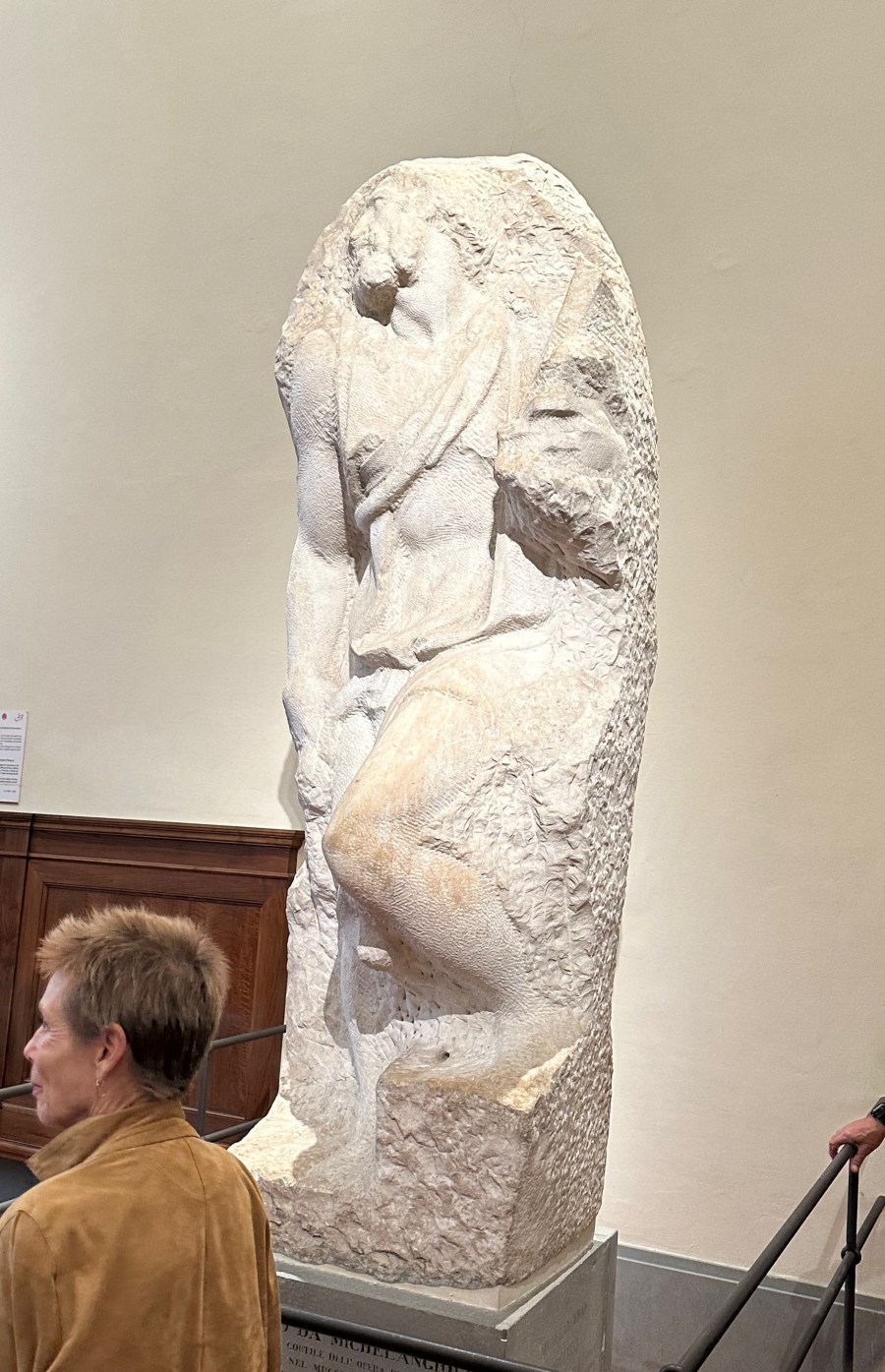
Photo: One of the unfinished marble pieces, never freed from the stone, of Michelangelo in Florence.