Prosper the work of our hands

This weekend in the United States we celebrate and recognize Labor Day and the efforts of all people who work. We acknowledge the American Labor Movement, and the social and economic achievements of all who have worked since the holiday was established. The Library of Congress says that the first Labor Day was established by the Central Labor Union and was celebrated on a Tuesday in 1882. Then in 1894, Congress enacted the law making Labor Day a national holiday, celebrated on the first Monday in September. Over the years it seems to be more of a final long summer weekend, a demarcation of the end of summer and the beginning of the school year for students. What if we honor and celebrate the work that we do all year on this weekend?

I listened to an interview this week with Bishop Robert Barron on the Word on Fire Show regarding the Theology of Work. It was a wonderful interview talking about the Catholic Church’s teaching on work. I especially loved the story of Bishop Barron’s first job, as a high school student, at Kroch’s and Brentano’s bookstore in Oakbrook, Illinois, and his brother throwing a used copy of A Seven Story Mountain by Thomas Merton at him and how that book ended up being so influential in his life.

Bishop Barron discussed how our work participates in the creativity of God and that if done with loving purpose, work is sanctifying. He talked a little about work before and after “the Fall”, and how we have gotten the idea that work is laborious, with all its negative connotations, but he stated that work is ultimately life-giving and how we “work creation” to make it even more beautiful. I was struck by his statement that God has nothing to gain from us. It’s true, my work doesn’t make God or the world any better, but it can participate in “His causality”. Everything God has created is good, but Aquinas says it doesn’t make it finished, it continues to unfold with our participation in it.

Bishop Barron talked about Pope Leo XIII’s encyclical, Rerum Novarum, and the importance of that writing at a time of horrible conditions for workers. I probably relate more to Pope John Paul II’s encyclical, writing on the anniversary of Rerum Novarum, Laborem Exercens in which he talked about the value of human work. Work has value not because of the work being done but because of the human person that is doing the work. Regardless of the work we are doing, God wants us to invite Him into that work, to prosper (not necessarily financial) the work of our hands.

I reflect on the many jobs, or variations of work, I have done over the years. There wasn’t a weekend growing up, in high school, that my brothers and I didn’t have to work at our family business, waiting on customers, drying off cars after the car wash (the unique spin my father added to the automatic car wash he operated), washing towels (Oh, the towels in the winter!) and working in the little store that had snacks, beer and soda, and a lottery machine. When I had my own little shop, I worked harder than I ever have at any job, cleaning ice cream/yogurt machines at 5:30 in the morning, making soup and washing the floor all before opening for the day, but I can honestly say I have never loved any work as much as that, because it was my business and I took pride in it and enjoyed the customers I served.

Any employment, if just viewed as a job with tasks to complete, will make work tedious. But when we begin to view the efforts of our labor as a use of our gifts and talents, a contribution in some way to the lives of others, even if solely providing for our families, or the way we are adding to, or contributing to creation, perhaps we will see, and feel, the dignity of that work in a new way.

I am fortunate that in all my different jobs and careers, I have always tried to ask “how am I serving God in this work?” It’s a gift now, to be in a ministry position, with Ignatian Ministries, where we constantly, and openly, seek the greater good for the ministry and our gifts, seeking “the magis”, the more, in all we do. This seeking, or reorientation, is available to all of us as we consider the work of our hands.

Don’t forget that we have just entered the Season of Creation, which began on September 1st with the World Day of Prayer for Creation, a season of grace to consider our way of living and renew the relationship between Creator and creation. It will conclude on October 4th, the Feast of St. Francis and the publication of Pope Francis’ follow up to Laudato Si’. As we reflect on the work of our hands, we are called also to consider that our work, or the way we live and consume products each day, does not exploit the earth. It is one of the most significant challenges of our day.

Create joy, Deena

Fill us at daybreak with your mercy,
that all our days we may sing for joy.
Make us glad as many days as you humbled us,
for as many years as we have seen trouble.
Show your deeds to your servants,
your glory to their children.
May the favor of the Lord our God be ours.
Prosper the work of our hands!

Psalm 90

Photo from my PicMonkey account

Why we do what we do

This morning, reading Maria Shriver’s Sunday Paper, I reflected on the question she and her team were asked by a facilitator brought in to conduct an offsite session to assess where they are and where they want to be, as writers for the Sunday Paper. They were asked “Why do you do this?” “To what end?”. Great questions for all of us. Why do we do what we do?

Many of you have shared in response to my posts from Maria that you started following her after I have shared her articles or that you admire her too. We post sunsets and flowers and graduation pictures. I have friends on “vacations”- one on a long trip to Israel visiting many of the holy sites I long to visit, others now returning from an incentive cruise to Norway as a result of great success with their stamp & paper crafting businesses and recently a group that traveled to Italy with my friend and author, Judith Valente, visiting lesser known Benedictine spiritual sites. I have enjoyed each and every picture they have shared from their journeys. I think we share those moments with each other to make a connection, to have companions for those special moments or to impart some information that we found helpful.

We recommend recipes and great restaurants because we want others to have the wonderful experience we had. We share the ordinary moments that make us smile, like my cats in their new cardboard box, which they won’t let me breakdown yet, or a friend who takes his dogs to establishments in Florida for lunch or refreshment and afternoon music. Are these things going to change the world? No, but they bring moments of happiness as we share them and as our friends participate, albeit virtually, in those moments with us. My morning posts of a coffee cup or an inspirational quote are not going to change your life, that’s for sure, but I hope it gives each of us a minute to pause and think about something pleasant in the world.

I share my love for essential oils, or a new system I have found to reduce pain and promote healing and restoration, because I want others to experience the same benefits I have found. Whether it’s health and well-being, kitchen items or jewelry, I believe that my friends are sharing these items because it brings them some delight or comfort. Maybe that’s what small communities used to be like. People set up their small businesses because they knew it was a trade they were good at and wanted to help others.

I am looking forward to reading a new book I found out about this week from author Kate Bowler, written by her former Yale professor Miroslav Volf, Life Worth Living; A Guide to What Matters Most. To be a complete fan girl of Maria Shriver today, she wrote opening comments to the book regarding her new venture, Open Field, and she said “We are all seeking the same things. We’re all seeking dignity. We’re all seeking joy….seeking to be seen, to be safe….We can all give each other these (spiritual) gifts if we share what we know-what has lifted us up and moved us forward.” Her new venture, Open Field, with Penguin Books is the publisher of this book. My initial sense of the book so far is that it asks all the Questions – questions that challenge us, inspire us to define what’s really important, face the limiting beliefs that prevent us from pursuing it and then start making the changes to get there.

Hopefully we do the work we do, paid or volunteer, because it brings us joy and fulfillment. At some point we must have reflected that it would be work we would enjoy or it is a gift or talent that we have. If it no longer does that, perhaps it’s a good time to ask why not and how we could change that activity to become more meaningful again. Or maybe it’s an opportunity to consider doing something new. It may be a stretch to think about a new venture. My transition from corporate life to ministry work has invited me to use a prayerful, discerning heart and mind over a rational, pragmatic one. It isn’t always easy to change but it may make a difference in each and every day of your life and potentially to the lives of those you impact on a daily basis.

Today is the Solemnity of Pentecost. We celebrate the birth of the Church with Mary and the Apostles but that continues to come alive each day in us. Ronald Rolheiser’s reflection in Give Us This Day for today, May 28, was poignant. He said “We are always dying in some ways, though never dead. We are always alive with new life. But we need to grieve what’s dead, adjust to the new, and let the old ascend. If we do this, Pentecost will happen in our lives. We will receive a new spirit for the life that we are, in fact, living.” Then he made a statement that perhaps is the answer I have been seeking for many years. He said that the Holy Spirit brings about the “dissatisfaction and restlessness” that we feel until our lives, and the spirit by which we are living them, is integrated and aligned. To that I say, Come Holy Spirit! Let us continue to pray for the gifts of the Holy Spirit in our lives: Wisdom, Understanding, Counsel, Fortitude, Knowledge, Piety, and Fear or Respect of the Lord.

Peace be with you, Deena

Image created with PicMonkey

Peace be with you

Maybe my mood is a bit more somber today because of the rain and gloom compared to the radiant sunshine of the past three days. So, I reflect, Thank you, God, for Divine Mercy Sunday! I don’t know about you but I can be Thomas on many days – I won’t believe unless… I can fill in the blanks with a variety of concerns or issues and then the desired outcome. Even though I have seen countless appearances of God acting in my life and the lives of others, I easily forget and let “dark clouds creep in and cover up the sun” and get discouraged. “We wonder if the sun is still up there. And perhaps we begin to get discouraged as our faith and trust start to waver and change to doubt and distrust.”

This quote is from the book, 33 Days to Merciful Love, by Father Michael Gaitley. I have used this book three different times over the course of seven years and found myself picking it up last night after attending Vigil Mass for Divine Mercy Sunday. I prayed the Divine Mercy Novena this week, beginning on Good Friday, and hope to attend a Divine Mercy Sunday celebration this afternoon in LaSalle at St. Hyacinth’s Church. I have had a few challenges over the past couple of weeks, so I found myself opening to the section, Week Four, Into the Darkness.

The book is a 33-day personal retreat (but often studied together in groups, as I did the first time) in preparation to consecrate our lives to Merciful Love. Through our prayer, study and offering we offer ourselves to Jesus and let his consoling love transform us into saints. The book is focused on the life and spiritual teaching of St. Therese of Lisieux and incorporates some of the teachings of St. Maria Faustina Kowlaska, best known for her writing on Divine Mercy and the Divine Mercy image. I have never been the biggest fan of St. Therese and her “little way”, but somehow her teachings shows up when I need them. My mother had a great devotion to her, so I wonder if Mom is tugging her sleeve at those times that I need a reminder of St. Therese’ trust even in dark and difficult times. Early on in the study we consider that sin (I replace with doubt and lack of trust) comes from a lack of faith in God, God’s Word in scripture and God’s goodness. Fr. Gaitley offers the premise that this is the deep root of the darkness in the world, people act as if God does not exist.

Yesterday, in my monthly Benedictine lay Oblate gathering, we studied Pope Francis’ 2015 Encyclical Letter Laudato Si: On Care for Our Common Home. A few lines have been on my mind since re-reading the assigned sections for our discussion. In #92, Pope Francis says “We have only one heart…” and any act that would mistreat an animal or another creature, creation in general, is “contrary to human dignity.” The darkness in the world feels that we do not live with that one heart of love and compassion for all we have in this world and for each other. So we offer our plea for mercy as we pray and repeat, in the Chaplet of Divine Mercy, “have mercy on us and on the whole world”.

Perhaps we need to embrace those days that we are more like Thomas and ask for a sign of God’s presence but then wait in hopeful anticipation for consolation versus living in doubt. We pray and place ourselves in the presence of the fountain of Mercy, over and over again, clinging to the love Jesus offers us, as St. Therese did. As Fr. Gaitley points out in a summary section, it isn’t about getting rid of the difficult and dry times in our faith lives, it’s about finding peace, joy and happiness in the midst of all the challenges and gifts of each and every day.

This Second Sunday of Easter, Divine Mercy Sunday, is such an important reminder for us to reach out to the extended hand of our Lord as he says to us, “Peace be with you.”

Peace, Deena

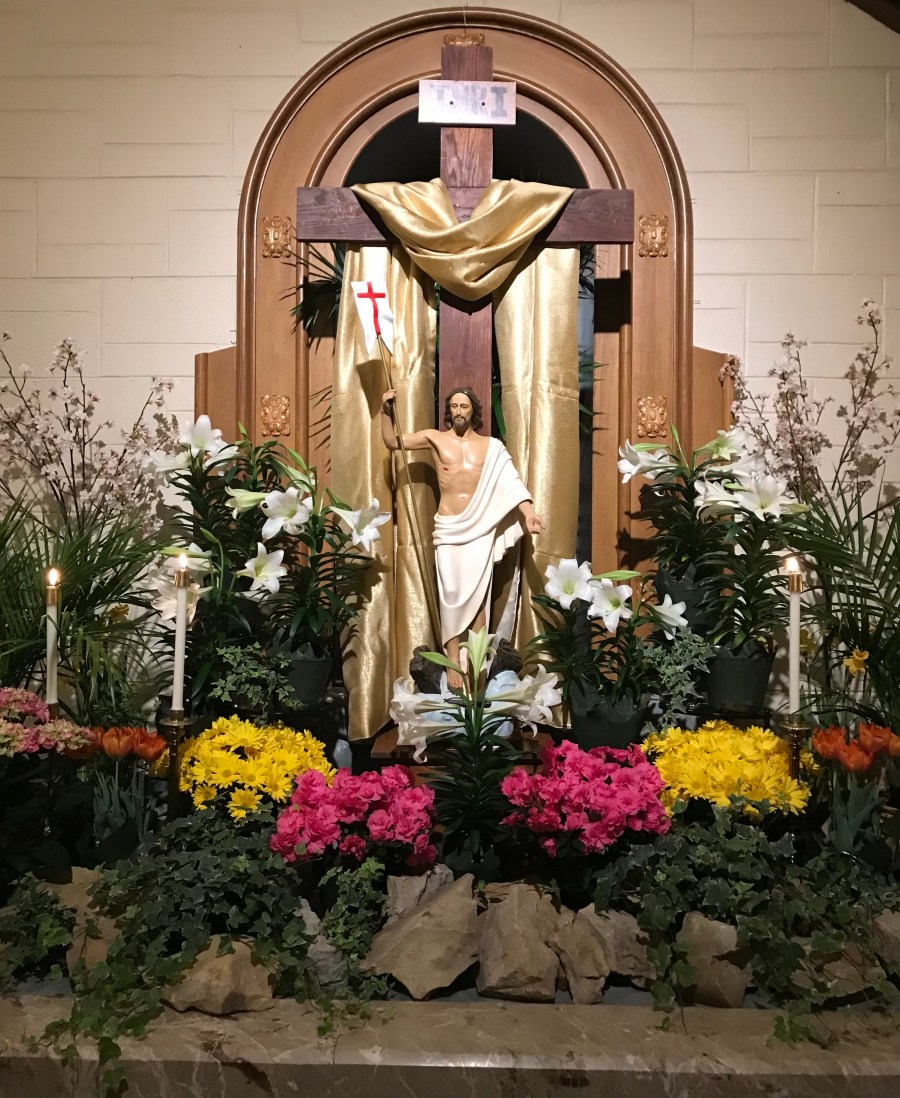
Image: Resurrected Jesus, Side Altar Holy Family Church

My Photo Album

Planning a New Year – Happy 2023!

Let me begin today’s blog by wishing you a happy, healthy and inspired new year!

I have to admit I love New Year’s Eve and New Year’s Day. I don’t go out and celebrate, and most years I rarely make it to the strike of midnight awake. The revelry of the neighborhood, and the return of the local cement mill whistle, usually wake me. I quickly and quietly greet in the new year. It is actually all the preparation, goal setting and planning, as well as the beginning of the fresh start in the new year, that are so exciting to me!

I am a self-professed planner addict. I have started planning in two and am waiting for 3 others to arrive. Each have their own purpose. The two I have started so far are for work. The ones I hoped would have arrived already are for journaling ideas and notes (separate than my daily journal books), planning goals, and tracking progress. I have also ordered a 2023 liturgical planner that I use for work planning and personal reflection on daily scripture. I’ll add some notes at the bottom of the blog in case you are interested in some that I use. They have varied over the years depending on the planning I am doing and things I hope to accomplish.

In all that planning, I don’t set New Year’s resolutions. That feels different to me – I will lose weight, I will walk every day, I will… I don’t set them because I would have to be honest and admit that I would be in the majority of the population that set the resolution and then forego it by the end of January, or mid February if I am lucky. If anything, I resolve to try to be more authentically myself and a live a life I can be pleased with when I reflect back at the end of the year. I like the process of setting intentions – things I want to be more aware of in life, or qualities to bring more of into my life like patience or gratitude, and to reflect on ways I can grow deeper in my faith life.

There is something about the writing of those intentions and reflections as the year progresses, jotting down new insights I have, or writing about a poem or a scripture reflection that moved me, that help me move through the year with more awareness regarding the intentions that I set at the beginning of a year.

Each year I read (it’s small and a quick read) Notes from a Friend by Anthony Robbins. I bought it when I had my business in 1996 and barely had the $7.95 for the book. (New cover and new price on Amazon.) The point is to be clear about what you want, see the details and write it down with no limits on possibility.

One of my favorite, more recent, rituals is to attend a retreat by my friend and author, Judith Valente, Writing the Prologue to Your New Year. This will be my third year. I was pleasantly surprised to open and read in 2022 what I wrote in 2021. Next Sunday I will open what I wrote in January 2022 when reflecting on the course that the year might take. Writing it and putting it away is a different than the Tony Robbins approach of reviewing it every day. Both clearly set the intention.

Some of my reflection for new year 2023 has been focused on the things that have become priorities, perhaps undesirable priorities, in my life. Early in Advent, his First Week of Advent YouTube homily, Bishop Robert Barron asked us to contemplate the mountains we worship, mountains such as status, money, acquisitions, etc. Things that have highest value in our lives, things we order our lives around and worship more than God. I have been chewing on it ever since I listened to it in early December and listen to it over and over. The other day I saw a Facebook post that really touched me, from Conception Abbey in Conception, Missouri, contemplating the presentation of infant Jesus in the temple to Simeon and his prayer of joy having seen the fulfillment of the coming of the Messiah. Fr Petsche asked us if we can name the person we long for on a daily basis. I wondered if in addition to who, I might add what do I long for each and every day?

As I contemplate the answers to those questions, and set a course for what I would like those to be in this new year 2023, I have to reflect honestly on what is most important to me, what is at the center of everything I do? I know what I would like the answer to be, but can I honestly report that most days I live it? Of course I have financial goals and personal growth goals. I want new furniture like the next person and I fretted day after day until I found the right car last month. It’s ok, and normal, to want all those things. But if I had an importance meter when making decisions or expending energy before making the decision, how important are they?

A favorite scripture passage is in this year’s Gospel for today, January 1, the Solemnity of Mary, found in the second chapter of Luke. “And Mary kept all these things, reflecting on them in her heart.” Reflecting on daily life, on the things that inspire or challenge us, is good for us. Things don’t always make sense in the moment but writing as we move through the year, reflecting on the things we want, then looking back on how life has unfolded can help us put things in perspective. It can help reveal God’s hand, and gentle nudges, in life.

One of the responsibilities that I have as part of my job with Ignatian Ministries is to post the weekly blog. As a result I have had the chance to read and begin contemplating the blog written by Vinita Hampton Wright. Our first series will be on the topic of Setting Up our Year in Christ. Vinita kicks us off remarkably! It’s actually because of Vinita and her posts for Loyola Press and the dotMagis blog on IgnatianSpirituality.com that I read and started following Becky Eldredge books and retreats, then ultimately starting working for Ignatian Ministries last year (but that’s a wonderful story for another day!). You won’t see Vinita’s post until Sunday night but it is worth checking out, it’s so good! Visit and bookmark Into The Deep on BeckyEldredge/Ignatian Ministries.

Another process for looking at the new year with eyes of faith that I would recommend is by the founder of our ministry and her husband, Becky and Chris. They have created a 4-week program, Living with Christ: An Ignatian Discernment Process for Intentional Living. For 20 years Becky and Chris have used this annual process in their lives and then in 2021 began offering it to others. They have been reviewing and working on the information and will offer four Zoom sessions on Thursdays, 12 – 1:30 CST, from January 26 – February 16.

Regardless of what your process is, short and quick or more complicated, spend a few minutes as we begin 2023 thinking about the qualities you would like to see more of in your life. Decide whether your faith life could use some sprucing up this year and what you would like to do about it. If you make resolutions and keep them, awesome and congratulations on beginning a new one. If not, what would you like to resolve to be more of this year, BE not DO. I’d love to hear from you and what that might be.

As we begin our journey through 2023 together, I wish you much happiness and joy!

Peace, Deena

Journal Suggestions:

Manifest Your Best Every Day by Kat Gottlieb

Monthly Planner by Cultivate What Matters. Not the Planner Sheets. I have used those in the past but didn’t really use them as designed)

Word and Worship Desk Calendar – Liturgical Planner by Paulist Press

Erin Condren Softbound Notebooks – favorites for journaling. I used the LifePlanner Collection for a few years but decided my other options work better for me. But they are pretty and well-designed.

My daily/weekly favorite format for work and appointments – the last couple of years has been Blue Sky

Image created in PicMonkey