Your words are life

Reflecting on today’s gospel (Matthew 21: 28-32) for the Twenty-Sixth Sunday in Ordinary Time, our pastor, Fr. Paul Carlson, spoke of the words of the sons to their father, not matching the deeds. Even though one of the sons didn’t act on the words he spoke, affirming to the father he would follow the request to go work in the vineyard, the words themselves still had value. He, we hope, showed respect and obedience. The son that said he didn’t want to go to the field and work, but changed his mind and went, shows us the value of reflecting on the word or the instruction we hear in the words spoken and letting them impact our behavior. All of the words in scripture point out who Jesus was and what He asks of us, in our own lives. As we reflect on them, and comprehend the words, we allow them impact our behavior, and transform our lives.

How can we integrate this in daily life? As I spent some time reflecting on Fr. Carlson’s homily, I thought about some guided prayers I was recording for work this week. One was a Lectio Divina, another a guided contemplation or imaginative prayer and lastly a prayer using Visio Divina. I am going to talk about two of them, Lectio Divina today and Visio Divina next week, and how these prayer methods of sacred listening or viewing can help us enter into the Word and let the Word enter into us.

Lectio Divina, a common monastic prayer method of praying with Scriptures, means “divine reading”. I learned this almost 30 years ago as I began my formation as an Oblate and it has been, to a greater or lesser degree, a part of my daily prayer. Sometimes I spend more time with Lectio, some days it is a very condensed version. The longer time spent in Lectio is always more fruitful, but life gets in the way. Lectio is simply reading or listening to a particular scripture passage, prayer or poem and letting those words enter our hearts. We read the passage once, and listen for a word or phrase that speaks to us. We read it again and reflect on what God or the Holy Spirit might be trying to say to us in those words. We read it a third time and contemplate the words, or sit in silence with them. Lastly we offer a prayer of gratitude for what we heard or a prayer of intention that rises up as we reflect on what God has asked of us as we have listened to the Word. The fruit of the prayer comes from really listening, with the ear of the heart, to the Word and then letting it impact our thoughts, words and actions.

We all know what it feels like to hear someone say one thing but then behave in a way that is contradictory to what they have spoken. It may not be intentional or malicious, but if the behavior and the action don’t correspond, then it gives us something to consider about the person or our relationship. Seeing this within our own behavior, helps us assess why we aren’t being true to the things that we say are important to us. We can assess, and change, when we see that we aren’t living in alignment with the values we say are important to us.

As our words and actions begin to become one and the same, we become the things we value and that we speak in life. I love the quote that you see on social media posts or in self improvement articles, we become what we think about. Or, another, your mind will believe everything you feed it, so feed it hope, truth and love.

If you have not prayed using Lectio Divina before, try it this week, it only takes a few minutes when praying it alone. Pick a short scripture or poem, it doesn’t have to have a lot of words to be impactful. Ask Spirit to guide your thoughts and speak to you with the words you need to hear. May it bring you peace!

Create joy, Deena

Photo from my PicMonkey account

Prosper the work of our hands

This weekend in the United States we celebrate and recognize Labor Day and the efforts of all people who work. We acknowledge the American Labor Movement, and the social and economic achievements of all who have worked since the holiday was established. The Library of Congress says that the first Labor Day was established by the Central Labor Union and was celebrated on a Tuesday in 1882. Then in 1894, Congress enacted the law making Labor Day a national holiday, celebrated on the first Monday in September. Over the years it seems to be more of a final long summer weekend, a demarcation of the end of summer and the beginning of the school year for students. What if we honor and celebrate the work that we do all year on this weekend?

I listened to an interview this week with Bishop Robert Barron on the Word on Fire Show regarding the Theology of Work. It was a wonderful interview talking about the Catholic Church’s teaching on work. I especially loved the story of Bishop Barron’s first job, as a high school student, at Kroch’s and Brentano’s bookstore in Oakbrook, Illinois, and his brother throwing a used copy of A Seven Story Mountain by Thomas Merton at him and how that book ended up being so influential in his life.

Bishop Barron discussed how our work participates in the creativity of God and that if done with loving purpose, work is sanctifying. He talked a little about work before and after “the Fall”, and how we have gotten the idea that work is laborious, with all its negative connotations, but he stated that work is ultimately life-giving and how we “work creation” to make it even more beautiful. I was struck by his statement that God has nothing to gain from us. It’s true, my work doesn’t make God or the world any better, but it can participate in “His causality”. Everything God has created is good, but Aquinas says it doesn’t make it finished, it continues to unfold with our participation in it.

Bishop Barron talked about Pope Leo XIII’s encyclical, Rerum Novarum, and the importance of that writing at a time of horrible conditions for workers. I probably relate more to Pope John Paul II’s encyclical, writing on the anniversary of Rerum Novarum, Laborem Exercens in which he talked about the value of human work. Work has value not because of the work being done but because of the human person that is doing the work. Regardless of the work we are doing, God wants us to invite Him into that work, to prosper (not necessarily financial) the work of our hands.

I reflect on the many jobs, or variations of work, I have done over the years. There wasn’t a weekend growing up, in high school, that my brothers and I didn’t have to work at our family business, waiting on customers, drying off cars after the car wash (the unique spin my father added to the automatic car wash he operated), washing towels (Oh, the towels in the winter!) and working in the little store that had snacks, beer and soda, and a lottery machine. When I had my own little shop, I worked harder than I ever have at any job, cleaning ice cream/yogurt machines at 5:30 in the morning, making soup and washing the floor all before opening for the day, but I can honestly say I have never loved any work as much as that, because it was my business and I took pride in it and enjoyed the customers I served.

Any employment, if just viewed as a job with tasks to complete, will make work tedious. But when we begin to view the efforts of our labor as a use of our gifts and talents, a contribution in some way to the lives of others, even if solely providing for our families, or the way we are adding to, or contributing to creation, perhaps we will see, and feel, the dignity of that work in a new way.

I am fortunate that in all my different jobs and careers, I have always tried to ask “how am I serving God in this work?” It’s a gift now, to be in a ministry position, with Ignatian Ministries, where we constantly, and openly, seek the greater good for the ministry and our gifts, seeking “the magis”, the more, in all we do. This seeking, or reorientation, is available to all of us as we consider the work of our hands.

Don’t forget that we have just entered the Season of Creation, which began on September 1st with the World Day of Prayer for Creation, a season of grace to consider our way of living and renew the relationship between Creator and creation. It will conclude on October 4th, the Feast of St. Francis and the publication of Pope Francis’ follow up to Laudato Si’. As we reflect on the work of our hands, we are called also to consider that our work, or the way we live and consume products each day, does not exploit the earth. It is one of the most significant challenges of our day.

Create joy, Deena

Fill us at daybreak with your mercy,
that all our days we may sing for joy.
Make us glad as many days as you humbled us,
for as many years as we have seen trouble.
Show your deeds to your servants,
your glory to their children.
May the favor of the Lord our God be ours.
Prosper the work of our hands!

Psalm 90

Photo from my PicMonkey account
Do not be concerned

I don’t know why, but I seem to have a short memory for all the things that have gone right after a time of worry and fret over health, work, finances or whatever concern was on my mind. I can even say that there have been at least two times that something extra-ordinary or miraculous has happened that, at the time, assured me of God’s presence and personal care. Yet, the past couple of weeks I have been anxious over circumstances in life.

Today is the Feast of the Transfiguration. The three apostles, Peter, James, and John get a glimpse of Jesus’ divinity, they see the prophets Moses and Elijah, they hear the voice of God. Just before ascending to Mount Tabor, they learned Jesus was going to suffer and die, they were warned that the road ahead will be difficult, so you would think this glorious experience would sustain them, right? No, in a short time, they run and hide from the cross, their memories are short and they succumb to fear.

I can reflect back on the time that I had my little business here in town and even though it was the most wonderful experience of my life, it wasn’t as successful as I had hoped and I decided to “go back” to work. It was a time before internet and social media, I love imagining how I might have used those platforms to advertise! I had moved back “home” to Illinois after working for General Motors in the Detroit area. I remember telling the loan officer at the bank, when asked “what will you do if your business isn’t successful?” I replied, “I will go back to work and pay off my loan”. So I did! I worked part-time at JC Penney’s and within a short time was offered a manager position. I wasn’t sure it was the right role for me but I needed the job. While I was trying to decide, a manager role at Boise Cascade opened, for a new venture, I applied and got the position. Twenty-three years later I retired after working in many different roles and serving customers in many ways. One of those was a position in e-commerce that I visioned, recommended for my business unit and ultimately filled, it was my favorite of all.

Before I moved to Michigan I worked for a small software company in the Chicago suburbs and, because I had an account in Warren, I heard that EDS was hiring people for the GM account. I applied and got a position along with 14,000 other people, all of us looking for housing at the same time. I was put up in a hotel in the Detroit area, not the most favorable part, and spent time after work each day looking for an apartment. I felt as though I would never find a suitable living space, EDS would figure out I wasn’t one of the “eagles” they expected us all to be, as loyal workers for Ross Perot, and they would send me back to Illinois. I found a cute apartment in a community I loved and close to a parish that was an important part of my life during those five years.

I am sure that you, like me, can reflect back on circumstances in life that worked out differently than you might have imagined or hoped for. In most cases, the result was better than I could have envisioned. Even if it wasn’t better, it was a threshold space, an answer until the next step was revealed. Yet, this week, I have forgotten, and like the apostles, have run from the cross and hid in the arms of inquietude and melancholy.

Luke chapter 12, verses 22-34, reminds us that all of our needs will be attended to, that we don’t have to worry. Like the birds of the air or the lilies of the field, we need not be concerned about life. I don’t believe that it means that we are careless and don’t discern the best options for our lives. But, worrying doesn’t change the outcome, lessen the time it takes to resolve the situation and, in most cases, probably limits our ability to see solutions that might be right in front of us. So, this week, I invite us to get a glimpse of the love and personal care God has for us and, like Peter, James and John, respond with an open heart to the voice that says “listen to him”.

Create joy, Deena

Compassion in the rubble

This week I have been touched by the story of Donaghy, Celtic name for “strong fighter”, a two-week old lamb that was rescued by Freedom Hill Sanctuary after undergoing all the normal procedures applied to young lambs on sheep farms. I will spare the details, you can research them, but after having these procedures done they wander in pain looking for their mothers again. For whatever reason, after five days, the farmer had compassion on this near lifeless and suffering creature, and called Freedom Hill Sanctuary to take him. Donaghy now has a chance at a better life. The pictures are difficult to see but they are caring for him and he has a warm cot and food to heal. He was taking food and improving but obviously still frightened. The image I used today was from Freedom Hill Sanctuary post this a.m. of Donaghy after healing touch and sound therapy (you can watch part of his response to the healing sounds on Instagram @freedomhillsanctuary). It filled my heart with such joy after seeing all the other pictures this week.

I haven’t seen the film “Sound of Freedom” yet with Jim Caviezel regarding child trafficking, but have heard it a deeply emotional and powerful story of a former CIA agent who goes undercover to rescue children. Last night on the news I watched a story of a restaurant owner from Highland Park who will be going to Ukraine to prepare meals. To have compassion – “to empathize with someone who is suffering and feel compelled to alleviate the suffering.”

This week, on one particular day, I was the recipient of three thoughtless comments, from separate individuals. Typically it throws me into judgement and criticism but for some reason I replaced my normal reaction with empathy for whatever the person was going through or simply the fact that they didn’t think about what they said before they said it. I certainly would like to do that more often! If I think about the number of times I have done the same, hopefully unintentionally, maybe it will be easier to respond with more grace and compassion.

During his homily this week, Fr. Carlson, our pastor at Holy Family talked about the weeds growing among the wheat, Matthew 13: 24-43, and how we see injustice around us in the world and wonder why. It can be challenging to deal with what we see in the world. The whole homily was rich with food for thought (you can find it on Facebook @holyfamilyoglesby, we livestream Masses) but the statements that captured my heart for reflection were: “There is evil that has to be endured. How much greatness within us would be lost if we didn’t have battles to fight? How much compassion would be lost if we didn’t have evil to endure?” By no means does this justify the evil. But we need to reflect on our own hearts and how we can look at these challenges in a different way. So I ask: Do I have a heart big enough for more compassion and what would that look like?

One of the authors we seem to return to over and over at work, for prayers of blessing, is Kate Bowler (@katecbowler and podcast – Everything Happens.). Her new book, The Lives We Actually Have, is full of lovely blessings. Her post on Instagram this morning was from another book, Good Enough: 40ish Devotionals for a Life of Imperfection. She says, in part of the blessing, “and while this life isn’t shiny, it does come with superpowers. superpowers of ever-widening empathy and existential courage that get you back up after another fall…” “and a deepened awe at the beauty and love that can be found amid life’s rubble. like flowers that grow from the cracks in the sidewalk. these virtues blossom in you. and thank God for you.” ending with “blessed are all of us who struggle, for we are in good company, and we’ll never walk alone.”

So let us pray for the grace of the “superpower” of compassion to help us bring more light and make the world a little brighter.

Blessings today and everyday, Deena

Image: As stated above, the image is from Freedom Hill Sanctuary Instagram and Facebook pages. I hope they would approve the use of their photo in hopes of raising awareness of their rescue organization and in hopes of creating a world with better farm practices for a more humane treatment of animals.

Mid-year pause

My intention this morning was to sit down and let you know I was going to pause on a blog update for today. It’s been a busy, and at times trying, week. So, on this morning of rain and clouds, I reflected on taking the time to rest in the quiet of a Sunday morning. I don’t know about you, but slowing down often brings about a deeper listening to the stirrings within. Maybe all the other noise stops long enough to listen to the yearnings on a soul level.

As we begin a new month, and enter into the second half of this year, maybe it is a good time to pause and reflect on what is to come. For me, it will be the excitement of returning to Italy in October. In addition, my part-time work is at an exciting threshold space. Effective July 1, we boldly stepped into the world of non-profit ministry and are preparing for the official launch of the new website and offerings in August. All of our discernment and planning is about to bear fruit. As a result, I am finally beginning to feel settled into a balance of semi-retirement and doing work that is fulfilling on a vocational level. Yet, there are so many questions I still hold about my personal vocation and living out God’s call in my life.

This weekend Fr. Paul Carlson, our pastor at Holy Family Church, during his homily, asked us to consider the priority we give to God in our life and how that is reflected in our relationships, choices we make regarding how to spend our time and even decisions we make regarding how we spend our money (ugh, did I really need one more “special” cleaning cloth when I have at least 10!). He invited us to use this summer as a time to consider that relationship, to spend time in prayer with the desire to go deeper in our relationship with God.

As I caught up on some emails, I read Saturday’s Pause+Pray by Franciscan Media (you know by now it’s a favorite daily reflection page for me). In A Matter of Trust, some of these very questions to consider were raised regarding our level of trust and faith. “Am I willing to let go of…?” The more I trust and can respond “yes” to each question, the more deeply I enter into a trusting relationship with God. I begin to get a better understanding of the priority God has in each of those various aspects of my life.

I think they are great questions to ponder this month/this summer. I hope you find them helpful too.

Peace, Deena

Photo from my PicMonkey account/Shuttersplash

Careful and thoughtful listening

In her book, The Monastery of the Heart, Sr. Joan Chittister said “Benedictine spirituality requires careful listening and responding to the Word of God, to the call of the Jesus who leads us, and to the call of the community, that is the foundation of our spiritual life.” As a Benedictine Oblate of a monastery, I do listen to the guidance and call of the community of which I made my profession but it’s not the same way as a religious sister of that monastery. I can do what I want each day and work where I want. But as a Catholic Christian woman, I do try my best to listen and respond to the Word of God proclaimed each day in the scripture readings during daily Mass or for my personal reflection.

Today’s Gospel Reading reminds us that we don’t have to be afraid, we are seen, known and loved. Why then, do we have sleepless nights? Why do we spend hours imagining the worse scenarios in situations that we don’t have any control over? You wouldn’t believe some of the things I have worried about at 2 a.m. each morning this past week! They weren’t even concerns in my life, events that I cannot possibly impact the outcome of. Fortunately at some point I turned the worry into prayer over those impacted.

Fr. Paul Sheller’s comments for Conception Abbey’s Scripture Reflection for the Twelfth Sunday in Ordinary Time, for their Online Spiritual Journey series, quoted Trappist Monk and author, Dom Eugene Boylon saying “But Jesus also saw clearly that the only obstacle to the achievement of His cherished purpose for me was my own refusal to trust Him, to believe Him, to cast all my cares upon Him, to take Him at His word.” Whether a spiritual vocation, a decision regarding how to spend time or when reflecting on the meaning of daily Scripture, the suggestion that I am refusing to trust Jesus and cast my cares on God is one I am going to reflect on this week.

I wonder if some of you are feeling the same way. How might we trust in God more this week?

Peace, Deena

Photo: a finch in my flower garden a couple of years ago, trusting the seed they want will be there.

A Canticle of Living

Most high, all powerful, all good Lord! All praise is Yours, all glory, all honor, and all blessing.

Yesterday I attended the 75th jubilee of my cousin, Sr. Mary Frances Seeley, at the “Motherhouse Chapel” as it is still fondly called although the building has been sold to the University of St. Francis for administrative offices and classrooms. Sr. Mary Frances, along with several other members of her Franciscan Community, the Sisters of St. Francis of Mary Immaculate, including sisters from their community in Brazil, celebrated their jubilees. Combined there was a celebration of 480 years of religious life and another 100+ of Associate commitment (Associates are lay members of the Franciscan community just as I am an Oblate of a Benedictine Community.). I was so happy I attended but it was a day flooded with memories too.

When I was a college student at St. Francis we did not attend Masses or religious services in the “Motherhouse Chapel”, we had a separate chapel in the Tower Building of USF. But I have been in the Motherhouse chapel many times. My aunt, Sr. Evarista, was also a member of this community. Of course we visited the Motherhouse when I was growing up, during those years we weren’t allowed to go in the living areas. Sr. Evarista was the one that invited me to consider the possibility of attending college at St. Francis. She was also the person that ignited my high school interest in psychology and sociology. As I sat in the chapel and reflected on the years of service and faithfulness being honored I reflected on the many hours that Sr. Evarista would have prayed in that chapel or walked those halls. I was overwhelmed with her presence. I visited with Sr. Kathleen, being honored for her 60 year jubilee, who was the campus minister when I attended St. Francis. She counseled and consoled me many times during my years, particularly the early ones when I was trying to figure things out and find my way. She remembered me and looked at me with the same loving, caring eyes that she did over 40 years ago. A college friend, Sr. Jeanne Bessette, is now President of their community. I watched her lead the community on this special day with the same grace, humility and humor that she had as a young college woman.

As I watched, remembered and prayed for these women, I found myself questioning all my life decisions and what would have happened if I responded “yes” to Sr. Carlene’s invitation to join the community. Where would I be now? What work would I have accomplished? Would I feel that my life has had more meaning and purpose?

The reflection, given by Sr. Margaret Hoffman, after the gospel (Amen to that!) shared lovely stories of trusting in God’s providence and handing worries over to God. I am sure the many years of service in various areas have not been without worry and have demanded great confidence that God will provide. They have served in many areas such as teaching, financial and administrative positions, community services, hospital and care for the elderly, and crisis care and suicide prevention (Sr. Mary Frances founded the Upper Room Crisis Center, is working on the publication of a book and has spent many years in leadership training and consulting in crisis management and suicide prevention ).

Sr. Margaret’s message hit me hard. The decisions I have made have led me where I am. There is no point in regret or questioning. “Can any of you by worrying add a single moment to your life-span?” (Matthew 25-27, 33-34) I must say the same as Sr. Margaret in her closing comment, and the theme for their Jubilee Celebration: For all that has been, Thanks. To all that shall be, Yes. (Dag Hammarskjold).

Laudate et benedicete mi Signore et rengratiate e seruiteli cum grande humilitate.

Translated: Praise and bless my Lord, and give thanks, and serve Him with great humility.

Peace, Deena

Opening and Closing Verses from Canticle of the Creatures, by St. Francis.

Image – art by Guistina de Toni I found hanging on the walls of the Motherhouse. I can’t find anything on this artist except to confirm the name. I am on a mission to find out more!

A Procession of Faith

After graduating from college, my friend Jane and I took a trip to Europe. Our first stop was London. The gentleman we sat next to on the flight from Chicago to London was quite kind and gave us lots of tips on what to do and see during our time in Europe. I am sure he saw these two naive young women and thought – they will either be afraid to explore or they will get in trouble. It was a different time then but his best advice, be adventuresome. He helped us mark our travel book with “must see” destinations. We arrived in London on a beautiful sunny day, I don’t think we saw one typical foggy English day during the several days we were there, so we dropped our bags off at the hotel and found “the Tube” and headed to Hyde Park. Hyde Park is the largest of the Royal Parks and has beautiful large gardens and a network of paths and sidewalks linking the gardens, fountains and places of interest in the Park. I remember all the sidewalks because as we arrived and looked around, I saw several religious processions around the Park with gold vestments and canopies. I remembered it was the Solemnity of Corpus Christi, the Most Holy Body and Blood of Jesus. It’s a memory that comes back to me each and every year on this beautiful feast day we celebrate today.

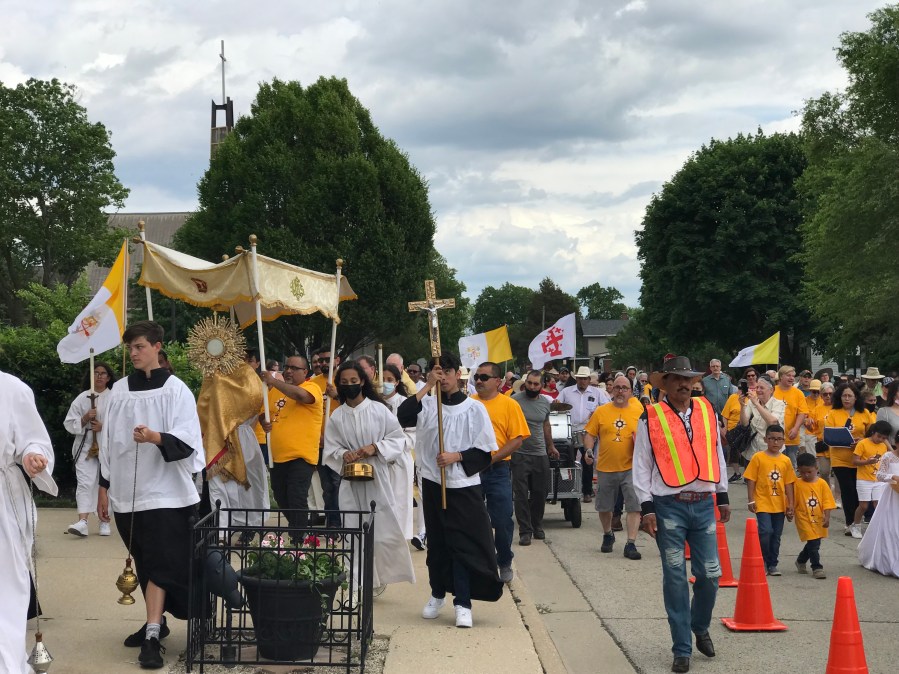
I don’t recall processions growing up. Growing up in the 60’s and spending several years in upstate New York, perhaps the age-old tradition had waned here in the Illinois Valley and in New York State but in more recent years I have seen a revival. My local parish began having processions around the church, or one year even inside the church because of rain, when Fr. Gary Blake was our pastor. The picture I used for today’s blog is an annual procession, that seems to get bigger each year, hosted by the LaSalle Catholic Parishes. It travels from St. Hyacinth’s church to Shrine of Our Lady of the Holy Rosary, just under one mile, through the streets of LaSalle. It includes the Eucharistic procession, music, horses, school children dressed in their First Communion outfits, parishioners with special t-shirts and concludes with Eucharistic adoration stops. It is amazing! I am moved each year but the devotion to our Lord in the Blessed Sacrament. It is a public statement, a profession and a procession, of faith to community members.

Today also marks the beginning of The Year of Parish Revival, the second phase of three, as part of the Eucharistic Revival movement. I am honored to be one of the two parish representatives for Holy Family Parish. The revival, grew from concern over the results of “pew studies”, and declining Catholic belief, that Jesus is truly present in the Blessed Sacrament. Two-thirds of Catholics reported that the Eucharist was merely a symbolic representation of Jesus’ presence. Bishop Robert Barron, Chair of the Committee on Evangelization and Catechesis at that time, shared with fellow bishops that there was a serious problem that needed to be addressed. Committees and meetings took place and the Revival was launched. Bishop Andrew Cozzens, now Chair of the Committee on Evangelization, has brought the fruit of those discussions to fulfillment. If your parish is involved, find out more. If not, ask your priest how to part of the parish-level revival. There are beautiful documents, parish kits and trainings to aid us during this special year of grace.

During graduate school, I attended a Newman Center for Mass and special liturgies. It was a wonderful Center, a peaceful place to study and a place of fellowship. At one point I found myself questioning my beliefs, particularly in the Eucharist, and asked to speak to one of the priests serving at the Center. I shared my concerns and questions. He asked me “Would you throw the Eucharist on the floor?” I said, “No! Of course not!” He replied then that I had a reverence for the Eucharist and that my questions were normal. I appreciated his help but now looking back I see it was misguided and perhaps the reason that many Catholics began to see the Eucharist as representing something holy, as reflected in the 2019 Pew Forum, but not actually the Body and Blood of Jesus. Our catechesis was lacking!

There are a couple of ways to look inward at your own belief, if you are Catholic, in the Eucharist. First, and most importantly, is to revisit the Church’s teaching on the Eucharist as the “source and summit of the Christian life”. Each week, or perhaps daily, at Mass, we witness the transubstantiation, bread and wine used for Communion, becoming the body and blood of Jesus. It is a miracle repeated each and every day. Another way is to spend some time researching the documented Eucharistic Miracles throughout the world. I had the great privilege of visiting the Church of St. Stephen in Santarem, Portugal and seeing the Sacred Host that has been enclosed in a reliquary since the miracle in (or around) 1247. It continues to liquify the Holy Blood over the centuries.

Blessed Carlo Acutis, an English-born Italian tech savvy teen, who died at the age of 15 in 2006, documented over 136 Eucharistic Miracles onto a website before he died. He was extremely devoted to the Eucharist, attending daily Mass and offering his sufferings from leukemia for the intentions of Pope Benedict XVI, who was the sitting pope during Blessed Carlo’s final years. He was like any other child in family videos singing at school plays or a typical teenager enjoying films, soccer, and video games. But Carlos also spent time after school volunteering to help the homeless of his city. He asked his parents to take him to many of the sites of Eucharistic Miracles in Europe. The website he created can be viewed or pdf’s downloaded to use in parishes. A traveling Eucharistic Miracle exhibition visited our area last year and exhibits continue to travel around country. He is one of the patron saints of the Eucharistic Revival movement.

St. Thomas Acquinas, Doctor of the Church and one of the greatest scholastic philosophers, said that “the Eucharist is the sacrament of love. It signifies love. It produces love.” To that I say, Amen.

Peace, Deena

Image used is from the Corpus Christi Procession in LaSalle, IL 2021

Why we do what we do

This morning, reading Maria Shriver’s Sunday Paper, I reflected on the question she and her team were asked by a facilitator brought in to conduct an offsite session to assess where they are and where they want to be, as writers for the Sunday Paper. They were asked “Why do you do this?” “To what end?”. Great questions for all of us. Why do we do what we do?

Many of you have shared in response to my posts from Maria that you started following her after I have shared her articles or that you admire her too. We post sunsets and flowers and graduation pictures. I have friends on “vacations”- one on a long trip to Israel visiting many of the holy sites I long to visit, others now returning from an incentive cruise to Norway as a result of great success with their stamp & paper crafting businesses and recently a group that traveled to Italy with my friend and author, Judith Valente, visiting lesser known Benedictine spiritual sites. I have enjoyed each and every picture they have shared from their journeys. I think we share those moments with each other to make a connection, to have companions for those special moments or to impart some information that we found helpful.

We recommend recipes and great restaurants because we want others to have the wonderful experience we had. We share the ordinary moments that make us smile, like my cats in their new cardboard box, which they won’t let me breakdown yet, or a friend who takes his dogs to establishments in Florida for lunch or refreshment and afternoon music. Are these things going to change the world? No, but they bring moments of happiness as we share them and as our friends participate, albeit virtually, in those moments with us. My morning posts of a coffee cup or an inspirational quote are not going to change your life, that’s for sure, but I hope it gives each of us a minute to pause and think about something pleasant in the world.

I share my love for essential oils, or a new system I have found to reduce pain and promote healing and restoration, because I want others to experience the same benefits I have found. Whether it’s health and well-being, kitchen items or jewelry, I believe that my friends are sharing these items because it brings them some delight or comfort. Maybe that’s what small communities used to be like. People set up their small businesses because they knew it was a trade they were good at and wanted to help others.

I am looking forward to reading a new book I found out about this week from author Kate Bowler, written by her former Yale professor Miroslav Volf, Life Worth Living; A Guide to What Matters Most. To be a complete fan girl of Maria Shriver today, she wrote opening comments to the book regarding her new venture, Open Field, and she said “We are all seeking the same things. We’re all seeking dignity. We’re all seeking joy….seeking to be seen, to be safe….We can all give each other these (spiritual) gifts if we share what we know-what has lifted us up and moved us forward.” Her new venture, Open Field, with Penguin Books is the publisher of this book. My initial sense of the book so far is that it asks all the Questions – questions that challenge us, inspire us to define what’s really important, face the limiting beliefs that prevent us from pursuing it and then start making the changes to get there.

Hopefully we do the work we do, paid or volunteer, because it brings us joy and fulfillment. At some point we must have reflected that it would be work we would enjoy or it is a gift or talent that we have. If it no longer does that, perhaps it’s a good time to ask why not and how we could change that activity to become more meaningful again. Or maybe it’s an opportunity to consider doing something new. It may be a stretch to think about a new venture. My transition from corporate life to ministry work has invited me to use a prayerful, discerning heart and mind over a rational, pragmatic one. It isn’t always easy to change but it may make a difference in each and every day of your life and potentially to the lives of those you impact on a daily basis.

Today is the Solemnity of Pentecost. We celebrate the birth of the Church with Mary and the Apostles but that continues to come alive each day in us. Ronald Rolheiser’s reflection in Give Us This Day for today, May 28, was poignant. He said “We are always dying in some ways, though never dead. We are always alive with new life. But we need to grieve what’s dead, adjust to the new, and let the old ascend. If we do this, Pentecost will happen in our lives. We will receive a new spirit for the life that we are, in fact, living.” Then he made a statement that perhaps is the answer I have been seeking for many years. He said that the Holy Spirit brings about the “dissatisfaction and restlessness” that we feel until our lives, and the spirit by which we are living them, is integrated and aligned. To that I say, Come Holy Spirit! Let us continue to pray for the gifts of the Holy Spirit in our lives: Wisdom, Understanding, Counsel, Fortitude, Knowledge, Piety, and Fear or Respect of the Lord.

Peace be with you, Deena

Image created with PicMonkey

I am with you always

Today is Ascension Sunday in most dioceses. I can only imagine the feelings of the apostles as Jesus reminds them He will be with them always, that He will send the Holy Spirit but then leaves them again. They watched Him suffer and die, He appeared to them after rising from the dead. He taught them and then He was gone again.

I read a reflection this morning, from Conception Abbey, for Ascension Sunday, in which Fr. Martinez shares a connection between the Ascension and the anniversary of his mother’s passing. He shares that he and his siblings came to understand that their mother was always with them if they lived as she had raised them. I think we probably have all had that kind of experience after losing someone we loved.

I will always remember the first time I was going to start planting a garden, the Spring after my dad’s passing. I said “Ok Dad, let’s do this”. I got all my holes dug, tomato plants lined up and knelt down to begin the task of putting them in. I heard, as clearly as if he was standing behind me, “You forgot the MiracleGro!”. I laughed out loud, got up and headed to the garage and proceeded to plant them “correctly” as I watched him do for so many years!

Fr. Martinez concludes that the apostles, and us, as children of faith, do the same if we listen to and follow the ways of Jesus. I am sure the apostles heard Jesus’ voice in their hearts and minds at times after the Ascension, just as clearly as I heard my Dad’s voice in the garden. It is the spirit of our loved ones that lives with us and keeps them alive, always with us, in our hearts. It was with the coming of the Holy Spirit that the disciples were able to go on and be witnesses to Him throughout the world, to be the new body of Christ. The same is true for us.

During the Mass of the Ascension of our Lord, the Easter candle is extinguished. Jesus has ascended to the Father and the Easter season has concluded. The sanctuary light, by the tabernacle in every Catholic Church, reminds us that Jesus remains with us, in the Most Blessed Sacrament. I have seen people walk in a church and genuflect toward the windows, the altar, and a variety of other directions. In newer church designs, it may be that they don’t know where the tabernacle is, so they are just kneeling toward the front which has the altar used for Mass. In other cases, it perhaps reflects that they don’t understand that we are kneeling, in reverence, to our Lord, present to us at all times in the Blessed Sacrament.

If you walk in a church and don’t know where the tabernacle, with Jesus is, just look for the red sanctuary candle. It burns at all times, until after The Mass of the Lord’s Supper on Holy Thursday when Jesus is removed during the holy days of Triduum, until Easter Vigil. My aunt, a Franciscan sister, used to make the sign of the cross as my Mom would drive by a church between my house and my other aunts home, during her visits with us. I thought she was doing so because it was a church. It wasn’t until I understood my faith more and learned that she was doing so because Jesus was present in that church, as He is in all Catholic Churches, in the Blessed Sacrament, in the tabernacle.

My essential oil classmate, Pat Brockman Iannone, shared this beautiful photo from her trip to Jerusalem, that I am using today with her permission, from the Church of the Holy Sepulchre. She wasn’t sure if there was a tabernacle by the hanging candle, but I did research to learn that there is an Orthodox tabernacle in the Church at the altar of Golgotha. Her photo reminds me of the older beautiful hanging sanctuary lights that were used in churches in Europe or older, more traditional design churches. Regardless of the style, the sanctuary lights remind us that Jesus said “Behold, I am with you always, even to the end of the age.” (Matthew 28:20)

I still have a preference for Ascension on Thursday, old-fashioned I guess. It provides an opportunity to savor the 10 days of waiting for Pentecost. My team at work decided to take this time for a “mini-retreat” and pray a novena between Ascension Thursday and Pentecost with prayers to the Holy Spirit to fill our hearts and minds as we continue discernment and work toward the official launch of Ignatian Ministries as a non-profit and our new website. This week, how might you reflect on the ways that Jesus is always with you and prepare for a deeper union with the Holy Spirit on Pentecost Sunday.

Peace, Deena

Photo by Patricia Brockman Iannone. Pat is also an essential oil educator and practitioner. Her website is gingkotreehealing.com. GingkoTree Healing is also on Facebook.

Concluding Prayer of the Divine Praises: May the heart of Jesus, in the Most Blessed Sacrament, be praised, adored, and loved with grateful affection, at every moment, in all the tabernacles of the world, even to the end of time. Amen.