Endless, inexhaustible mercy

One of the things I am learning, and appreciate, about the Spiritual Exercises of St. Ignatius of Loyola is that it begins with the premise, in the First Principle and Foundation, that God’s love for each one of us, individually, is endless and unconditional. We have unique gifts and talents, along with our deepest desires, that God wants us to realize and fulfill, to the ultimate purpose of living with God forever. A person making the Exercises is invited to spend time in this First Principle and Foundation, considering this love, before moving on to the other “weeks”. It is only then that we look at how our response to God’s love has been impacted by the sin in our lives, how to follow Jesus more closely, a consideration of Jesus’ passion and death and then the joy of the Resurrection.

Today is Divine Mercy Sunday, the Second Sunday of Easter. I enjoy the gospel of Thomas’ encounter with Jesus, Jesus’ greeting of “Peace” in a room full of his frightened apostles, men that abandoned him, and the prayers of Divine Mercy, but I think I haven’t been approaching the day quite right. I hope it makes sense as you read this.

I found a quote by Thomas Merton to reflect on while trying to look at Mercy a new way. It’s from his book “No Man is an Island”.

“But the man who is not afraid to admit everything that he sees to be wrong with himself, and yet recognizes that he may be the object of God’s love precisely because of his shortcomings, can begin to be sincere. His sincerity is based on confidence, not in his own illusions about himself, but in the endless, unfailing mercy of God.”

Last week, on Holy Thursday, as I traveled to various parishes to visit their Altars of Repose, I found myself contemplating the prayer of Jesus before his arrest and the brutal treatment of sentencing and crucifixion. I prayed, “I am so sorry. Can you forgive us for how we treated you?” I instantly heard, in my mind, an answer to that prayer. “You are forgetting, I already have, that’s what Good Friday was all about.” Wow. It changed my prayers and reflections on Good Friday, Holy Saturday and Easter and I have been contemplating it all week.

Yesterday in the Modern Mystics class I am participating in, Fr. Ron Rolheiser gifted us with his presentation on priest, writer and theologian Henri Nouwen, “The Light of Tenderness”. During the presentation he said, speaking of Nouwen’s writing, that “the heart is stronger than our wounds”. He said that Nouwen believed that we have to live our wounds vs. think about them, we have to take them from our head to our heart and live them so they don’t destroy us. I understood this to mean, for me, that we accept and learn from our wounds instead of rationalizing them, finding people to blame for them or continuing to dwell in them.

We can do this, it occurred to me, only if we believe in that “unfailing mercy of God” that Merton spoke of. I can remain in the posture of constantly trying to understand why I did what I did, keep asking for forgiveness, for the mistakes I have made, over and over again, or I can accept that Mercy and move on. Instead of dwelling on the reason I seek Mercy, I can share the joy of experiencing that Mercy in my life. Otherwise, it seems, I haven’t truly believed in the gift of Jesus’ death and resurrection or the gift of God’s Mercy.

There is immense freedom in knowing that God knows exactly who I am and who I have been. I don’t have to pretend it was anything else. God’s mercy is inexhaustible, precisely because of God’s love and despite my failed attempts to live as a loving human person to others.

I am going to continue to spend some time with this as we celebrate the Feast of Divine Mercy. I invite you to also consider how we might accept that Mercy more fully and move on with the intention of living with more love and compassion, because that great love and mercy has been gifted to us.

Peace, Deena

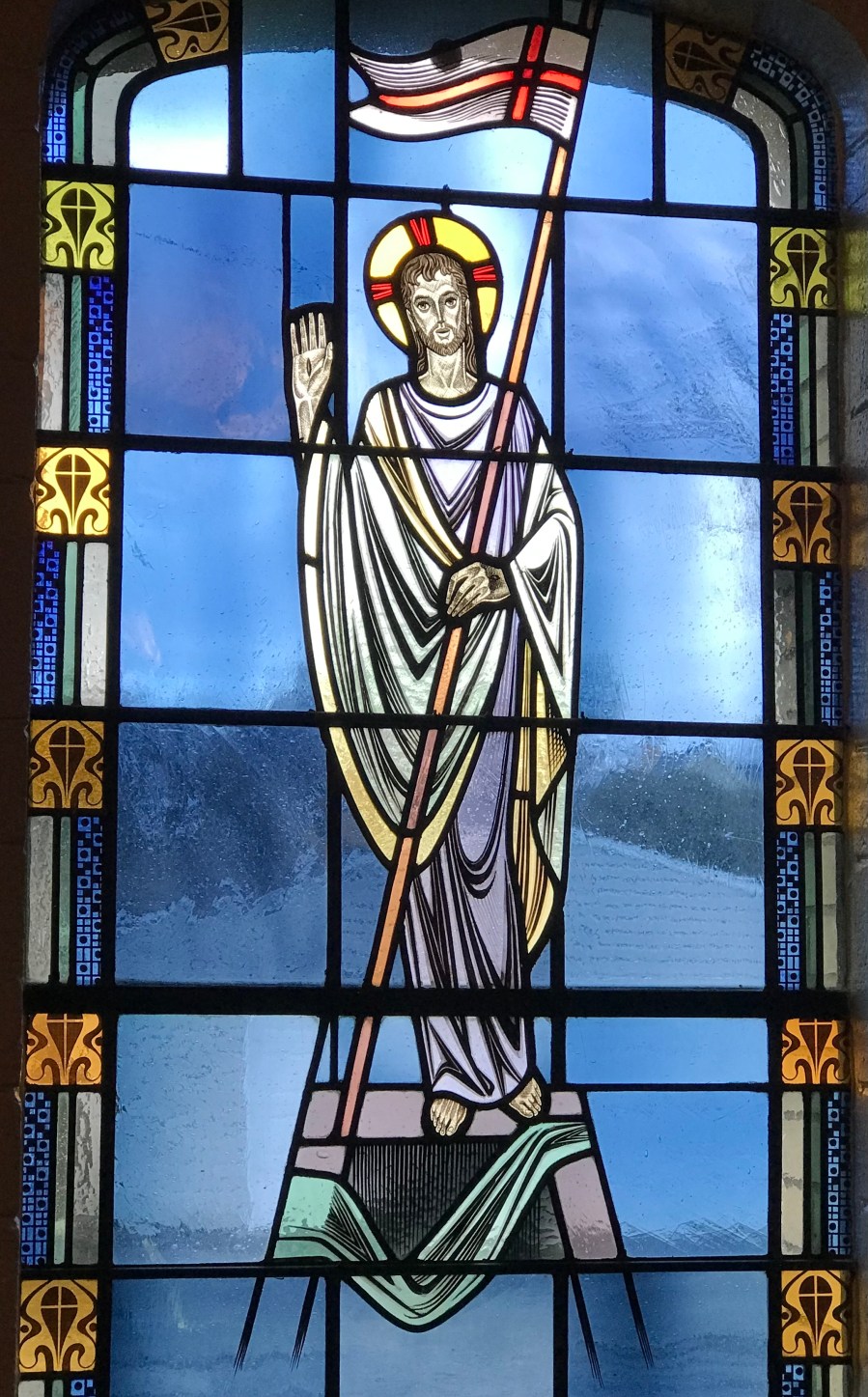
Photo: Our Resurrection Window at Holy Family Church, Oglesby.
Into the desert

Here we are in the first week of Lent. We hear in Mark’s brief gospel account of the time that Jesus went into the desert for forty days. It’s an account that sets us up for our forty day pilgrimage and journey into the desert of prayer, fasting and almsgiving.

“The Spirit drove Jesus out into the desert, and he remained in the desert for forty days, tempted by Satan. He was among the wild beasts, and the angels ministered to him.”

During his Angelus address today, Pope Francis asked us if we retreat into the desert or try to spend some time reflecting on the disordered passions, the “wild beasts” that stir in our hearts. He said that “the angels bring us good thoughts and feelings, suggested by the Holy Spirit, while the temptations tear us apart. “

We must enter into this season of silence and prayer, during Lent, to ask these important questions. The “Ash Wednesday” days, the short week before the First Week of Lent, of my retreat with Abbey of the Arts, A Different Kind of Fast, has been a thought-provoking entry into the desert. This retreat is also the title of the latest book by Christine Valters Painter, our online abbess and retreat facilitator. We have looked at the things we consume, not just food, that don’t really nourish or satisfy us. We look, during this entire journey, at those “disordered passions”, as Pope Francis labeled them today, in order to make space to grow closer to the Beloved. We look at those activities and habits that keep us from being present and aware, keep us from experiencing greater freedom, as I discussed in last week’s blog.

During the retreat we will journey into the desert, in guided meditations, to learn from the Desert Fathers and Mothers. This week we “spent time” with Abba Arsenius, to glean wisdom on true hunger and what is enough in life. At the end of the meditation Abba Arsenius presents us with a bowl, a bowl that we can fill up with things that no longer serve us and “empty the contents into the hands of the divine.”

I have added a picture of my bowl at the bottom of this post. I actually used it two years ago, the first time I took this retreat. When Lent was over, I put the bowl, wrapped, and safely back in a box in the basement. As soon as Abba Arsenius handed me a bowl, this purple bowl came to my mind. After discussing the contents that I could fill the bowl with each week, I thanked Abba and went downstairs to retrieve it. I thought, while unwrapping it, how many items do I have wrapped or stored in cabinets to be used for a special occasion instead of enjoying them? Then thinking of my other consumption, how many craft supplies do I buy and never use? Do I feel more creative just by having them? Or am I afraid to put myself out there? How many books do I have that have not been read? Do I feel more wise as a result of them sitting on my bookshelves throughout the house (and basement!)? Or is the purchase itself filling some kind of void? Why do I allow time to be filled with less nourishing activities instead of those that bring me peace? Similarly, what foods do I eat in order to stuff down a feeling I prefer not to deal with? What is the food in life that will truly nourish?

Yesterday we took part in a creative ritual to create an altar space, a space with symbols to remind us of this season of pondering the deep questions and to help us enter into our prayer practice. Mine came together easily with items that will remind me of my quest this Lent. I have a stone cross surrounded by stones, that built a cairn during my first Abbey of the Arts retreat, Earth; Our Original Monastery. I have a purple cloth bag to represent the things I have been carrying but desire to be free of. I have beautiful prayer cards that symbolize the journey: St Catherine of Siena, a lovely card I bought in Siena this past Fall, known for her rigorous fasting on vegetables, water and the Holy Eucharist; a card with St Teresa of Avila’s prayer, Let nothing disturb you; a prayer card I picked up in Rome, of Jesus and the Samaritan woman at the well, “Sir, give me this water so that I might not be thirsty…”; and a prayer cards of angels. My hope is that these cards will remind me of those holy saints and angels that accompany me on this journey through Lent.

The questions of Lent are hard ones to ask and replacing them with more life-giving practices takes time. It’s a journey of a lifetime, but a good one to begin during this holy season of Lent. We can ponder the questions of Pope Francis today. What disordered passions or wild beasts consume my life and keep me from more life-giving practices? What might I be invited to let go of? Am I spending time in silence and prayer?

Are there some symbols or objects that you can place in your prayer space to invite you to this time of deeper union with God? I would love to hear what items will assist you during this Lenten pilgrimage.

I wish you great peace, freedom, and inner calm this week, Deena

Images:

The purple bowl that I was invited to bring out during my meditation with Abba Arsenius.

Desert image, as a featured image for this blog, from my PicMonkey account

A desire for freedom

When I began the year I decided my “word of the year” was Fortitude. One of the practices I have incorporated in each new year, inspired by many authors and retreat leaders, has been to spend time asking questions and reflecting on the predominant quality or theme I want to grow in during the new year. I feel I lack discipline in many ways, so Fortitude came to mind. However, February has been a month of transitions and new learning, so it doesn’t feel right any longer. So, what word will it be? This week Freedom keeps coming to mind.

Last week I wrote about reflecting on the grace we seek before times of prayer, reflection or meditation. I am excited to begin Lent this week. I see Lent as a time of prayer, fasting and almsgiving that allows us to search our hearts. I have several practices that I hope to incorporate and new teachings to reflect upon. I have found that each of them touch on freedom (physical, emotional and spiritual) in some way, shape or form.

Yesterday was my monthly Creative, Visual Journaling class. Lisa invited us, as she gave us prompts to journal about, to be free of what we think is possible, from what has been part of our past experience and imagine the life we wish to live. We have to start with our mindset, Lisa challenged us. We have to change our minds to think about what is possible. Lisa believes that journaling helps us navigate change and transition, it “gives our subconscious mind the problem to solve”. So I embraced the freedom to imagine the life I want – the who, what, how of a life of using my authentic gifts, boldly and with joy.

Another teaching that has been weaving its way into my daily life and practice has been the desire to live more mindfully. The practice of mindfulness helps us be in the present moment, aware of what we are feeling, setting aside the scattered and distracting thoughts of “later”, “what if”, “how will I be able to?”, “why can’t I”, “should I?”, “how could they”… I am sure you have had similar lists. These thoughts do not serve us. A better way is to be in the moment, aware of the only thing we can be sure of, the present moment. I have read and studied many authors and teachers of mindfulness, Christian and Zen, but a review of mindfulness impacted me in a new way this month.

I shared in a Facebook post this month, that some of you may have seen, that I just began the third year of a Wisdom/Mystics program. The first year was Women Mystics and last year, Celtic Wisdom and Mystics. This year we are studying Modern Mystics. On the first Saturday of February we were blessed with the teaching of Thich Nhat Hanh, Zen Master and Buddhist teacher, by his student Kaira Jewel Lingo. Kaira Jewel is a teacher in her own right, given authorization to teach by Thich Nhat Hanh, after spending 15 years at Plum Village living and studying with him. Kaira Jewel is an author and teaches many programs, which you can find online or on apps, like Insight Timer.

A simple practice, one of many Kaira Jewel shared with us during our class, is to set the intention (i.e. in the language of my blog last month, name the grace) to be present for yourself. During our slow breath work as part of meditation, or you could do as part of Christian Centering Prayer, is to inhale “I have arrived” and exhale “I am home”. Kaira Jewel shared that we have to first come home to ourselves, to get to the root of our own suffering and to find unity and inter-being with all other persons and species. If “suffering” seems foreign to you, simply think of it as areas we have opportunities to be more aware of, to grow and let go of.

There have been a multitude of ways that the simple practice of returning to the breath, to the home of my body and spirit, has helped me this month. Has it been perfect? No! But I am learning. I tried to be more present listening to others. Instead of thinking of something outside the moment like a “to do” list, I tried to be attentive to what a person was saying to me. I have tried to be present to my physical pain, instead of reacting in anger or fear of it. Physical therapy seemed to go better this week! I have tried to think about why I am eating what I am eating, especially when it is an attempt to stuff down some other feeling or issue I would prefer to avoid. In a moment when I found myself reacting to someone, I came home to my anger and judgement and wondered why I was reacting to their words, then tried to have compassion and understanding for the person speaking, why they might be saying what they were saying.

Again, was it perfect? No, but perfection isn’t the goal, freedom is. Freedom from worry, anxiety, anger, judgment, etc is. All of those feelings do not change the situation so why do I view them as helpful? It was as if I learned that I had left my home unattended for years, just kept the heat on but the dust accumulated.

The leper in today’s Gospel for the Sixth Sunday in Ordinary Time desired to be made clean, had the faith that Jesus could do it by his act of will. At that time the man’s leprosy was viewed as an outcome of his sin. So Jesus’ act of healing brought him back into his community, it freed him. Doesn’t our sin, judgment and separation from others do the same for us? We are saying, what I want is more important than what God wants for me or how I might be here for others. Our own need and desire trumps everyone else, including God. Desiring to be made whole, desiring freedom from sin and the accumulation of dust, moves us back into community, with God and others.

Author and dear friend, Judith Valente’s Sunday blog (found on Medium and on Facebook), reflecting on Lent and looking at it in a new way, asks us to examine similar questions, “can I take a hard look at the habits I’ve acquired over the past year that don’t serve me or others well? Can I make a conscious effort to let go of them, to make a fresh start?” Again, freedom, freedom to move beyond the habits of my past with a desire to live with more awareness of and for love for self and others. These questions will be part of my daily examen during Lent!

In her weekly email, and in preparation for our Lenten Retreat, “A Different Kind of Fast”, author Christine Valters Painter discusses the Three Renunciations of theologian of the early Christian Church, John Cassian. Christine says the third renunciation was one she found most powerful, and I would agree, as I read her description of them. The third calls us to “renounce even our images of God so that we can meet God in the fullness of that divine reality beyond the boxes and limitations we create.”

This renunciation challenges me to be free to sit with, be gazed upon by the God who desires to be with me. I can be home with God exactly as I am, knowing that I am loved. I can look at the areas that I hope to grow in greater love and compassion for others. I can desire a purging of old ways with the desire to make more room for God and love of others.

So this Lent, where do you desire greater freedom? What grace do you seek for these 40 days of “retreat”, a time to free yourself of habits that prevent you from listening to and responding to God’s call in your life? May it be a time of growth and greater freedom to love and serve with our lives.

May it bring you greater peace, Deena

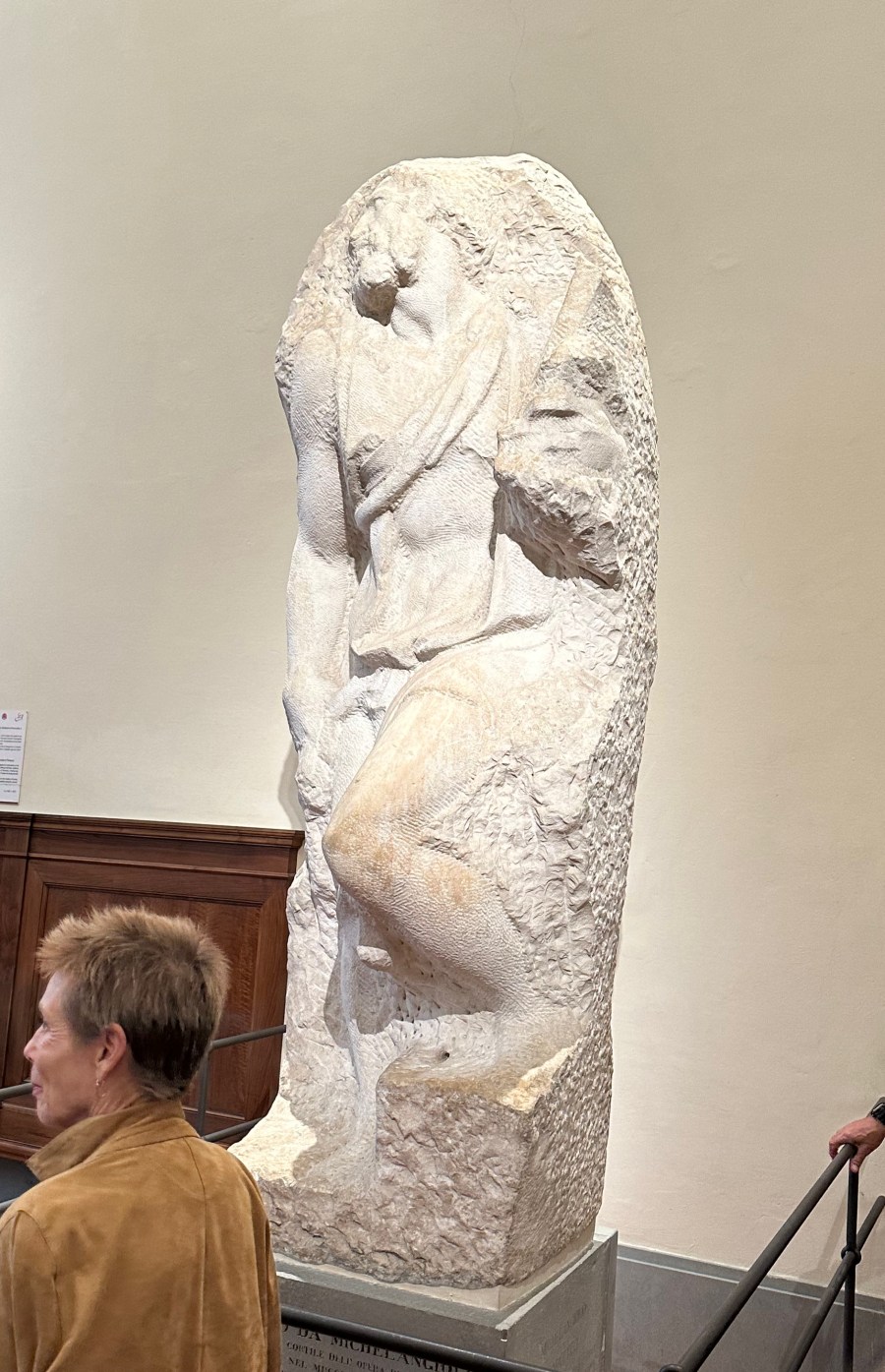
Photo: One of the unfinished marble pieces, never freed from the stone, of Michelangelo in Florence.