Human dignity and the rights of all

The gospel reading for Saturday in the Second Week of Easter is from the Acts of the Apostles and describes the needs of the growing church and the selection of individuals to assist in the cause of the distribution of goods to those in need, in the case of this scripture reading, widows.

Earlier this week, the Vatican released a final version of the Declaration of the Doctrine of Faith “Dignitas Infinita” on Human Dignity. I read it through a couple of times but need to spend more time with it in prayer and study. It occurred to me, upon reading Saturday morning’s scripture, that from the earliest days of the small community following the teachings of Jesus there has been concern and a need to respond to the needs of others.

Pope Francis requested the additional drafts of Dignitas Infinita because additional attention was needed to address the violation of human rights, in light of his Encyclical Fratelli Tutti in which he stressed the dignity of all persons “beyond all circumstances” and summoned all of us to defend human dignity “regardless of physical, psychological, social, or even moral deficiencies.”

The Declaration provides a biblical foundation for, theological perspective and the position of the Church on human dignity. We see countless examples in the gospel writings where Jesus responds to and elevates the dignity of each person he encounters. We should all follow this example with the same respect for the dignity and needs of each person we encounter in life.

The Declaration is a rich study of the Church’s recognition of the dignity of every person. It also acknowledges grave violations in various forms (not claiming to be a comprehensive list) such as poverty, war, the migrant issue, human trafficking, sexual abuse, violence against women, abortion, surrogacy, euthanasia and assisted suicide, marginalization of people with disabilities, gender theory and sex change, and digital violence. It is a helpful explanation of the Church’s position and I would encourage the document be read in totality versus bits and pieces that the media may choose for any specific agenda.

As mentioned, I need to spend more time studying it, but regardless of my opinions, it is an beneficial attempt by Pope Francis and the Roman Curia to continue to bring the needs of all peoples and situations impacting the dignity of each person to our attention, inviting us all to fight for the protection of that dignity and remember our own, a dignity no one can take from us.

I encourage you to read the Declaration, and whether you agree or not, be well-informed when speaking about the Church’s position for each of these concerns. Let’s also be sure that in any discussion, we support and maintain the dignity of each person whose opinion might be different than our own. We certainly are in need of a lot more of that these days!

In love and mutual respect, Deena

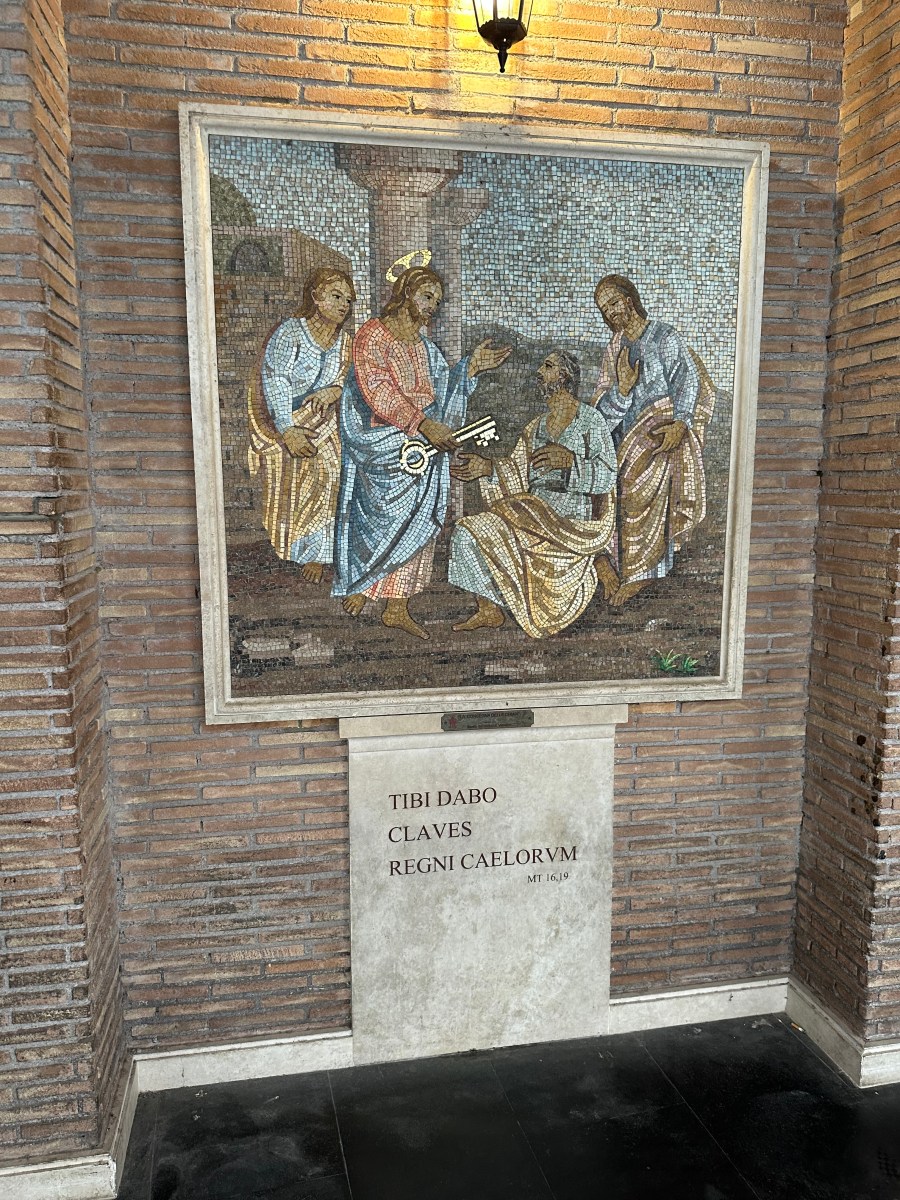
Image: From my trip to Italy, art at the Vatican, Jesus gives the keys to Peter.

Standing at the threshold

Here we are, at the threshold of Holy Week, Palm Sunday. This week, the holiest of all weeks in the church year is our final week of Lent, leading us to Easter. Just as Jesus entered the gates of Jerusalem, we stand at the gate of this special week, prepared to journey with Jesus. Regardless of how our Lent was, how well we did on our Lenten promises, we can embrace this week with intention to enter into the mysteries of Christ’s suffering and death, leading to the Resurrection, the ultimate victory over death for each of us. It is a week of beautiful and moving Church liturgies, I would encourage you to attend as many services this week as you can.

Regardless of your church affiliation, most Christian denominations have Holy Week Services. If yours does not or has not been one in the past that motivates you to want to return, find a parish or church that has an active community. Last week I visited Christ the King Parish in Moline, IL (after Mass we witnessed the baptism of Wilder, the son of my niece Maureen and her husband Ben) and the priest asked the catechumens to come forward after the homily. They had more than 20! It’s a vibrant parish community as indicated by the number of people seeking to join the Church and that parish family! It was amazing and gives me hope.

This week I began reading William Barry’s Experiencing God in the Ordinary Barry invites us to consider that we don’t have to look for God in special places, we don’t have to go somewhere (“away”, to a retreat or monastery) to experience God, God is present to us in ordinary ways and experiences. In his introduction Barry wrote that it is true that some places make it easier for us to have that experience, that some places are “thin places” (as the Irish Celts would say) for us where God is able to break through to us more easily. I would suggest that Holy Week is one of those thin places or times. As we move through each of these holy days this week, we can more tangibly experience the presence of Jesus in our lives, as we walk with him during his final hours.

I have found that many are not aware of the various services of Holy Week and what they represent. If you are, I hope there is some tidbit of information for you in this explanation.

Holy Week begins with Palm Sunday and then concludes with the Triduum, the final holy days of Lent, Holy Thursday, Good Friday and Holy Saturday, we walk through and with Jesus during the final days of his triumphant entry on Palm Sunday into Jerusalem, his final supper with his apostles, his arrest, torture and crucifixion, death and burial. Then on Easter, we rejoice in the Resurrection.

On “Spy Wednesday” we recall Judas betrayal of Jesus for the thirty pieces of silver. We might reflect on the many ways we have betrayed Jesus in the way we live and treat others.

Triduum begins on Holy Thursday (Maundy Thursday) as we commemorate Jesus’ washing of the apostles feet (an act representing our need to be of service to all) and his final Passover meal, the Last Supper, with them. As Catholics, we celebrate the institution of the Holy Eucharist. The altar is then stripped bare, leaving us with the starkness of the cross for Good Friday. Many parishes create an Altar of Repose, a beautiful space created with flowers and palm trees, with the Blessed Sacrament in a tabernacle. We are encouraged to visit different Altars in the community, to spend quiet time in prayer with Jesus in the garden.

For Catholics, Good Friday Service, is not a Mass but a time that we pray with the Passion of our Lord, have a Communion Service, and then venerate the cross. It is a solemn remembrance of all that Jesus suffered and endured for each of us. Because it is not a Mass and the Eucharist has been removed, we don’t kneel before the tabernacle, the Blessed Sacrament is no longer there. Holy Water is also removed until Easter Vigil, when the water is blessed again for Baptism. In the past local parishes have also had Tenebrae Services, a moving service of the psalms of lament and a slow extinguishing of candles throughout the readings. It then usually ends with a loud noise, in almost total darkness, representing the closing of the tomb that held the body of Jesus.

Holy Saturday morning is a time of silent waiting, concluding with the most beautiful service of the church year, the Mass of Easter Vigil. We light the Easter fire, burning old palms, as the new Easter candle for the year is prepared and from that new candle, representing the Light of Christ, we each light our candles to begin the Vigil Mass. In the midst of that beautiful candlelight, a deacon, cantor or priest sings the Exsultet, the Easter Proclamation, an ancient (7th or 8th century) hymn of praise. It is the most beautiful part of Easter Vigil. You may enjoy listening to this version by Glenstal Abbey in Ireland. It is during this Mass that any new members of the Church are welcomed, receive their first sacraments and join fully in the participation of the Holy Mass.

Each Holy Week, and through the Triduum services, I recall my spiritual teacher and mentor saying to me, the first time we met, to “enter the deep, dark incense filled corners of the church” and really experience the ritual and liturgy of the Church. That wise advice helped me find meaning in each of these beautiful liturgies, regardless of any feelings that I have for the church at any particular time or in reaction to any particular teaching that a more conservative priest or bishop might pronounce. We are all human and capable of sin and error, but Holy Week reminds us that Christ died for each of us. My goal is to keep paying attention, to look for God in the places that God seeks to communicate with me, to do my best to get to know this God of tender love and compassion and then make a return of love, in response to that generous love, with my life.

I hope that this Holy Week is one of deep connection with God and that you find many blessings as you are able, and choose, to participate in the beautiful liturgies of the Church. Deena

Photo: Taken during my pilgrimage to Italy in 20923, the Sancta Sanctorum is a Roman Catholic chapel entered via the Scala Sancta (Holy Stairs) of the Lateran Palace in Rome. The photo is the chapel at the top of the stairs. It is believed that the white marble stairs were brought to Rome by St. Helena and were stairs used by Jesus as he walked toward his crucifixion.

Walking behind great women

Some of these blogs start with an idea and a plan and things fall nicely into place. Today my plan was disrupted by the jubilant article written by Maria Shriver in Maria Shriver’s Sunday Paper, “A Woman’s Moonshot”. Maria shares the experience of joining the First Lady, Dr. Jill Biden, for the State of the Union this past Thursday. She shares the story of taking her idea to bring equity to women’s health research for Alzheimer’s, rheumatoid arthritis, menopause, autoimmune diseases and much more to the First Lady last year. Women’s health research has always been underfunded. She acknowledges the First Lady for taking her request seriously and acting quickly. But the best part of her article, for me, was when Maria stated that as the First Lady raised her arm in acknowledgement of the President’s introduction of the health research initiative, she quickly reached out for Maria’s hand to raise it with hers. As Maria says, “She didn’t have to do that, but she did…”

Great women working together for a common goal, that started with an idea or dream! That’s a vision we need for Women’s History Month. If you have a dream, follow it! Don’t give up, even when the road seems bumpy and unsure. Earlier this week I sat with an idea with my journaling cards, from my Visual Journal monthly class project, and thought of all the reasons why it’s too late, will take too long, or that I am not creative enough. Maria Shriver is seeing this dream come to life at 68, granted she has a family history and life experience to walk in bigger circles and perhaps dream bigger dreams, but she follows her dream of living a “life above the noise” and empowering change-makers – “big thinkers, visionaries and visionaries” to move humanity forward. We can each do this, regardless of the size of our circle of influence.

My original plan for this blog, in honor of Women’s History Month and International Women’s Day this week, was to write a litany to the great women, Saints and saints, in my life. Sr. Joan Chittiser’s powerful Litany of Women for the Church has always been a favorite. This link is 2021, but I think this is revised. I had a much older version, perhaps published by Pax Christi, on a well loved prayer card, that I can’t seem to locate now. It calls on great women, channels of the Word, to intercede for us and model what we might become. I wanted my version to include the women in my life that have lifted me up and encourage me along with way.

Besides saying “pray for us” or “intercede for us” you might also use “model for us”, “show us the way”, “teach us”, etc. Don’t we need to pray for and be that for each other?

Who would you include in your litany?

Wishing you the support and encouragement to dream your big dreams! Deena

Image: a photo our Our Lady of Good Counsel window in the Votive Candle Chapel at the Shrine of our Lady of Guadalupe in La Crosse, WI.

Trusting in new life

We have been teased the past week or so with a taste of Spring. Then all of a sudden it was winter again. Today the sun is shining with a forecast of high 60 degrees tomorrow and possibly 70’s on Tuesday, before it drops to 30’s again Weds. January was brutal and February, well, was just February in Illinois. It can be exhausting. I watch my bulbs, and early Spring plants, like my Lenten Rose, starting to grow. I am ready for Spring! Later this week we will cross the threshold into March. I hope it will be a month filled with warm days of sunshine and continued growth.

We are also only entering the Second Week of Lent. Perhaps like me, you began Lent full of enthusiasm and a desire to be renewed in the desert and leave it a transformed person. The early days are easy when desire is strong. Yet, they can be challenging too because the new practices have not yet been firmly established.

Last week, for three nights, I attended a Lenten Rosary Mission at a neighboring parish, hosted by Fr. Gary Blake, with the retreat given by Fr. Lawrence Lew, from England and the Promoter General of the Rosary for the Dominicans. It was wonderful to hear the Fr. Lawrence’s message of Jesus’ sacrificial love for us, how we can learn from and model that love in our desire to serve him and to see our prayers, especially in the Rosary, contributing to all the prayers being prayed for each other and the world, as we trust in God’s providence. To pray in community was uplifting but it also took me out of my newly established Lenten routine of special daily prayers and participating in my online retreat. This weekend I reflected that I didn’t completely return to it after the retreat ended. As a matter of fact, I felt a bit disheartened about doing so.

Mark’s gospel of the Transfiguration reminds us that Jesus wanted to give Peter, James and John a glimpse of heaven, and hope to hold on to in the days ahead, days of his arrest, trial, torture and eventual death on the cross. He had just told them he was going to die, so this was his invitation to see beyond the cross. We know that aside from John and the women of the cross, they all ran and hid in fear, the vision of the Transfiguration a distant memory.

Last Spring, and the Springs before that, likely seem a distant memory to us too. But Spring will come, we are seeing signs of it in nature. So, let’s not be discouraged or tempted to give up our desired fasts or initiatives to enter more deeply in prayer. If one day isn’t so great, do not despair. Start again in the morning with an intention to do better. Today I plan to catch up on the days of my retreat I missed this week and do some journaling.

Let us hold on to that vision of new life that we will encounter at Easter. Lent isn’t about winning a trophy in an Ironman competition of accomplished feats. It’s about growing closer to God, creating more time and space to look closely at our relationship with God. It’s a time to look at the things we spend time on and value in life, considering them from a perspective of our spiritual lives. The Transfiguration gives us hope to hold on during difficult days, with the glimpse of what lies ahead. May we move through these remaining days of Lent with a steadfast spirit of faith!

Wishing you continued strength for your Lenten pilgrimage, Deena

Image: tulips in my flower bed last year

A desire for freedom

When I began the year I decided my “word of the year” was Fortitude. One of the practices I have incorporated in each new year, inspired by many authors and retreat leaders, has been to spend time asking questions and reflecting on the predominant quality or theme I want to grow in during the new year. I feel I lack discipline in many ways, so Fortitude came to mind. However, February has been a month of transitions and new learning, so it doesn’t feel right any longer. So, what word will it be? This week Freedom keeps coming to mind.

Last week I wrote about reflecting on the grace we seek before times of prayer, reflection or meditation. I am excited to begin Lent this week. I see Lent as a time of prayer, fasting and almsgiving that allows us to search our hearts. I have several practices that I hope to incorporate and new teachings to reflect upon. I have found that each of them touch on freedom (physical, emotional and spiritual) in some way, shape or form.

Yesterday was my monthly Creative, Visual Journaling class. Lisa invited us, as she gave us prompts to journal about, to be free of what we think is possible, from what has been part of our past experience and imagine the life we wish to live. We have to start with our mindset, Lisa challenged us. We have to change our minds to think about what is possible. Lisa believes that journaling helps us navigate change and transition, it “gives our subconscious mind the problem to solve”. So I embraced the freedom to imagine the life I want – the who, what, how of a life of using my authentic gifts, boldly and with joy.

Another teaching that has been weaving its way into my daily life and practice has been the desire to live more mindfully. The practice of mindfulness helps us be in the present moment, aware of what we are feeling, setting aside the scattered and distracting thoughts of “later”, “what if”, “how will I be able to?”, “why can’t I”, “should I?”, “how could they”… I am sure you have had similar lists. These thoughts do not serve us. A better way is to be in the moment, aware of the only thing we can be sure of, the present moment. I have read and studied many authors and teachers of mindfulness, Christian and Zen, but a review of mindfulness impacted me in a new way this month.

I shared in a Facebook post this month, that some of you may have seen, that I just began the third year of a Wisdom/Mystics program. The first year was Women Mystics and last year, Celtic Wisdom and Mystics. This year we are studying Modern Mystics. On the first Saturday of February we were blessed with the teaching of Thich Nhat Hanh, Zen Master and Buddhist teacher, by his student Kaira Jewel Lingo. Kaira Jewel is a teacher in her own right, given authorization to teach by Thich Nhat Hanh, after spending 15 years at Plum Village living and studying with him. Kaira Jewel is an author and teaches many programs, which you can find online or on apps, like Insight Timer.

A simple practice, one of many Kaira Jewel shared with us during our class, is to set the intention (i.e. in the language of my blog last month, name the grace) to be present for yourself. During our slow breath work as part of meditation, or you could do as part of Christian Centering Prayer, is to inhale “I have arrived” and exhale “I am home”. Kaira Jewel shared that we have to first come home to ourselves, to get to the root of our own suffering and to find unity and inter-being with all other persons and species. If “suffering” seems foreign to you, simply think of it as areas we have opportunities to be more aware of, to grow and let go of.

There have been a multitude of ways that the simple practice of returning to the breath, to the home of my body and spirit, has helped me this month. Has it been perfect? No! But I am learning. I tried to be more present listening to others. Instead of thinking of something outside the moment like a “to do” list, I tried to be attentive to what a person was saying to me. I have tried to be present to my physical pain, instead of reacting in anger or fear of it. Physical therapy seemed to go better this week! I have tried to think about why I am eating what I am eating, especially when it is an attempt to stuff down some other feeling or issue I would prefer to avoid. In a moment when I found myself reacting to someone, I came home to my anger and judgement and wondered why I was reacting to their words, then tried to have compassion and understanding for the person speaking, why they might be saying what they were saying.

Again, was it perfect? No, but perfection isn’t the goal, freedom is. Freedom from worry, anxiety, anger, judgment, etc is. All of those feelings do not change the situation so why do I view them as helpful? It was as if I learned that I had left my home unattended for years, just kept the heat on but the dust accumulated.

The leper in today’s Gospel for the Sixth Sunday in Ordinary Time desired to be made clean, had the faith that Jesus could do it by his act of will. At that time the man’s leprosy was viewed as an outcome of his sin. So Jesus’ act of healing brought him back into his community, it freed him. Doesn’t our sin, judgment and separation from others do the same for us? We are saying, what I want is more important than what God wants for me or how I might be here for others. Our own need and desire trumps everyone else, including God. Desiring to be made whole, desiring freedom from sin and the accumulation of dust, moves us back into community, with God and others.

Author and dear friend, Judith Valente’s Sunday blog (found on Medium and on Facebook), reflecting on Lent and looking at it in a new way, asks us to examine similar questions, “can I take a hard look at the habits I’ve acquired over the past year that don’t serve me or others well? Can I make a conscious effort to let go of them, to make a fresh start?” Again, freedom, freedom to move beyond the habits of my past with a desire to live with more awareness of and for love for self and others. These questions will be part of my daily examen during Lent!

In her weekly email, and in preparation for our Lenten Retreat, “A Different Kind of Fast”, author Christine Valters Painter discusses the Three Renunciations of theologian of the early Christian Church, John Cassian. Christine says the third renunciation was one she found most powerful, and I would agree, as I read her description of them. The third calls us to “renounce even our images of God so that we can meet God in the fullness of that divine reality beyond the boxes and limitations we create.”

This renunciation challenges me to be free to sit with, be gazed upon by the God who desires to be with me. I can be home with God exactly as I am, knowing that I am loved. I can look at the areas that I hope to grow in greater love and compassion for others. I can desire a purging of old ways with the desire to make more room for God and love of others.

So this Lent, where do you desire greater freedom? What grace do you seek for these 40 days of “retreat”, a time to free yourself of habits that prevent you from listening to and responding to God’s call in your life? May it be a time of growth and greater freedom to love and serve with our lives.

May it bring you greater peace, Deena

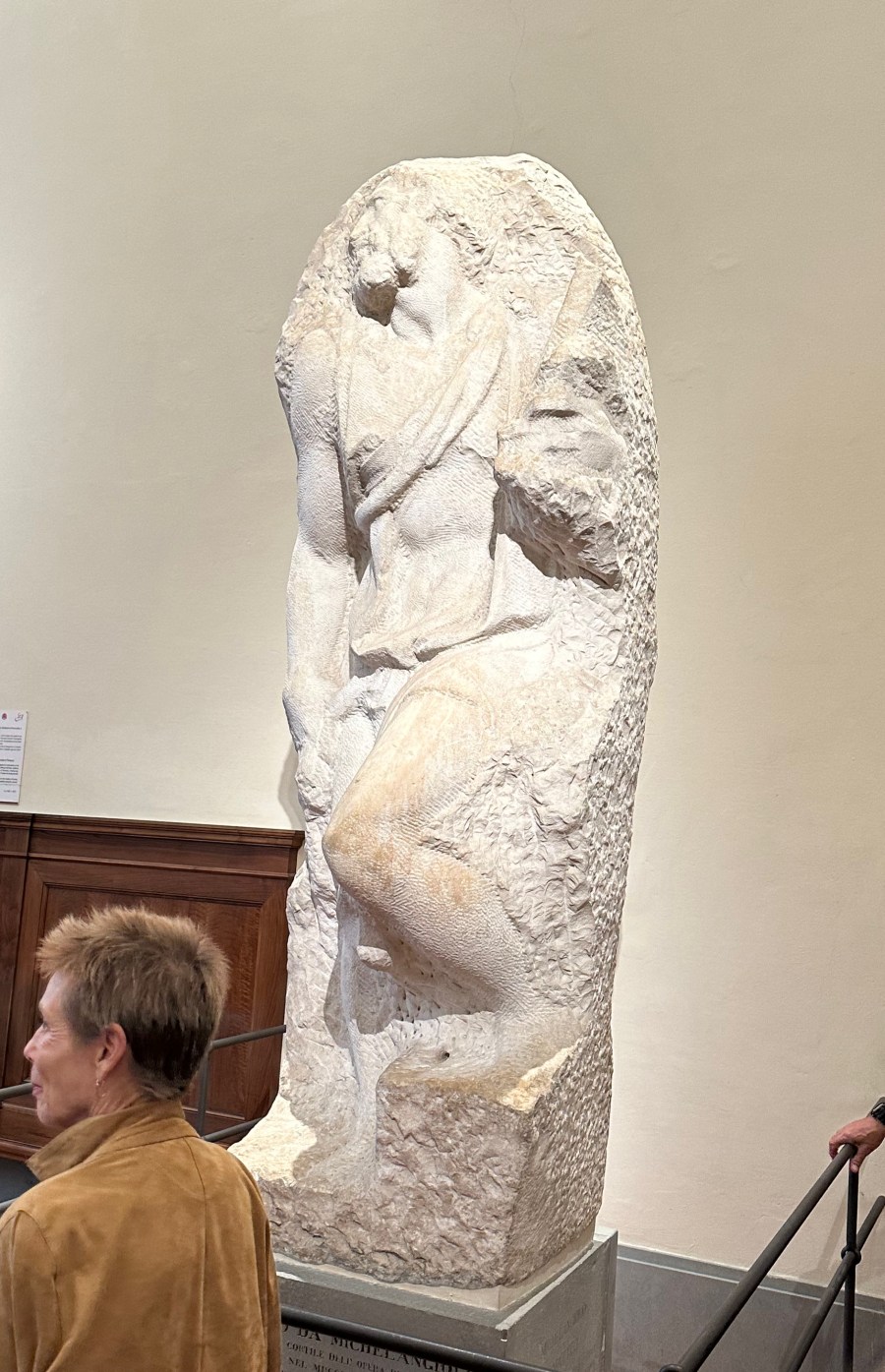
Photo: One of the unfinished marble pieces, never freed from the stone, of Michelangelo in Florence.

Alert and listening

I have to admit there have been times that I was listening to someone and not hearing what they said. Have you ever listened to a speech, a lecture, a homily, or even a conversation with a friend, and realized you missed what was being communicated? We may be tired, distracted or preoccupied but we can’t really hear what the other person is saying unless we are awake, attentive and active in our listening. I would add that we have to be open to what is being said as well. If I have already decided that there is nothing to be gained from the person speaking, I certainly won’t hear anything.

Yesterday I attended the first session, for me and for the year, of a monthly creative expression workshop offered by visual artist, Lisa Sonora. I have been feeling that I haven’t been expressing my creativity enough lately, so I was instantly attracted to an email Lisa sent earlier this month. Yes, I write this blog and create written content for work, but visual art expression with photos, stamps, ink, paint and my journals has been on a sabbatical for months. I love the tag line on Lisa’s site for her workshops – “Make Art. Feel Better.” I know when I am creating with color and different medium, something comes alive in me. Of course I have to put judgement and comparison aside, that isn’t the point of creative expression. It is letting that inner voice that desires to speak do so. I saw a post this week that I shared to my crafting page on Facebook and loved the sentiment by a crafts and yarn supplier, Mary Maxim, “Crafting may not solve all my problems, but it solves enough of them.” I could not agree more!

In the workshop session we didn’t actually create anything, we listened and then journaled. Lisa asked us questions and we began the “dreaming and scheming” of those voices and desires we keep quiet. I can’t say I was shocked or surprised by my answers to the questions Lisa asked. But I definitely heard from the creative voice within that is longing to express herself. So, I am going to make a point this year to listen to that voice and provide the nurturing and support to let that voice have a place in my life.

The first reading for the Second Sunday of Ordinary Time is one of my favorites, from the first Book of Samuel (1 Samuel 3:3b-10,19). The young Samuel is sleeping in the temple and hears a voice call him. He assumes it is his mentor and teacher, Eli and goes to him and asks what he needs. This happens a couple of times before Eli realizes that Samuel is not attentive to the voice of the Lord and guides him to respond to the Lord the next time he hears the voice. Eli tells Samuel to respond “Speak Lord, your servant is listening.” There are a couple of key points in the scripture that relate to what I am trying to say in this blog this week. Samuel is not alert or aware of the Voice speaking to him. His teacher, Eli, helps him understand. Then Samuel has to respond to the call he is hearing.

We need to be awake and alert to hear those inner desires of our heart. St. Ignatius of Loyola would say that those desires help us to hear the call to live the unique purpose for which we were created. Often times we, like Samuel, need a guide, a spiritual director, a mentor or teacher to help us discern the call. Lastly we need to respond, take a step in the direction of that purpose. If we remain sleeping and unaware, then we will continue to run to the wrong places and potentially miss an opportunity to respond and live out that call.

Pick up a journal and some colorful markers and draw this weekend. If you don’t feel you can draw freehand just yet, or wouldn’t know where to start, pick up coloring book and crayons. If you don’t have a coloring book, there are plenty of free coloring pages online such as mondaymandala.com to download, print and color. While coloring, ask yourself, “What part of my life, work or relationships feels stagnant or asleep? What would I be willing to invite in to change that?” Then listen, really listen to the inner part of you that knows the answer and is longing to tell you. Listen with the ear of your heart (Prologue of the Rule of St. Benedict). Take some notes, journal, write it down. You don’t even have to do anything with that information yet. Just listen and watch to see what shows up in your life. I’ll check back again during the year on this. Feel free to send me a message if you want to share some of thoughts before then.

Create joy, Deena

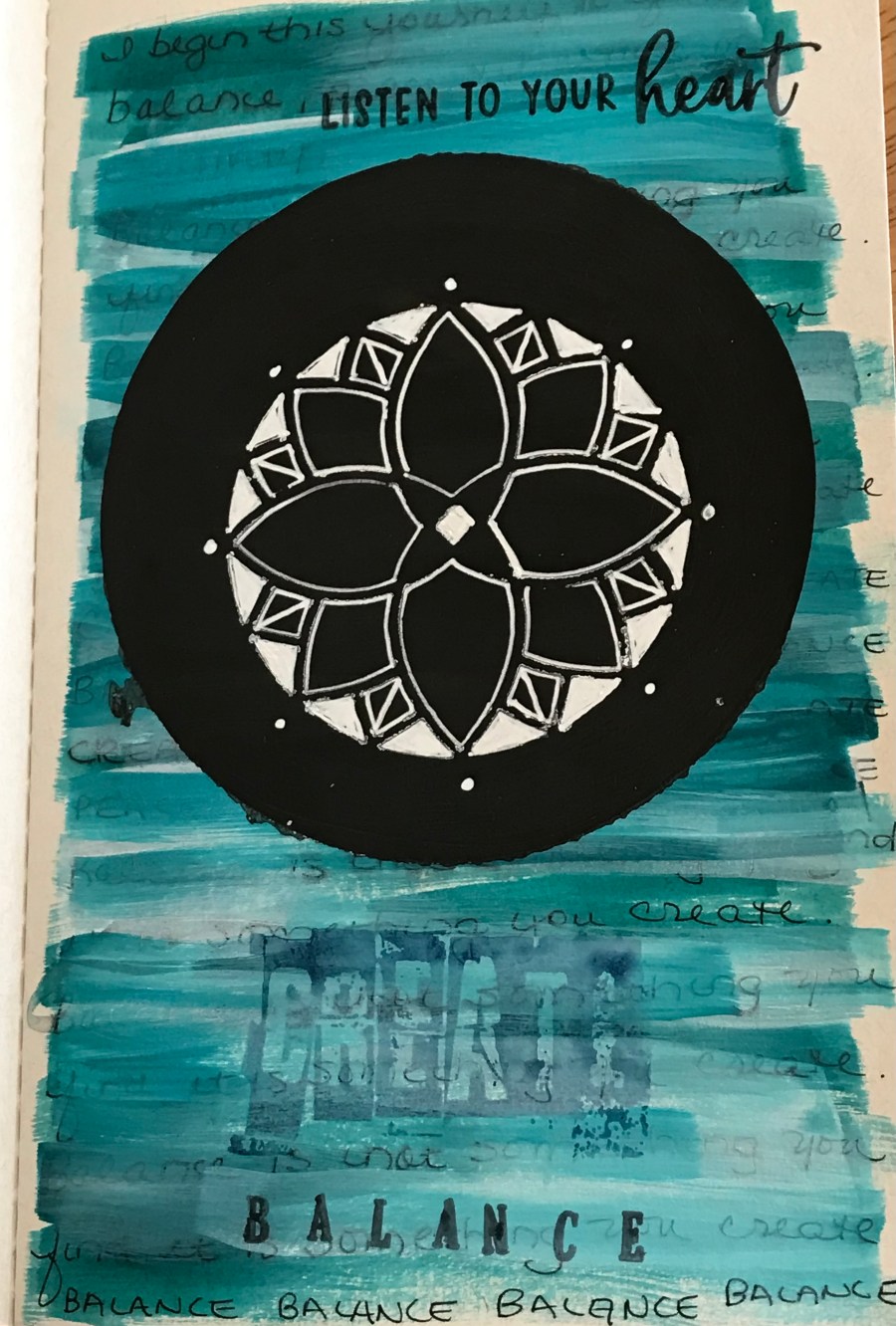
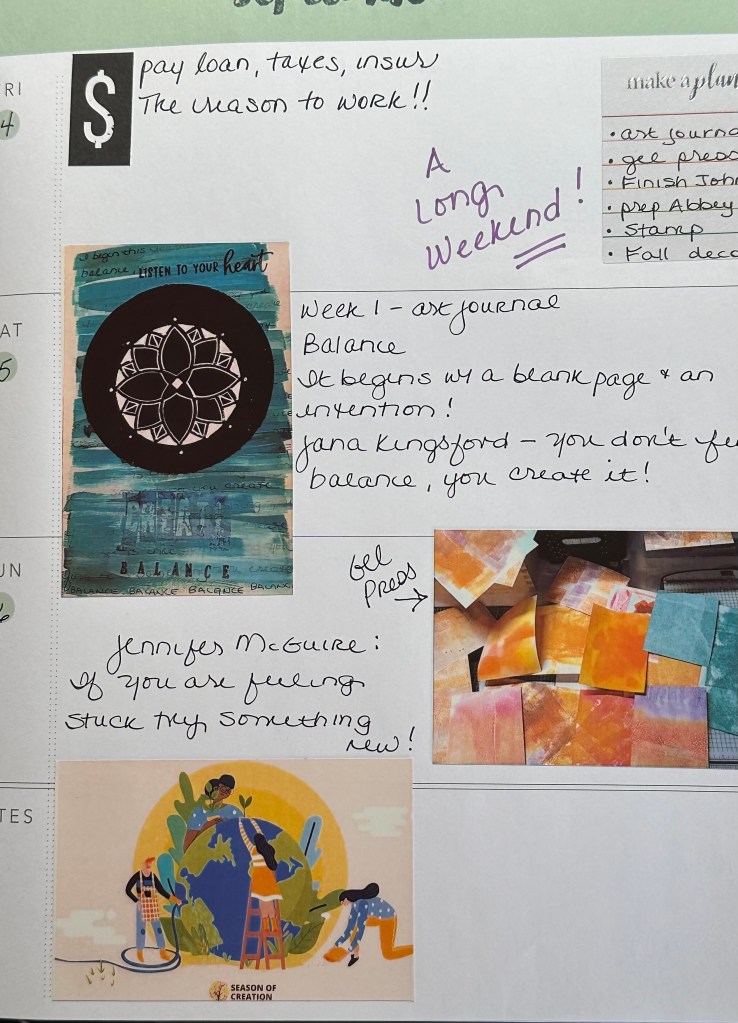
Images: Blog cover; a page in one of my art journals from 2020, created as part of a class but then also written about in my photo journal soon below.

Remember to stop and breathe

As I sat in quiet reflection before Mass on Saturday evening I was reading from Evening Prayer (Give Us This Day monthly prayer book) and was cut to the heart by the scripture from 1 Peter 4:8-11. “…let your love for one another be intense, because love covers a multitude of sins. Be hospitable to one another without complaining.” FAIL.

I have to admit one of the worst weeks I have ever had dealing with anger, rage, irritation, reaction to others… The circumstances may have warranted frustration, or not being satisfied with the way an event unfolded, but anger and rage? A wise person once told me anger was simply frustrated will. This week I would have to agree with that!

There I was feeling fully convicted, right before having to approach the ambo to proclaim the Word of God as lector for the Mass. The words of the Responsorial Psalm 138, literally stuck in my throat “I will give thanks to you, O Lord, with all my heart, for you have heard the words of my mouth;” I had to take a nanosecond to regroup. Give thanks that God heard all the hateful words I spewed out this week? Give thanks for the times that I said “this isn’t worth it!” (life, faith, times of intense humility after needing to ask for help).

The gospel for this week, Sunday August 27, is Matthew 16: 13-20 in which Jesus tells Peter that he will build the church upon him. Peter who messes up countless times and Peter, who Jesus knows will deny Him during His time of need. I felt some hope. “Your kindness O Lord endures forever” (Psalm 138).

Earlier in the day on Saturday I was part of a retreat on the 14th century book (letters written by an anonymous monk to a student or disciple) The Cloud of Unknowing, hosted by Abbey of the Arts, presented by award winning translator Carmen Acevedo Butcher. The book has long been considered as the source for the practice of Centering Prayer, a form of Christian contemplation. When we take the time to sit, or walk as Carmen prefers at times, to go within, to listen in silence, we will encounter “God’s unabsent being” and the “soul is helped by grace”. It was a lovely reminder to return to the practice of my breath work and silent prayerful meditation at the end of a week that was so completely in need of grace.

This morning as I was finalizing some of these thoughts to post in the blog, I also read Judith Valente’s blog for this week, Practicing the “Psychological Hygiene” of Compassion. I was delighted for the additional reminders of a way to practice letting go of anger and welcome a stance of compassion in its’ place. I would encourage you to read her blog.

“Close the doors and windows of your spirit against the onslaught of pests and foes and prayerfully seek his strength; for if you do so, he will keep you safe from them.” Anonymous/The Cloud of Unknowing

Create Joy, Deena

Our other gods

On Friday of this week, Give Us This Day, shared a poem written by Sr. Macrina Wiederkehr (d. April 2020) from her book, Seasons of Your Heart, as the daily reflection. Macrina is one of my favorite Benedictine poets and authors. It brought back found memories of an Oblate Conference in Arkansas in 2015. We listened to many speakers share their thoughts on the conference theme of “Nurturing Benedictine Spirituality: From Theory to Practice”.

We visited several local attractions such as, Mount Magazine, this highest point in Arkansas and a winery. We traveled to Fort Smith, Arkansas, to attend prayer and have dinner with the sisters of St. Scholastica. I had the great pleasure of being at the dinner table with delightful and joyful women. One of those women said her name quickly and then bantered throughout the dinner with Sr. Karen from the monastery in Ferdinand, Indiana. She was silly and frivolous, almost flighty. The conversation was full of laughter and joy.

It wasn’t until the next day, when a woman came on stage to offer a keynote presentation that I realized it was the same woman I heartily laughed through dinner with. Macrina spoke about Benedictine spirituality and elements that are an essential part of integrating this spirituality into our lives; living awake, living more simply and the daily practice of Lectio Divina (sacred reading of scripture). She talked about being mindful in every moment of our lives, a theme you will find in her books. Her talk moved me, not only because of the key points that she invited and challenged us to consider, but because I saw that she embodied what she spoke about. She was joyful, spontaneous, astute and wise. She was completely genuine and had no desire to make herself the center of attention. She personified the aspects of Benedictine spirituality to which I aspire, especially humility.

I am sure the wisdom she radiated was gained from a lifetime of integrating the elements of which she spoke and that this poem voice. I will share a few lines of the poem below that I have been sitting with since Friday.

The God I was trying to love was too demanding

And so I looked for other gods who would ask less of me…

Possession, recognition, power!

I bowed before them but my hunger only deepened…

But my true God never lost sight of me and in that lies my salvation

for in one desperate moment

smothered by gods who couldn’t save me

I prayed for a God would fill my lies with truth…

God heard that prayer and loved me

I was given back to myself,

and taught how to answer my own prayer

so that with other believers I might again proclaim:

Jesus Christ is Lord!

Peace, Deena

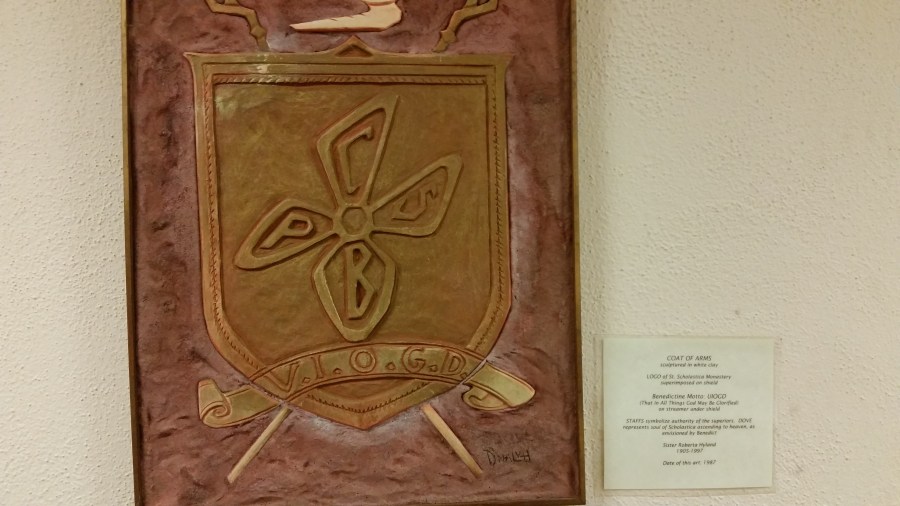
Photo: from my photos taken during the Oblate Conference in Subciaco, Arkansas. This photo is the Coat of Arms/Logo of St. Scholastica Monastery in Arkansas. Macrina made her home there with the Sisters of St. Scholastica.

A Canticle of Living

Most high, all powerful, all good Lord! All praise is Yours, all glory, all honor, and all blessing.

Yesterday I attended the 75th jubilee of my cousin, Sr. Mary Frances Seeley, at the “Motherhouse Chapel” as it is still fondly called although the building has been sold to the University of St. Francis for administrative offices and classrooms. Sr. Mary Frances, along with several other members of her Franciscan Community, the Sisters of St. Francis of Mary Immaculate, including sisters from their community in Brazil, celebrated their jubilees. Combined there was a celebration of 480 years of religious life and another 100+ of Associate commitment (Associates are lay members of the Franciscan community just as I am an Oblate of a Benedictine Community.). I was so happy I attended but it was a day flooded with memories too.

When I was a college student at St. Francis we did not attend Masses or religious services in the “Motherhouse Chapel”, we had a separate chapel in the Tower Building of USF. But I have been in the Motherhouse chapel many times. My aunt, Sr. Evarista, was also a member of this community. Of course we visited the Motherhouse when I was growing up, during those years we weren’t allowed to go in the living areas. Sr. Evarista was the one that invited me to consider the possibility of attending college at St. Francis. She was also the person that ignited my high school interest in psychology and sociology. As I sat in the chapel and reflected on the years of service and faithfulness being honored I reflected on the many hours that Sr. Evarista would have prayed in that chapel or walked those halls. I was overwhelmed with her presence. I visited with Sr. Kathleen, being honored for her 60 year jubilee, who was the campus minister when I attended St. Francis. She counseled and consoled me many times during my years, particularly the early ones when I was trying to figure things out and find my way. She remembered me and looked at me with the same loving, caring eyes that she did over 40 years ago. A college friend, Sr. Jeanne Bessette, is now President of their community. I watched her lead the community on this special day with the same grace, humility and humor that she had as a young college woman.

As I watched, remembered and prayed for these women, I found myself questioning all my life decisions and what would have happened if I responded “yes” to Sr. Carlene’s invitation to join the community. Where would I be now? What work would I have accomplished? Would I feel that my life has had more meaning and purpose?

The reflection, given by Sr. Margaret Hoffman, after the gospel (Amen to that!) shared lovely stories of trusting in God’s providence and handing worries over to God. I am sure the many years of service in various areas have not been without worry and have demanded great confidence that God will provide. They have served in many areas such as teaching, financial and administrative positions, community services, hospital and care for the elderly, and crisis care and suicide prevention (Sr. Mary Frances founded the Upper Room Crisis Center, is working on the publication of a book and has spent many years in leadership training and consulting in crisis management and suicide prevention ).

Sr. Margaret’s message hit me hard. The decisions I have made have led me where I am. There is no point in regret or questioning. “Can any of you by worrying add a single moment to your life-span?” (Matthew 25-27, 33-34) I must say the same as Sr. Margaret in her closing comment, and the theme for their Jubilee Celebration: For all that has been, Thanks. To all that shall be, Yes. (Dag Hammarskjold).

Laudate et benedicete mi Signore et rengratiate e seruiteli cum grande humilitate.

Translated: Praise and bless my Lord, and give thanks, and serve Him with great humility.

Peace, Deena

Opening and Closing Verses from Canticle of the Creatures, by St. Francis.

Image – art by Guistina de Toni I found hanging on the walls of the Motherhouse. I can’t find anything on this artist except to confirm the name. I am on a mission to find out more!