I have seen the cloud of incense, representing our prayers, burn and move in interesting ways around the altar in our church. During the incensation, after exposing the Blessed Sacrament, the incense rises to the great high ceilings, lifting our prayers. Impacted by heat or air conditioning, air coming into the sanctuary from opening doors, etc. it can often create a cloud around the altar and monstrance.
The other night, during Adoration, the incense took on a life of its own, and a symbolism, that was quite moving for me.
The cloud hovered around the altar and the monstrance, creating a thin veil, inviting me to see beyond the physical to the reality of what was present before me. It sanctified the space for the Divine Presence with us. It slowly moved to the ambo, the pulpit, where the Word of God is proclaimed, as if to say, as the apostles heard in today’s Gospel, Listen to him. Then, it turned and drifted to sanctify our presence there. The cloud drifted out toward the pews, at the perfect height of those of us present and kneeling in this sacred space. It moved slowly from the altar, over each of us, as it moved towards the back of the church.
The Jewish Tabernacle, or Mishkan (dwelling place), initially portable, moved to more permanent structures with the building of Jewish synagogues. The scrolls are now housed in the Ark, the Aron Kodesh, while the building itself can be viewed as the Mishkan. In Exodus, the Jewish people were instructed to build an altar of acacia wood in the Mishkan which would create a pleasing altar for the burning of incense. Everything in the Tabernacle, each piece of furniture and the way it was constructed, represented intimacy with God. The altar of incense then represented the prayers of the people rising, in intimacy with and love of God.
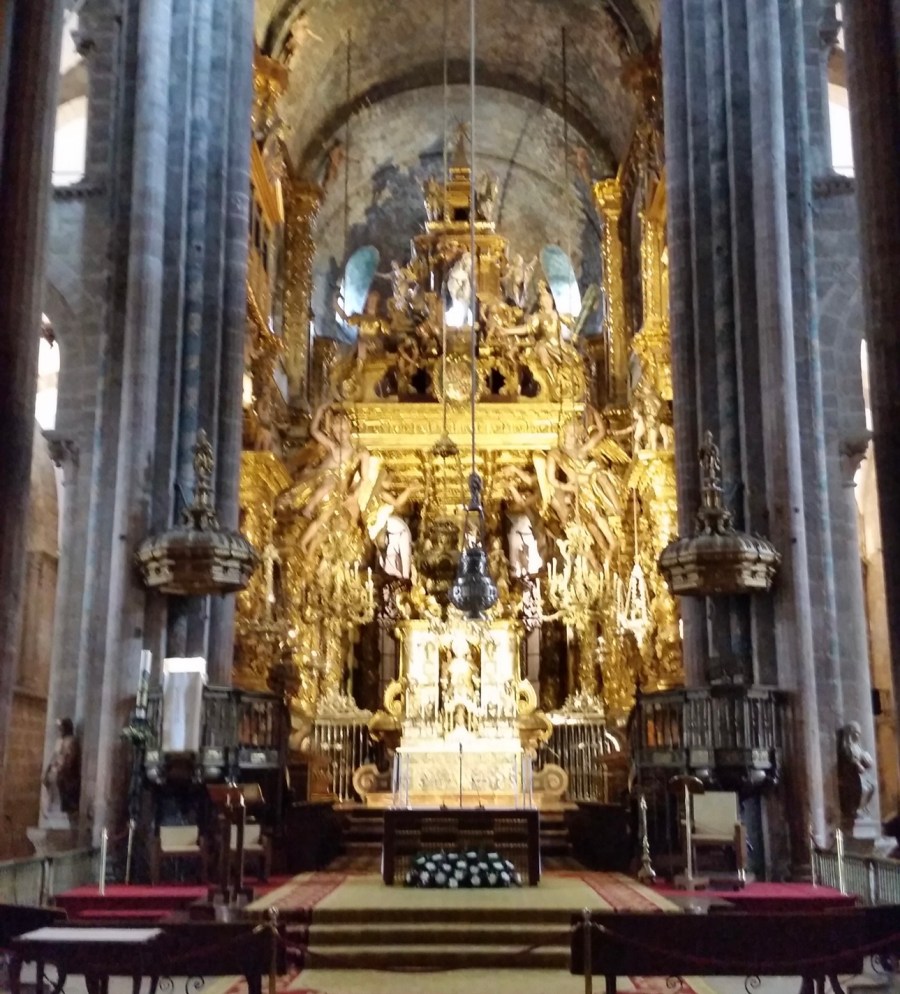
The large thurible, or Botafumeiro, at the Cathedral in Santiago de Compostela was not swung during my visit to Spain but I have seen videos of it during special liturgical feasts. It is swung to purify the air, participants and symbolize the prayers of the people rising to God. If pilgrims happen to arrive to the Cathedral on these special holy days, after walking the Camino, I envision the incense sanctifying their journeys, lifting and receiving all the intimate and personal prayers said during their pilgrimage.
In the book of Revelation we also hear of bowls of incense. The angel was “given much incense to offer with the prayers of all the saints on the golden altar before the throne and the smoke of the incense, with the prayers of the saints, rose before God from the hand of the angel.” It’s a beautiful image to consider the continual burning of incense, representing the prayers of the communion of the saints, small “s”, each person in the eternal presence of God.
As I reflected on the background of incense, and the scriptural references of our prayers like incense, I thought about our Lenten prayers and practices as fragrant and pleasing offerings to God. I pray to become a more pleasing “Mishkan”, a dwelling place, and enter into greater intimacy and union with God.
I pray that your journeys continue to be fruitful and meaningful as we begin this Second Week of Lent. Deena
Image: A picture I took of the great Botafumeiro in the Cathedral in Santiago de Compostela, Spain, visited during my pilgrimage.
 Deena Pavinato - Journeys