Notice what you are noticing

At times during the week a topic for this blog will evolve and begin to take shape. It might be a book, a quote, a class I took, etc. But a thought emerges and I ruminate on it throughout the week. Some Sunday mornings I wake up and ask for inspiration. Then there are days like today, well, weekends really, that I am bombarded with similar ideas from random places. I could journal for weeks on the things that have captured my attention!

One of the books I ordered to read this weekend is Discovering Your Dream by Gerald Fagin, SJ. It’s a little primer on an Ignatian approach to discernment and decision-making. I didn’t have anything specific in mind regarding discernment, just to continue to learn more about the topic. As I mentioned last week, it’s an ongoing process in life. Fagin says “discernment presupposes that life is a mystery to be lived out, not a problem to be solved.” People use the words spirituality, prayer, meditation and discernment so freely today it can be difficult to find things that will be useful or beneficial to personal and spiritual growth. One of the things I have found helpful is the adage to “notice what you are noticing”. God is at work in the people, encounters, situations and dare I say, even the things we read, around us. God is at work, personally, in my heart and in yours, each and every day.

I couldn’t help think about the mystery and unfolding of God in the events of Maria Shriver’s life as I read her Sunday Paper today. She revealed a meditation she had while in Cambodia, regarding birthing a new version of herself, and then a visit to the hospital with her daughter upon their return. While waiting outside, she helped a nurse deliver a baby in the parking lot! She concludes with a suggestion that every day is a chance to begin again or birth a new version of ourselves. She also mentioned that maybe God is trying to get her attention…notice what you are noticing.

Richard Rohr’s Daily Meditation, Evolving Faithfully, today acknowledges that everything is and keeps changing, that God “keeps creating things from the inside out”. He surmises that many people want instant or quick solutions versus a “universal pattern of growth and healing—which always includes loss and renewal. This is the way that life perpetuates itself in ever-new forms: through various changes that can feel like death.” It’s a helpful reflection for me as I look at what is happening in the world, both in the environmental and political landscape, as well as the evolving aspects of my self, the parts that I want to let go of and the parts I want to birth.

As you pay attention to the changing aspects of who you are and who you want to be, pay attention to those who stand in your circle, your “tribe” or supporting cast. In today’s Gospel, Mark 6: 1-6, Jesus is “amazed at the lack of faith” of those around him. He is in his home town and surrounded by people that have watched him heal and work miracles, yet, they question the things he says to them.

I appreciated Diana Butler Bass’ reflection today, Sunday Musings, regarding their unbelief. She suggests that unbelief isn’t an idea about God but a “disposition of the heart”. She says that Jesus was amazed at the lack of trust they had or their inability to have faith, he was alone and perhaps, Diana says, a little heart-broken. But the highlight of the post was: “The truth is that we need others to rise to our fullest abilities; there are certain things that can only be done with the love and trust of those committed to being there with and for us…Faith and trust are necessary for wisdom, to heal what is wounded, to cast out injustice, and to care for all those in need. Ideology will only divide us more deeply. Those idea-tribes are killing us, separating us.”

As we listen to and become more aware of the desires of the heart that emerge in prayer and reflection, we must also acknowledge the parts that are ready to fall away. We look also for the places and people that stand with us and encourage us rather than hold us back. We may not receive support from everyone, but life’s too short for less than this.

Lastly, consider reading my friend, and author, Judith Valente’s blog post today on a “well-lived life”. As all of these thoughts tumble around in my head this week I will continue to ponder the essence of Judith’s theme to keep focusing on things that bring meaning and passion while considering what a well-lived life might actually mean for me. It’s an excellent read, I hope you take the time to consider Judith’s musings and consider what a “life well-lived” might mean for you as well.

Then this week, notice what you are noticing…Deena

Image: The “Devotion” or Giboshi (refers to the finial used on the bridge and posts) Bridge at Anderson Japanese Gardens was recently reopened after a multi-year restoration process of curing and air-drying the Alaskan Yellow Cedar and then constructing the bridge. Our docent advised us that as we crossed the bridge we were invited to leave the dust of the world behind us, inviting us to a time of peace and serenity during our stay in the Gardens.

When the waters are muddy

This week I am going to continue the topic I introduced last week; Who am I in God? What is God calling me to see, to be, to love in my life? Once we start asking the questions and searching for the answers we are bound to encounter the shadow side of who we are.

I am very impatient. That impatience causes frustration, fear and even anger. I want the answers now versus being content with the process of the answers unfolding. I am very sensitive and expect too much of others. Pride sneaks up on me before I can catch it and I am easily let down and disappointed when an idea is taken, I am not acknowledged for what I do, am ignored, or hurtful comments are made. As I do a daily Examen, these same vices keep coming up over and over again. Hopefully none of these are familiar to you!

But God understands says Sr. Joan Chittister. In her book, Illuminated Life, Joan says, “Contemplation is the mirror through which we come to touch the greatness of God, yes, but contemplation is also the filter through which we discern the scope of our smallness and the potential of our greatness at the same time. The contemplative looks for perfection nowhere but in God. The contemplative understands brokenness. And, most of all, the contemplative realizes that it is precisely at the point of personal need that God comes to fill up the emptiness that is us.” As we contemplate our lives and our lives in and with God, we see what and where we are lacking. She continues, “Not to know what we lack is to become our own gods”.

I often share saint quotes or images on my social media pages, or in this blog, because I draw inspiration from them. Certainly because of a desire to be more like the people they were. But also to learn where they came from and the challenges they had to overcome. It is often in acknowledging their shadow and dark sides that they made the choice to change, to learn more about who God was calling them to be.

I participated in another amazing retreat, Stretching of the Heart: A Celtic Mini-Retreat on St. Columba, this weekend with Abbey of the Arts, led by our online abbess and poet/author Christine Valter Painter, musician/songwriter and interspiritual minister Simon de Voil, and poet Kenneth Steven. The prayers, meditations, and poetry were wonderful as always and as expected. What I learned, that I had not been aware of, was that St. Columba, Columcille (his Irish name, Columba is the Latin), was the cause of a war and the death of many in Ireland. Columba kept one of the manuscripts he was illuminating for the Church, refusing to return it. Doing some additional research I have learned that there are various versions of who died, how many died and whether Columba left Ireland for the island of Iona or was banished there. Regardless, a desire to possess the manuscript and unwillingness to obey was a dark side of Columba’s story. But he went on, desiring to be a pilgrim for Christ, to found more monasteries, write over 300 books and is said to have had a main role in the conversion of Scotland to Christianity.

In social media posts in May, Bishop Robert Barron painted a description of this discovery of who we are in God that I have reflected on often since reading it. He compared the “ego-drama” to the “theo-drama”. The ego-drama is “the play that I’m writing, I’m producing, I’m directing, and I’m starring in. We see this absolutely everywhere in our culture. Freedom of choice reigns supreme: I become the person that I choose to be.” The theo-drama is the play God is writing, as we discover who we are in God and what God is calling me to be, we learn our part in the great story. Yes, we still have freedom, freedom to choose who we want to be and who we are in God.

As I continue this exploration of Who am I in God and What is God calling me to see, be and do in my life, don’t be afraid of the resistance to change you might feel, the human imperfections you find and the endless challenge to overcome them. Let’s just continue to shed light on them and keep contemplating the questions.

Out of the mud, a lotus flower emerges without dirt or blemish on the lovely petals it produces. Lotus flowers return to the murky water every evening but open their blossoms each morning with the light of the new day. Just like the lotus flower I am using for my image this week, out of a muddy waters of our lives, the murky waters of those habits and characteristics we are still working to free ourselves of, we can emerge in the light of who we are in God.

Image: A lotus flower print I purchased at a conference almost 30 years ago. It is framed and is one of the first images I see each morning.

Answering the great question

For as long as I can remember I have been interested in self growth, self knowledge, the interior life and helping others consider the same things. In high school I was interested in retail and art design, but psychology was my favorite class. One of our parish priests at the time asked me if I felt I would be helping the world if I pursued my interest in design. Maybe he saw more in me than I did or maybe that question led me to reflect on my interest in psychology. Maybe I allowed myself to be influenced by his opinion. Certainly at the time I did not have the awareness that we can help others and live our life purpose in any job or role we pursue. Regardless I began to consider social work as a field of study and my Aunt, a sister in the congregation of the Franciscans in Joliet, introduced me to the professor of social work at University of St. Francis (College at the time) and so it began.

I ended up with a double major in Psychology and Sociology, began a study of Developmental Psychology and then ultimately got a Masters in Counselor Education from Northern Illinois University. My focus was adult psychology and education and I studied the techniques of Rational Emotive Therapy. My favorite professor challenged me to look at every worry or concern, where the source of my frustration was rooted, which ultimately is our thinking, irrational thoughts, about situations. Lately his voice and teaching have been echoing in my mind again. I worked for a couple of years at a community college close to the University but helping students figure out what English or Math class to register for was galaxies away from my interest in finding purpose and meaning in life. Oh sure, there were the occasional mini classes and conversations but generally it was not fulfilling work and I was eventually enticed by the world of technology, business, travel and making more money.

During travels and especially during my time in Michigan, working for Electronic Data Systems on the General Motors account, I encountered people, teachers, thought systems and new spiritual ideologies that awakened my passion for the interior life. After five years, and a suggestion that if I wanted to move up the corporate ladder with EDS a move to Texas would be something to consider, I moved “home” to Illinois from Michigan. I opened a small business, with a storefront as a means of encountering others. Soon I was invited to teach personal development workshops at the local community college. At the same time I went through a lay ministry program, got more involved with my parish and began the three year formation process to become a Benedictine Oblate, making a promise of fidelity to the monastic life and commitment to be a “monk in the world”.

The interior questions, who am I and what is my place in the world, have been the fundamental and important questions that have been the foundation of each of those changes and decisions in life. I can’t say that I have ever felt that I have truly answered the question or been content with wherever I was in each phase of life. Recently I have noticed that there have been slight changes to the question about purpose that continue to consume my prayer and meditation.

Several quotes or classes have crossed my path this week that have given me reason to pause and ask why they are catching my attention. What am I hearing or what are they asking that tugs at my heart? I will share and explore these more in the coming weeks.

We have all seen the quotes that we are ultimately responsible for our happiness and that we have to control the things we give our time and attention to in our search for happiness. We hear that if we don’t spend time getting to know ourselves and honor what is important to us, then we will only end up listening to the opinions of others and allowing ourselves to be influenced by them. All of that is true but it feels like the focus or the goal is self-centered.

Yesterday, in my Modern Mystics monthly class, we listened to Robert Ellsberg, author and feature writer of Blessed Among Us in the monthly prayer guide, Give Us This Day, as he spoke of his friendship and written correspondence with Sr. Wendy Beckett. Sr. Wendy, fondly named the “art nun”, became well known for her books and her BBC series which was her insightful reflections on art and art history. Sr Wendy was a consecrated hermit and her preference was for her life of solitude at a Carmelite monastery in England. Some of Sr. Wendy’s thoughts that Robert shared deeply moved me. Sr. Wendy believed that we can’t plot every point in our lives, we just need to allow Jesus to come alive in our lives. We need to keep looking at God, be held by the love of God and be carried by that love. She said that we flow from God’s being, a breath he breathes.

Today I read a quote, on Facebook, from John O’Donohue, one of my favorite spiritual writers and poets, that read:

“There are no manuals for the construction of the individual you would like to become. You are the only one who can decide this and take up the lifetime of work that it demands. This is a wonderful privilege and such an exciting adventure. To grow into the person that your deepest longing desires is a great blessing. If you can find a creative harmony between your soul and your life, you will have found something infinitely precious. You may not be able to do much about the great problems of the world or to change the situation you are in, but if you can awaken the eternal beauty and light of your soul, you will bring light wherever you go. The gift of life is given to us for ourselves and also to bring peace, courage, and compassion to others.” Excerpt from Eternal Echoes.

So yes, we are the only ones who decide what life we will lead, but the difference I feel, in a life with true meaning, is that we listen to the connection to soul, we become aware of that breath that breathes us, we ask “who am I in relation to God”, what unique work have I been created to do, and we see that God uses all the situations and relationships in our lives to invite us, to trust and grow closer to God, to deeper union.

I would like to spend the next couple of blogs, or perhaps continue with this topic, exploring the great question, Who am I in God and What is God calling me to be, to see, to love in my life? This is the ultimate question in our search for meaning and happiness. This is the journey we all take.

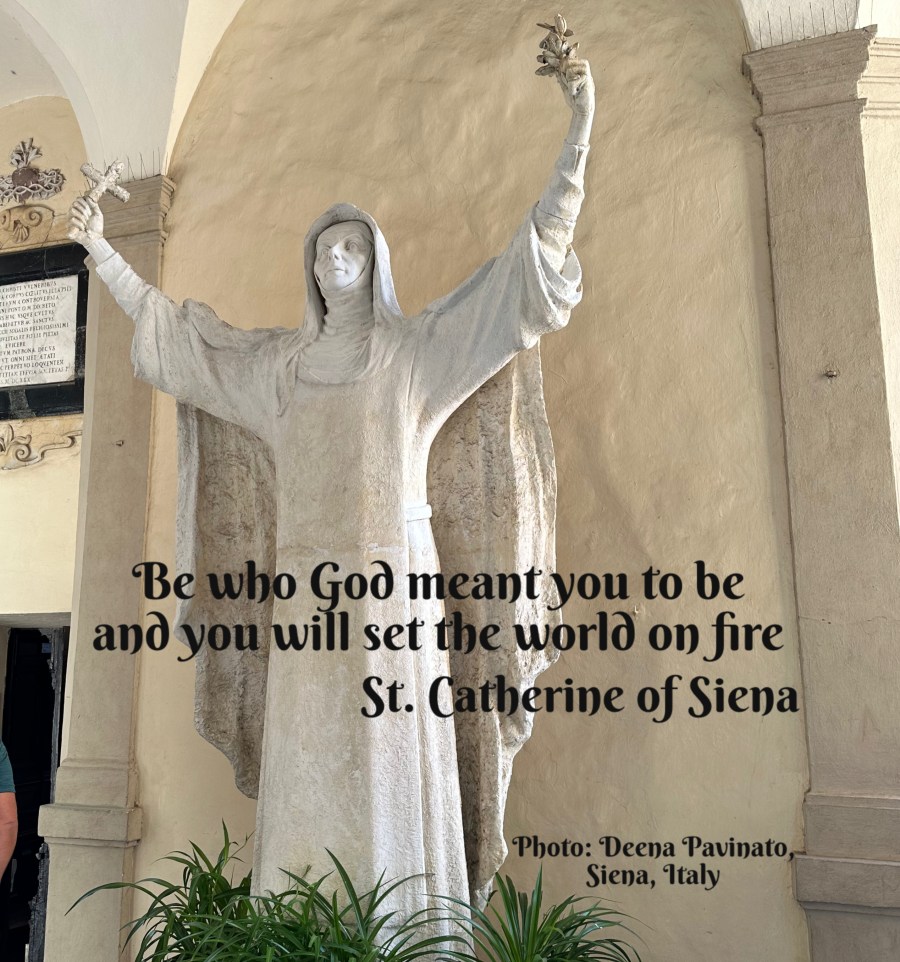
For today I will end with one of my favorite quotes, which I have shared before, by St. Catherine of Siena, Be who God meant you to be and you will set the world on fire.

With deep love and gratitude, Deena

Photo: A status of St. Catherine of Siena, Siena Italy