Notice what you are noticing

At times during the week a topic for this blog will evolve and begin to take shape. It might be a book, a quote, a class I took, etc. But a thought emerges and I ruminate on it throughout the week. Some Sunday mornings I wake up and ask for inspiration. Then there are days like today, well, weekends really, that I am bombarded with similar ideas from random places. I could journal for weeks on the things that have captured my attention!

One of the books I ordered to read this weekend is Discovering Your Dream by Gerald Fagin, SJ. It’s a little primer on an Ignatian approach to discernment and decision-making. I didn’t have anything specific in mind regarding discernment, just to continue to learn more about the topic. As I mentioned last week, it’s an ongoing process in life. Fagin says “discernment presupposes that life is a mystery to be lived out, not a problem to be solved.” People use the words spirituality, prayer, meditation and discernment so freely today it can be difficult to find things that will be useful or beneficial to personal and spiritual growth. One of the things I have found helpful is the adage to “notice what you are noticing”. God is at work in the people, encounters, situations and dare I say, even the things we read, around us. God is at work, personally, in my heart and in yours, each and every day.

I couldn’t help think about the mystery and unfolding of God in the events of Maria Shriver’s life as I read her Sunday Paper today. She revealed a meditation she had while in Cambodia, regarding birthing a new version of herself, and then a visit to the hospital with her daughter upon their return. While waiting outside, she helped a nurse deliver a baby in the parking lot! She concludes with a suggestion that every day is a chance to begin again or birth a new version of ourselves. She also mentioned that maybe God is trying to get her attention…notice what you are noticing.

Richard Rohr’s Daily Meditation, Evolving Faithfully, today acknowledges that everything is and keeps changing, that God “keeps creating things from the inside out”. He surmises that many people want instant or quick solutions versus a “universal pattern of growth and healing—which always includes loss and renewal. This is the way that life perpetuates itself in ever-new forms: through various changes that can feel like death.” It’s a helpful reflection for me as I look at what is happening in the world, both in the environmental and political landscape, as well as the evolving aspects of my self, the parts that I want to let go of and the parts I want to birth.

As you pay attention to the changing aspects of who you are and who you want to be, pay attention to those who stand in your circle, your “tribe” or supporting cast. In today’s Gospel, Mark 6: 1-6, Jesus is “amazed at the lack of faith” of those around him. He is in his home town and surrounded by people that have watched him heal and work miracles, yet, they question the things he says to them.

I appreciated Diana Butler Bass’ reflection today, Sunday Musings, regarding their unbelief. She suggests that unbelief isn’t an idea about God but a “disposition of the heart”. She says that Jesus was amazed at the lack of trust they had or their inability to have faith, he was alone and perhaps, Diana says, a little heart-broken. But the highlight of the post was: “The truth is that we need others to rise to our fullest abilities; there are certain things that can only be done with the love and trust of those committed to being there with and for us…Faith and trust are necessary for wisdom, to heal what is wounded, to cast out injustice, and to care for all those in need. Ideology will only divide us more deeply. Those idea-tribes are killing us, separating us.”

As we listen to and become more aware of the desires of the heart that emerge in prayer and reflection, we must also acknowledge the parts that are ready to fall away. We look also for the places and people that stand with us and encourage us rather than hold us back. We may not receive support from everyone, but life’s too short for less than this.

Lastly, consider reading my friend, and author, Judith Valente’s blog post today on a “well-lived life”. As all of these thoughts tumble around in my head this week I will continue to ponder the essence of Judith’s theme to keep focusing on things that bring meaning and passion while considering what a well-lived life might actually mean for me. It’s an excellent read, I hope you take the time to consider Judith’s musings and consider what a “life well-lived” might mean for you as well.

Then this week, notice what you are noticing…Deena

Image: The “Devotion” or Giboshi (refers to the finial used on the bridge and posts) Bridge at Anderson Japanese Gardens was recently reopened after a multi-year restoration process of curing and air-drying the Alaskan Yellow Cedar and then constructing the bridge. Our docent advised us that as we crossed the bridge we were invited to leave the dust of the world behind us, inviting us to a time of peace and serenity during our stay in the Gardens.

Ever growing desire

My niece’s daughter, Genevieve, is going to be 6 this week. She loves to play, craft and create. She really loves her Legos! Last year she worked on a Cinderella castle for ages 12+. It took her a little while longer than her normal creations but I believe she was done in less than a week. The kits for children her age are done in no time. She began with the smaller combinations of regular pieces, then advanced to the small kits with specific designs and now loves the more challenging ones. She gained one level of skill and then advanced to the next, desiring to learn and do more.

As we bring June to a close today, I would like to talk once more about the topic of Who am I in God? What is God calling me to see, to be, to love in my life? Then I will pause it, at least for a while. A few people commented to me, after reading the past few blogs, that they really hoped I found what I was searching for, that it seemed I was really searching for something in my life. I guess on some level I always have been and will likely continue to be searching for deeper meaning and greater depths of understanding in my life. But it is more like peeling back layers of an onion or going deeper into the middle of a spiral. At Ignatian Ministries, we refer to that as “called deeper together”, to go beyond the shallow waters and into the deep waters of faith.

We don’t get a Catholic education in grade school, or as CCD students, and then stay at that level of understanding all of our lives. At least I hope we don’t. Genevieve would quickly be bored with working on Lego kits at a level for 5 year olds. Go to church or not, I believe it’s an important aspect of faith and community, you will be bored with your faith if you stay at a grade school understanding of it. Growth happens as we look for new ways to understand the Mystery of God and its meaning in our lives.

The practice of Lectio Divina, sacred and prayerful reading of scripture, is part of my Benedictine Oblate practice. Listening to and reflecting on the Living Word of God in scripture each day, and our additional study, whether in books, retreats or more structured study programs, should take us deeper and deeper in our understanding of who God is calling us to be in life. We go deeper into that spiral, finding new meaning, based on the desires of our heart and the circumstances in our lives.

I love the First Principle and Foundation of Ignatian Spirituality, to live with God forever, but the depth of the spirituality comes in daily prayer, daily examen and discernment. It is an ongoing process. God loves each of us, uniquely and passionately, where we are in our state in life. It doesn’t matter if someone else is further along or has a greater depth of understanding. We are where we are, with all of our desires and situations, and God wants to meet us there.

Go ahead, touch the tassel of Jesus’ garment today, (today’s Gospel reading is Mark 5: 21-43) let him turn to you and talk to you. Have a conversation regarding who you are and what you are called to be and to see, right now, today. Keep having those conversations, they will change over time, as you do!

Wishing you overflowing peace today, Deena

Image: Sen on Unsplash

A discerning spirit

On Friday I was chatting with Becky, the founder of Ignatian Ministries, the non-profit Ignatian virtual ministry that I work for. I shared with her a decision that I am holding and how I have been wavering as I decide the right thing to do. She reminded me to use the four steps of discernment, as we do with everything we do in our ministry. Ignatian discernment is not decision making from a strictly rational or practical perspective. It is noticing the movements of our heart and soul. All of who we are, our thoughts, feelings and emotions, are part of what we notice and bring to awareness as we use those insights to decide where God is leading us. Sometimes it is quick but often it will take time to really listen and notice how we feel as we consider the options we have in front of us.

As I continue to consider Who am I in God? What is God calling me to see, to be, to love in my life? in my personal life and in this blog for the past four weeks, discernment must play an important part in answering those questions. I thought about that as I read Maria Shriver’s Sunday Paper this morning. She asked poignant questions after reading the final words of someone who had died, preparing those words before her passing, and after a trip to Asia to see one of her children working in Thailand. Maria asked: “What does it take to love the life we’ve been given? What does it take to be joyful, to feel we have enough, or even to feel like we won the lottery?” My personal answers to those questions have been becoming more clear lately but I acknowledge it is a process and I know that there is something that I need to do, in the near future, that will continue to bring clarity to my answers. What I do know, at this point, is that those answers lie in knowing our purpose in life.

I also believe that finding the answers, at least long term and deeply fulfilling answers, come from where we turn for them. Oh sure, people can find answers in living day to day and acquiring all the relationships and things in the world that they want but all you have to do is look at the current state of things in our world to know those don’t bring deep satisfaction.

Doing some research for a workshop I am helping to teach tomorrow night, John Hopkins reported, in their Mental Health Statistics (2024), that 18% of people ages 18-54 will have an anxiety disorder, 9.5% of American Adults ages 18 or over will suffer an illness labeled as depression (not just having a bad day, another study indicated that it means feeling depressed each day for two weeks or more) and 26% percent of Americans will be diagnosed with a mental health disorder every year. Those numbers are staggering to me! I think it gives us some indication that as Americans something is missing in our lives.

As I listened to two different reflections this weekend on today’s Gospel reading of Jesus calming the storm at sea (Fr. Carlson, my pastor at Holy Family Parish, and you know my other favorite, Bishop Barron!) both indicated each in their own way, Jesus is waiting for us to rouse him to help as we navigate the decisions and storms in life. If we continue to let Jesus sleep in the boat, if we attempt to go it alone, then we cannot expect the tranquility that the Christ can bring to our lives. In prayer and with prayer, I can invite Christ into the inner cave of the heart where I know and can find the answers and peace that I desire in life.

Are there storms you are navigating? Are there questions you are holding and just can’t seem to decide what to do? Do you have peace with your purpose and place in life? If not, maybe finding a new way to approach the answers, turning to prayer and discernment, just might be an option to try.

To learn more about Ignatian Spirituality, discernment and prayer follow our blog, Into the Deep, which I post weekly and also write for, as well as our upcoming retreats and courses. You can also read more about using discernment in your life by accessing the free prayer resource, The Four Steps of Discernment written by Becky Eldredge.

Photo: seaside port of Cascais, Portugal taken during my 2015 pilgrimage to Spain and Portugal

A day to be

This is the third blog in the series that began unfolding a couple of weeks ago, Who am I in God? What is God calling me to see, to be, to love in my life? Today in that quest to discover and learn more about the topic I have been reminded to pause, rest and listen.

I don’t work, clean or shop on Sundays, it’s a day to pray, write, read, reflect and rest. But there are times that I even get a bit ambitious about these more laid back goals!

The heat index is going to be at a new high today for this year so far. These temps feel early for June, but then again weather hasn’t felt typical the last 2 or 3 years. It was in the 70’s already at 6:30 a.m. I felt the warmth of the breeze coming in the patio door, and the humidity starting to increase, so I thought I better water all the plants and do some trimming before the heat became excessive. But before that, I reminded myself to run downstairs to gather up some clothes drying after yesterday’s laundry. Moving too fast, I felt my knee give and a shooting pain. I hobbled down and then back up the steps, rested a bit, and then watered outdoors, frustrated that my day was going to be impacted by the pain in my knee and leg. Muscle spasms in my leg and knee pain have been a struggle since January, some days better than others. It frustrates me to be slowed down but as I have heard multiple times, if we don’t slow down and listen to our bodies, our bodies will do that for us.

So, today will be my day to slow down and rest. I am not being a willing participant in this plan, because I had a different topic in mind to write about today, another art journal reflection that I want to spend time on, and slides for a class later this month on essential oils and productivity to prepare today (Yes, the irony is not lost on me today)! The muscle relaxer that is calling my name will likely impact some of that, at least for a couple of hours, they really impact my ability to focus.

Yesterday I started a new nine day reflection series on “revival”. After the prayer and reflection, the challenge was to sit and listen, to pause for 15 minutes asking the Holy Spirit to help us see where we need and desire revival. I wasn’t in “pause” mode at that time of the day that I read it but it was the best time to respond to the challenge. Several times my mind wandered and I had to pull it back in and just “listen”. Perhaps today is my repeat lesson for not giving it the proper attention yesterday!

In talking about the midmorning pause, “the blessing hour”, Macrina Wiederkehr, in her book Seven Sacred Pauses, says that in the midst of the possibilities of a new day, we need to try to be aware of the Spirit’s abiding presence. To pause as the day is just getting started and we begin to feel productive, Macrina says, takes great trust. “When you spirit mingles with Spirit, you are transformed into a temple of God. The house of God that you are…need frequent renewal. It needs affirmation and blessing. Go deep into your temple. This is your real work place. Dwell there in silence….”

So on this holy day, Sunday, I pause to rest, my spirit and my knee, giving them both the time and attention they need.

Are you in need of a sacred pause today?

Wishing you love and peace, Deena

Photo: On a lighter note, I was reminded of my visit to Florence this Fall. It was hot and everyone took the noon break to shop or visit other spots not on the tour guide’s schedule, I opted to enjoy a refreshing aperitif in the piazza watching all the people, sights and sounds.

When the waters are muddy

This week I am going to continue the topic I introduced last week; Who am I in God? What is God calling me to see, to be, to love in my life? Once we start asking the questions and searching for the answers we are bound to encounter the shadow side of who we are.

I am very impatient. That impatience causes frustration, fear and even anger. I want the answers now versus being content with the process of the answers unfolding. I am very sensitive and expect too much of others. Pride sneaks up on me before I can catch it and I am easily let down and disappointed when an idea is taken, I am not acknowledged for what I do, am ignored, or hurtful comments are made. As I do a daily Examen, these same vices keep coming up over and over again. Hopefully none of these are familiar to you!

But God understands says Sr. Joan Chittister. In her book, Illuminated Life, Joan says, “Contemplation is the mirror through which we come to touch the greatness of God, yes, but contemplation is also the filter through which we discern the scope of our smallness and the potential of our greatness at the same time. The contemplative looks for perfection nowhere but in God. The contemplative understands brokenness. And, most of all, the contemplative realizes that it is precisely at the point of personal need that God comes to fill up the emptiness that is us.” As we contemplate our lives and our lives in and with God, we see what and where we are lacking. She continues, “Not to know what we lack is to become our own gods”.

I often share saint quotes or images on my social media pages, or in this blog, because I draw inspiration from them. Certainly because of a desire to be more like the people they were. But also to learn where they came from and the challenges they had to overcome. It is often in acknowledging their shadow and dark sides that they made the choice to change, to learn more about who God was calling them to be.

I participated in another amazing retreat, Stretching of the Heart: A Celtic Mini-Retreat on St. Columba, this weekend with Abbey of the Arts, led by our online abbess and poet/author Christine Valter Painter, musician/songwriter and interspiritual minister Simon de Voil, and poet Kenneth Steven. The prayers, meditations, and poetry were wonderful as always and as expected. What I learned, that I had not been aware of, was that St. Columba, Columcille (his Irish name, Columba is the Latin), was the cause of a war and the death of many in Ireland. Columba kept one of the manuscripts he was illuminating for the Church, refusing to return it. Doing some additional research I have learned that there are various versions of who died, how many died and whether Columba left Ireland for the island of Iona or was banished there. Regardless, a desire to possess the manuscript and unwillingness to obey was a dark side of Columba’s story. But he went on, desiring to be a pilgrim for Christ, to found more monasteries, write over 300 books and is said to have had a main role in the conversion of Scotland to Christianity.

In social media posts in May, Bishop Robert Barron painted a description of this discovery of who we are in God that I have reflected on often since reading it. He compared the “ego-drama” to the “theo-drama”. The ego-drama is “the play that I’m writing, I’m producing, I’m directing, and I’m starring in. We see this absolutely everywhere in our culture. Freedom of choice reigns supreme: I become the person that I choose to be.” The theo-drama is the play God is writing, as we discover who we are in God and what God is calling me to be, we learn our part in the great story. Yes, we still have freedom, freedom to choose who we want to be and who we are in God.

As I continue this exploration of Who am I in God and What is God calling me to see, be and do in my life, don’t be afraid of the resistance to change you might feel, the human imperfections you find and the endless challenge to overcome them. Let’s just continue to shed light on them and keep contemplating the questions.

Out of the mud, a lotus flower emerges without dirt or blemish on the lovely petals it produces. Lotus flowers return to the murky water every evening but open their blossoms each morning with the light of the new day. Just like the lotus flower I am using for my image this week, out of a muddy waters of our lives, the murky waters of those habits and characteristics we are still working to free ourselves of, we can emerge in the light of who we are in God.

Image: A lotus flower print I purchased at a conference almost 30 years ago. It is framed and is one of the first images I see each morning.

Answering the great question

For as long as I can remember I have been interested in self growth, self knowledge, the interior life and helping others consider the same things. In high school I was interested in retail and art design, but psychology was my favorite class. One of our parish priests at the time asked me if I felt I would be helping the world if I pursued my interest in design. Maybe he saw more in me than I did or maybe that question led me to reflect on my interest in psychology. Maybe I allowed myself to be influenced by his opinion. Certainly at the time I did not have the awareness that we can help others and live our life purpose in any job or role we pursue. Regardless I began to consider social work as a field of study and my Aunt, a sister in the congregation of the Franciscans in Joliet, introduced me to the professor of social work at University of St. Francis (College at the time) and so it began.

I ended up with a double major in Psychology and Sociology, began a study of Developmental Psychology and then ultimately got a Masters in Counselor Education from Northern Illinois University. My focus was adult psychology and education and I studied the techniques of Rational Emotive Therapy. My favorite professor challenged me to look at every worry or concern, where the source of my frustration was rooted, which ultimately is our thinking, irrational thoughts, about situations. Lately his voice and teaching have been echoing in my mind again. I worked for a couple of years at a community college close to the University but helping students figure out what English or Math class to register for was galaxies away from my interest in finding purpose and meaning in life. Oh sure, there were the occasional mini classes and conversations but generally it was not fulfilling work and I was eventually enticed by the world of technology, business, travel and making more money.

During travels and especially during my time in Michigan, working for Electronic Data Systems on the General Motors account, I encountered people, teachers, thought systems and new spiritual ideologies that awakened my passion for the interior life. After five years, and a suggestion that if I wanted to move up the corporate ladder with EDS a move to Texas would be something to consider, I moved “home” to Illinois from Michigan. I opened a small business, with a storefront as a means of encountering others. Soon I was invited to teach personal development workshops at the local community college. At the same time I went through a lay ministry program, got more involved with my parish and began the three year formation process to become a Benedictine Oblate, making a promise of fidelity to the monastic life and commitment to be a “monk in the world”.

The interior questions, who am I and what is my place in the world, have been the fundamental and important questions that have been the foundation of each of those changes and decisions in life. I can’t say that I have ever felt that I have truly answered the question or been content with wherever I was in each phase of life. Recently I have noticed that there have been slight changes to the question about purpose that continue to consume my prayer and meditation.

Several quotes or classes have crossed my path this week that have given me reason to pause and ask why they are catching my attention. What am I hearing or what are they asking that tugs at my heart? I will share and explore these more in the coming weeks.

We have all seen the quotes that we are ultimately responsible for our happiness and that we have to control the things we give our time and attention to in our search for happiness. We hear that if we don’t spend time getting to know ourselves and honor what is important to us, then we will only end up listening to the opinions of others and allowing ourselves to be influenced by them. All of that is true but it feels like the focus or the goal is self-centered.

Yesterday, in my Modern Mystics monthly class, we listened to Robert Ellsberg, author and feature writer of Blessed Among Us in the monthly prayer guide, Give Us This Day, as he spoke of his friendship and written correspondence with Sr. Wendy Beckett. Sr. Wendy, fondly named the “art nun”, became well known for her books and her BBC series which was her insightful reflections on art and art history. Sr Wendy was a consecrated hermit and her preference was for her life of solitude at a Carmelite monastery in England. Some of Sr. Wendy’s thoughts that Robert shared deeply moved me. Sr. Wendy believed that we can’t plot every point in our lives, we just need to allow Jesus to come alive in our lives. We need to keep looking at God, be held by the love of God and be carried by that love. She said that we flow from God’s being, a breath he breathes.

Today I read a quote, on Facebook, from John O’Donohue, one of my favorite spiritual writers and poets, that read:

“There are no manuals for the construction of the individual you would like to become. You are the only one who can decide this and take up the lifetime of work that it demands. This is a wonderful privilege and such an exciting adventure. To grow into the person that your deepest longing desires is a great blessing. If you can find a creative harmony between your soul and your life, you will have found something infinitely precious. You may not be able to do much about the great problems of the world or to change the situation you are in, but if you can awaken the eternal beauty and light of your soul, you will bring light wherever you go. The gift of life is given to us for ourselves and also to bring peace, courage, and compassion to others.” Excerpt from Eternal Echoes.

So yes, we are the only ones who decide what life we will lead, but the difference I feel, in a life with true meaning, is that we listen to the connection to soul, we become aware of that breath that breathes us, we ask “who am I in relation to God”, what unique work have I been created to do, and we see that God uses all the situations and relationships in our lives to invite us, to trust and grow closer to God, to deeper union.

I would like to spend the next couple of blogs, or perhaps continue with this topic, exploring the great question, Who am I in God and What is God calling me to be, to see, to love in my life? This is the ultimate question in our search for meaning and happiness. This is the journey we all take.

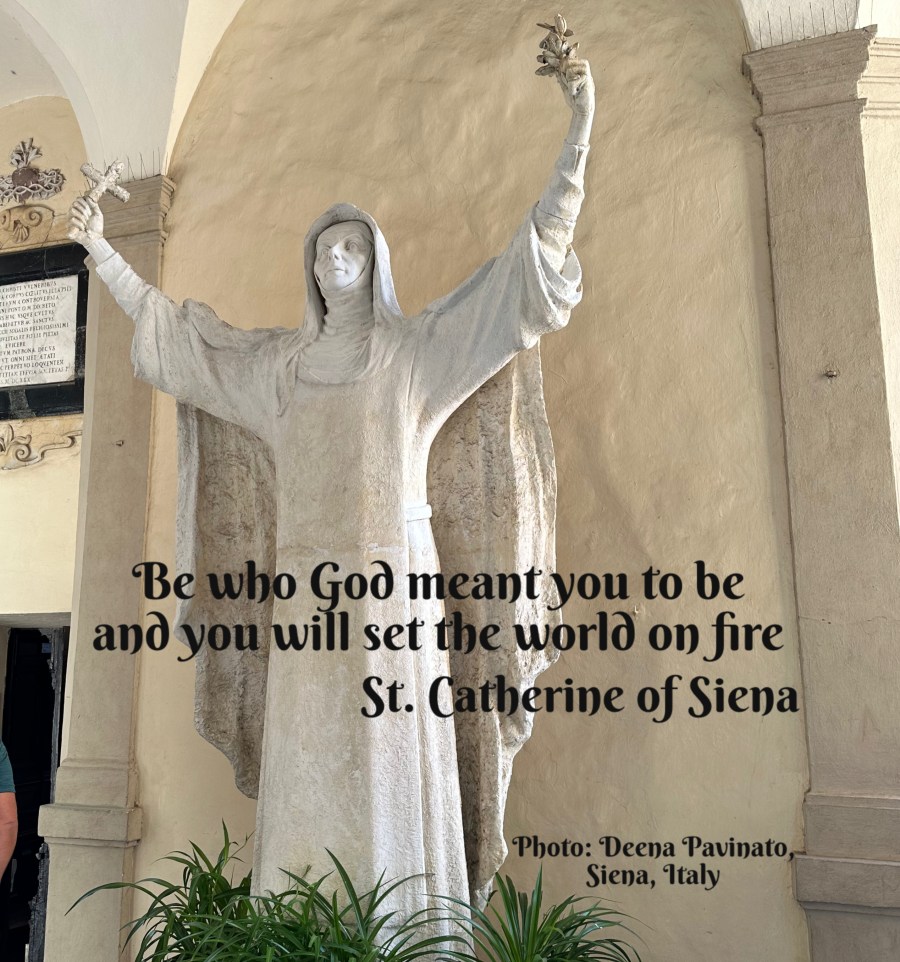
For today I will end with one of my favorite quotes, which I have shared before, by St. Catherine of Siena, Be who God meant you to be and you will set the world on fire.

With deep love and gratitude, Deena

Photo: A status of St. Catherine of Siena, Siena Italy

A journey with wild geese

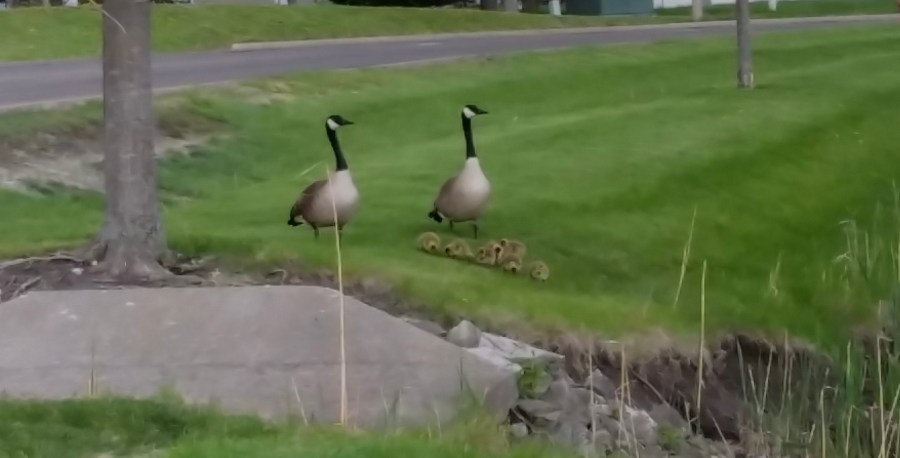
Two of my favorite signs of Spring and a new season of growth are the little baby corn sprouts as they begin to emerge in the fields and the two geese and their goslings that appear every year by the retention pond and grass near a local grocery store. Both just make my heart sing; winter is over and Spring is on the way!

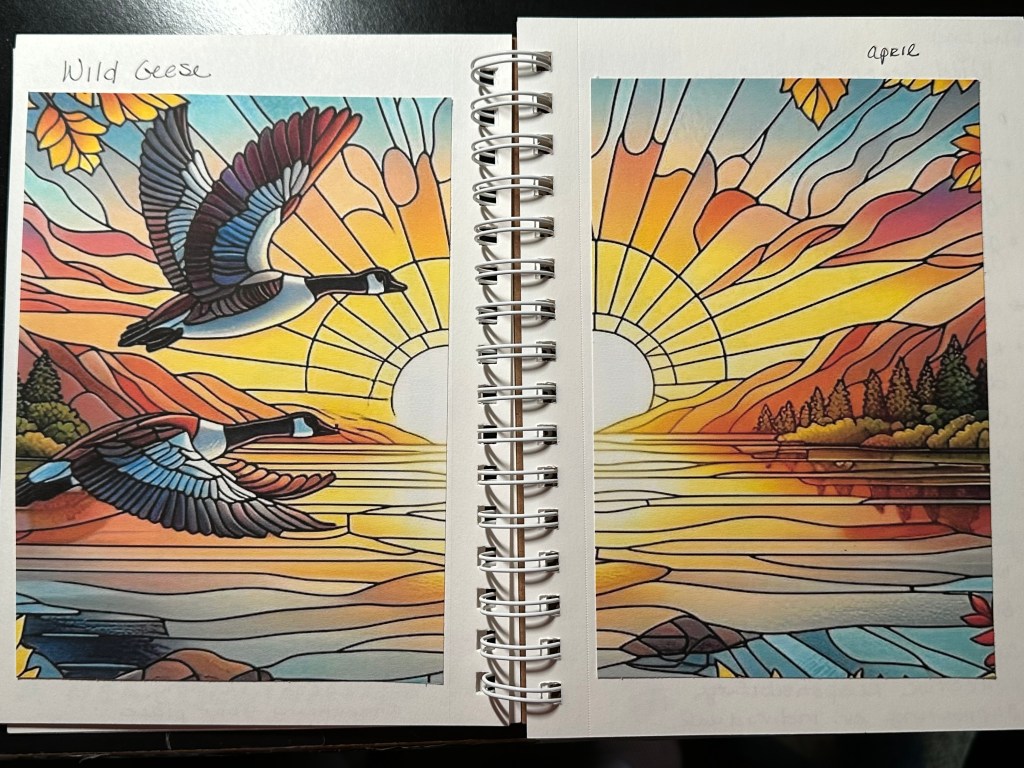
In April, our assignment for the monthly visual journal class I am taking, was to determine an animal we wished to draw and research symbolism for the animal. Geese quickly came to mind because I had been checking the pond with each trip to the grocery store, anxiously awaiting the arrival of this year’s family. I researched symbolism for geese and found it quite interesting. Geese represent family, teamwork, loyalty. They are resilient, adaptable, and are determined to weather life’s changes with grace. As a totem they might represent that it may be time to take flight and begin a new journey. Birds in general represent messengers, in Native American and many spiritualities, or that there is a message to pay attention to or watch for. In Christian spirituality they represent Spirit. I learned this week, in a blog I will mention in a bit, that in Celtic Spirituality the goose, rather than a dove, represents the Holy Spirit. In this form, the goose is loud and demands our attention.

Part of my decision was also influenced by one of my favorite poems by Mary Oliver, Wild Geese. especially with the lines as the poem ends, “the world offers itself to your imagination, calls to you like the wild geese, harsh and exciting – over and over announcing your place in the family of things.” (Written and published in 1986 in her book Dream Work). So with the decision made I found an image to model and prepared for our workshop. The intention for the class was to practice drawing images and then in the “journal” page let our hearts, and creative tools like pens or watercolors, express what the animal is saying to us. I have included, below in this post, the image I selected on Facebook, from a Mary Oliver poetry group, to model and my initial pencil drawings. The journal page is a work in progress.

In May some additional things happened that remind me that the wild geese are still calling for my attention. Last week, on Pentecost Sunday, I attended a virtual retreat by my friend Judith Valente titled “The Spirituality of the Poetry of Mary Oliver”. It was my second time attending this presentation by Judy but there were new insights and treasures as I expected. It was a delight to listen to Mary Oliver read her poem, Wild Geese, in one of the video clips Judy shared. In Oliver’s poetry, Judith reminded us there is a similarity to monastic practice and a consistent theme to be reverently being aware, to pay attention and to be astonished. In all her work, Judith said, there is a wake up call to reflect on who or what is calling us to live joyfully.

Then this week I received the monthly email from Mary DeTurris Poust, with the blog title “Welcoming the Wild Goose”. Mary shared a recent experience giving a retreat in Maryland in which she felt like she was living inside the Mary Oliver poem I mentioned above, “in which the ‘world calls to you like the wild geese — harsh and exciting.'” The honking and distraction of the geese during the entire retreat offered, to Mary, an analogy of Spirit in our lives. She said we often wait for the quiet whisper of Spirit and don’t want the incessant, unrelenting and loud voice of the Holy Spirit calling us to something new. Reflecting on Pentecost, Mary DeTurris Poust asked: “How often do we do just that, push away the loud and insistent call of the Holy Spirit because we don’t like the message or the delivery?” Can we be open to Spirit no matter how we are called? Can we listen and respond even if the message might be asking us to consider something new in our lives? Both Judith’s retreat and Mary’s blog provide additional considerations for my journal page. I begin this journey of bringing May to a close with great questions to ponder regarding how the Spirit might be calling me this summer and beyond.

How do you hear Spirit calling out to you and inviting you to something more?

It doesn’t take long for the corn in the fields around me to establish itself and emerge as long lanky stalks or the goslings to lose their baby cuteness and look more like their “mom and dad”. My spirit loses a bit joy of watching the transition of both as Spring dwindles and Summer begins. While I found the symbolism of the wild geese interesting, I also found it quite telling for this phase I seem to be going through with an intense calling to be seeking something more and find my place in the world. Rather than lose the internal fire for new growth, when life seems to be stagnant or difficult, I can try to be more aware and look for reminders to live life more joyfully.

So, this Memorial Day weekend, the unofficial start of summer, I am grateful to Judith Valente, Mary DeTurris Poust, Mary Oliver and the Wild Geese reminders in my life, to let myself “love what it loves” and continue to look for my place in the “family of things”.

Blog Photo: The geese and their gosling family a couple of years ago

Additional photos below from my Visual Journal pages:

A spirit of love

Love is one of the fruits of the Holy Spirit. On this Pentecost Day my prayer is that I open my heart to hold more love, joy, patience… all of the beautiful gifts of the Spirit (Read Galatians 5:16-25 one of the optional readings for Pentecost Sunday). It’s been a week that has challenged those fruits in me. I have thought about what I wanted to write all week but I wanted it to be written in a spirit of love, real love, which is “willing the good of the other”.

I read the reflection in Give Us This Day for today’s Solemnity written by Carolyn Woo, CEO/Catholic Relief Services and dean of the Mendoza College of Business at the University of Notre Dame and was especially moved by these three sentences regarding the apostles experience of Pentecost: “Their proclamation enveloped all in a spirit of love, belonging and oneness. What the people heard and understood was not just some breaking news of the day, a good chat, or rules for success. What they heard was the ‘mighty acts of God’-magnificent creation that included themselves, covenant love that is never broken, forgiveness, redemption, and ultimately reunion with God.”

So why have I been wrestling with my thoughts for today? I am having a difficult time because I want to respond to a limited view of Catholicism shared this week in a commencement address by Harrison Butker at Benedictine College and then debated widely in the news and in social media. I have seen more dissension and vitriol in social media than I can tolerate (and we still have an election coming up this November, I might have to fast from social media!). Initially I found myself responding with disdain rather than wanting to understand all that was included in the address. Once I stepped back, read the address, taking in all the reactions, positive and negative, I pondered when and how it got this bad, that every statement someone makes requires a personal rebuttal, nasty comment, sarcastic meme or hateful statement. Then gospel readings of vocal outbursts between the righteous Pharisees and Saducees came to mind. So maybe the reactions have always been there but are just more noticeable in the constant news and social media frenzy we live with.

I do not object to any person’s freedom of speech and opinion. I did wonder if the college that invited the speaker didn’t have a hidden agenda and expect the attention and backlash that it would cause. I was shocked, however, when the Benedictine Sisters of Mount St. Scholastica, in their response, as the founding institution and a sponsor of the College, received so many argumentative comments to their letter. I find it interesting that people who say they are open to discussion and debate hurl condescending responses when the opinion is different than their own. Is it no longer possible to disagree and turn away?

I am thankful for the many articles written in support of the Benedictine and Christian values that I believe in. I stand in complete solidarity with the Benedictine Sisters of Mount St. Scholastica and their statement that they are “faithful members of the Catholic Church who embrace and promote the values of the Gospel, St. Benedict, and Vatican II and the teachings of Pope Francis.”

I also listened to Bishop Barron’s Sunday Sermon on YouTube this morning regarding this solemn Feast we celebrate today. Bishop Barron contemplated each of the fruits of the Holy Spirit outlined in the Galatians reading. I would highly recommend listening to it. But one comment stands out, “Love stands at the center of the Church’s life, because that’s what the Holy Spirit is.” In speaking of the fruits of the Spirit, Bishop Barron suggests to pay attention to those things in life, vocations and activities, that give rise to the fruits, and stay close to those. If they don’t, if they bring up the opposite of those, stay away.

In no way am I saying that I take Bishop’s sermon as a validation of my feelings or the “truth” regarding my reaction to the commencement address or the response by the Benedictine Sisters. That answer is for people wiser than me. What I do hear, for me, in a spirit of discernment, is to stay away from the dissension, draw close to things that bring about more love, more joy, more patience. Going back to Carolyn Woo’s quote, look for opinions that are expressed in a “spirit of love, belonging, and oneness.” That, my friends, feels like the truth of the Gospel message that we should seek and ask the Holy Spirit to bless us with.

Lastly I offer most of the Blessing for Pentecost written and shared by poet and author Jan Richardson yesterday on her Facebook page. I highly recommend you read the blessing in its entirety.

Here’s one thing

you must understand

about this blessing:

it is not

for you alone.

It is stubborn

about this.

Do not even try

to lay hold of it

if you are by yourself,

thinking you can carry it

on your own.

To bear this blessing,

you must first take yourself

to a place where everyone

does not look like you

or think like you,

a place where they do not

believe precisely as you believe,

where their thoughts

and ideas and gestures

are not exact echoes

of your own.

Bring your sorrow.

Bring your grief.

Bring your fear.

Bring your weariness,

your pain,

your disgust at how broken

the world is,

how fractured,

how fragmented

by its fighting,

its wars,

its hungers,

its penchant for power,

its ceaseless repetition

of the history it refuses

to rise above.

I will not tell you

this blessing will fix all that.

But in the place

where you have gathered,

wait.

Watch.

Listen.

Lay aside your inability

to be surprised,

your resistance to what you

do not understand…

Again from Galatians; “If we live in the Spirit, let us also follow the Spirit.”

I wish you abundant peace this week. Deena

Image: A photo from my pilgrimage to Italy. Bernini’s stained glass window “The Dove of the Holy Spirit”.

A call to pause

As I prepared to write this, reviewing my notes and ideas, the bells rang calling those attending 10 a.m. Mass to hurry along and, then again, to mark the top of the hour. I hear the bells every day, from my parish church at the end of the block that I live on, but especially now with more windows open and time spent outside attending to my plants. They remind me of the bells at the monastery. They remind me of a call to pause and say a prayer. They remind me of some words of Sr. Joan Chittister in her book, The Monastic Heart, that were also used as part of a reflection a couple of weeks ago in our weekly email update from Sr. Joan.

Joan said, “The purpose of Benedictine bells is not to spell out the hour of the day at all; that task is left to horologists. Our bells, on the other hand, are there to wrench our attention back to what is really important in life: the memory of God in our midst. The memory of the purpose of life. The memory that time is moving on and so must we. The recognition that life today is different than yesterday, and we must not try to hold life back. The bells jog the memory that there are actually more important, more meaningful, more demanding dimensions of life than anything ordinary we can possibly be doing as they ring. The bells stop us in midflight to prod us to ask ourselves again if what we are doing is what we are really meant to be doing.”

It’s true that the bells also call us to remember the great concerns of life, such as caring for the poor and people in need, or comforting the sick or grieving. We must ask whether we aware of the concerns of our brothers and sisters in areas of the world ravaged by war, weather or persecution? But they also cause me to pause and look at what I am doing in the moment, is it important? Does it matter? Am I living my vocation in life?

This week I had several opportunities to pause and slow down, to look at my self-care, nurturing or self-compassion. My friend Kate Brown taught a workshop, “Nurture and Grow: Cultivating Self-Compassion in a Turbulent World.” We considered ways to be more compassionate to ourselves and that in doing so we build a reservoir to compassion to give to others. We discussed being more mindful vs mind full and the importance of finding a community of like-minded individuals that will support and encourage us and then we in turn for each other. We also discussed embracing our imperfections and the importance of accepting ourselves, where and who we are at this moment.

Speaking of imperfections, yesterday was my monthly creative journaling workshop and our topic was “Resistance, Joy and Self-Compassion.” Resistance and judgement in our creative endeavors is definitely the thief of joy! We experimented with drawing ovals, faces and a drawing ourselves from a selfie taken during class. Lisa encouraged us to break resistance by doing a little bit of creative art or journaling every day, to make little promises to ourselves to commit to our creativity. But it can be so hard to find and set aside the time for our own self-nurturing. Am I willing to commit to doing so?

Church, convent and monastery bells have provided this reminder to pause to countless men and women throughout the centuries. For some reason, the bells were a soothing reminder this morning of all of the women who have guided me throughout my life. When I remember my mother on this Mother’s Day, I remember a woman who worked harder than anyone I have ever met. I don’t know what she thought about self-nurturing or self-compassion, we never talked about it, at least not in those words. But I do know while she always gave of herself to others, she also knew how to relax and enjoy herself when the work was done, whether it was Saturday night dinners out with my father, their annual fishing trips to Minnesota or backyard gatherings with friends. I remember my “Noni” (Italian grandmother) and times spent with her, usually in the kitchen or the garden. I recall my aunt, a Franciscan sister, who encouraged me in ways that I didn’t realize fully at the time. The Benedictine sisters who invited me to learn more about the monastic life and community remain important witnesses to me of a life of purpose.

Pause for a few minutes today and consider the women who have influenced you in your life, whether mothers, grandmothers or nurturing women and role-models. Did they offer (or perhaps they are still alive and continue to offer) examples of self-care and compassion? Who does offer that reminder to you? Would you be willing, if you don’t regularly, to take a few minutes each day to find ways to embrace who you are and what you feel you need to live a life that supports your purpose and vision in life? Why not start now!

Wishing you abundant peace and compassion, Deena

Picture: of the bell tower at St. Mary Monastery in Rock Island, Illinois. I am an Oblate of this monastery.

Springing to life

It’s been a glorious week in Illinois, even with the times of rain, wind and storm. It is feeling like Spring, maybe even late Spring with the warm 70-80 temperatures during the day this week. Everything is growing and lush around my home. The lilacs are close to full bloom, I actually prefer the deep purple they are now. My hostas and perennials are gorgeous. It’s time to start thinking and planning the annuals I will put in pots by the doors and on the patio. I purchased my favorite plant of each year, Ruellia brittoniana (Purple showers or Mexican petunias) which I hope to get in pots today. The fresh air and beautiful blossoming that is springing to life around me reminded me of special days and women that I reflected on this past week.

Last Monday was the Feast of St. Catherine of Siena, Italian mystic, lay Dominican and Doctor of the Church (one of four women Doctors of the Catholic Church). The image I included for this week is a sculpture in Siena that I saw while on pilgrimage. I love it and another statue of St. Catherine we saw because they show her passion and fierce spirit. Most paintings depict Catherine as pale and sickly. It is true she practiced excessive “holy fasting” with a diet that consisted of only water and vegetables and was considered anorexic (anorexic mirabilis or holy anorexic). But Catherine had a strong and bold spirit, bringing about unity of the papacy and convincing the pope to return to Rome after almost a century in France. My favorite quote of St. Catherine, that reflects her passion for following what she believed in is “Be who God meant you to be and you will set the world on fire.” Catherine did this and lived her life with her eyes on God and with Heaven as the goal of her life.

Wednesday was May 1st, May Day or Beltane, one of the cross-quarter days of the Celtic Year. May Day symbolizes Spring to me, regardless of the weather. The sweet images of children bringing May Day baskets of flowers to neighbors symbolizes, to me, our coming outdoors from winter and sharing that joy with our neighbors and friends. May Day also reminds me of St. Hildegard of Bingen. Hildegard, another Doctor of the Church, was a medieval mystic, visionary, writer, herbalist, composer and artist. Hildegard was well-aware of the images of Beltane, the Green Man and used similar language when speaking of God and Earth images as a source of wisdom and power. Hildegard criticized the church, emphasizing that the criticism came from Spirit and not from her own perceptions. But after reviewing her writings and visions, Hildegard was encouraged to write her visions down by church leaders such as the Pope and St. Bernard of Clairvaux. She spoke of the goodness of the earth and God’s “greening power” or Viriditas, verdant “greenness”, and the creative power of life. Hildegard was another woman with deep faith, listening to God’s voice but, not afraid to move outside the constraints of her time on women. She was willing to speak boldly of her belief in the truth God was revealing to her. Similar to St. Catherine, Hildegard challenges us to “Dare to declare who you are. It is not far from the shores of silence to the boundaries of speech…you must be prepared to leap.”

In both of these women I also see their desire and commitment to, as Jesus speaks in the gospel for this Sixth Sunday of Easter, “remain in my love”. Both women, in their own way, remained true to the teachings of the Church but in sharing their wisdom, helped us see the truth of our relationship with God in an expanded way.

So I wondered what “remain in my love” means and how do I live that more fully in my life. Certainly it includes time of prayer and contemplation, listening and surrendering to the Word in the way God is calling me to live it and share my life in God with others. But it isn’t a passive love, it involves going forth, bearing fruit, and loving others. Those become the signs of remaining in God’s love.

I found a new website this morning, CatholicWomenPreach.org with a reflection on the gospel message. Meghan Larsen-Reidy shared that “love stems from a commitment.” She speaks of the commandment to form relationships and challenges us to look at whether we prioritize “the Divine and people over material possessions and appearances.” This commitment, she suggests, changes our actions, how we spend our time, money, how we care for others and for the planet.

Saints Catherine and Hildegard embody that commitment to God, to love, and to changing the world around us by the way we live the gospel invitation to remain in the love of the Divine.

My wish for all of us this week as we relish these days of Spring and new life around us are expressed in St. Hildegard’s poem, Viriditas.. I found this modern translation (fccucc.org) of Hildegard’s words, that keep to the meaning of her words but in a way easier for us to relate to.

Good people, Most royal greening verdancy,

Rooted in the sun,

You shine with radiant light, in this circle of earthly existence.

You shine so finely, it surpasses understanding.

God hugs you. You are encircled by the arms of the mystery of God.

With a grateful heart, Deena