The Center for Action and Contemplation in New Mexico, published a series this past week on Creation. Each week, Fr. Richard Rohr’s (Franciscan priest and founder of CAC) writings, as well as those of other writers, poets and theologians, are shared in a daily blog. Each day, this week, has challenged me to reflect on creation as an ongoing act of God’s love. Recent events have weighed heavily on some of us. Yet, in the midst of turmoil, there have also been moments of great peace and tranquility, solidarity and hope. Those stories might be harder to find, but they are there.
If you read the Bible, especially the early stories in Genesis, it’s a mess! Lies, deception, betrayal, thousands of Israelites defeated in battle, and exile. We know these stories were passed down to preserve an ancient heritage and the wisdom gleaned through that history. These words carry a truth that despite all of the sin and error committed by our early families in faith, an ultimate truth remains. As Fr. Richard wrote, this story shared through generations “is saying that everything is grace, everything is gift, everything comes from God. God is the one who makes something out of nothing and gives it to us, not only then, but now. God created both the natural universe and our own human nature, and all of it is good. All of it is to be enjoyed, if we can receive it as a gift.”
Brian McLaren’s article in the series invited us to remember that all of creation is good and that in that creation, all matter and each person, are part of the story and are different branches on the tree of life. Later in the week, theologian Elizabeth Johnson shared a more poetic perspective, that existence itself is an ongoing act of God’s love, and that “without the ongoing creative power of God at every moment, all would collapse into … an unimaginable no-thing.” She stated the “Creator gives with great affection; creatures receive. Nothing in the great world would exist but for this constant relationship.”
We are rereading the newer (2010) translation of Sr. Joan Chittister’s commentary on The Rule of St. Benedict in our monthly Oblate gatherings. Sr Joan, in the section on the Prologue of The Rule, which has guided monastics for well over 1,500 years, proposes that in “failing to respond to God everywhere God is around us, we may lose the power of God that is in us.” We have all been failed by the things of this world, the people in our lives, leaders both personal, local and national, security in our work and our homes, things that will not ultimately satisfy us. God is the only “lifeline” when nothing else fulfills and satisfies, and when the world feels to be imploding, it is comforting to remember the source of all goodness continues to create out of love for us.
I do not suggest that a solution is ignorance of current events. I am inspired by those who choose to more actively represent, and speak out for, the just and equitable principles that our country was founded and has been guided by. But when I feel myself reacting with rage and condemnation, I remember the words I reflect on each morning and evening, from the venerable monks walking for peace, unless we have peace in our hearts, we will never have peace in the world. So I pause, mindful of the present moment, and turn inward. I reflect on the warmth of the sun through the window, the tea in my mug, and I send a silent prayer, a prayer for peace in my being and a peaceful solution to what is happening in our country.
I can’t think of a better way to pray for and reflect on the drastic change needed in our country today, than on the eve of Martin Luther King Jr. Day, to share one of his most famous quotes, “Darkness cannot drive out darkness, only light can do that.”
May we be light. May we embody peace. May we be a seed in the ongoing act of creation. May we be a source of inspiration to those seeking answers in a world that will never provide them at the deepest level. Amen.
Wishing you abundant peace and hope this week, Deena
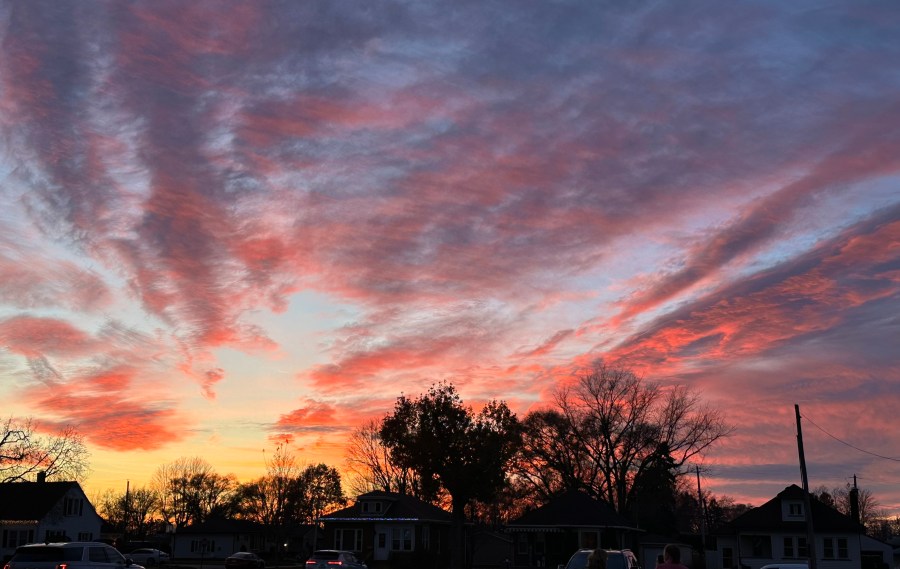
Photo: A recent sunset, a visible sign of the glory of creation.
 Deena Pavinato - Journeys