Advent 3rd Sunday – From darkness to light

This Sunday is Gaudete Sunday, the Third Sunday of Advent. We light the rose candle, the joy candle on our Advent wreaths. Gaudete means Rejoice! Even if you have not been familiar with this particular Sunday in the beginning of our liturgical year in the Church, you have undoubtedly heard the Latin word in Enya’s version of O Come O Come Emmanuel or other versions of the traditional Advent song.

As I prepare for Christmas this year, I seek that joy. Not giddy happiness or pleasure but a divine, deeply rooted in the heart and spirit, joy. A joy that doesn’t get squashed out by the stress of not having my baking or shopping done (or started!) or the feeling that the slow-paced prayerful days of Advent are passing me by despite my best efforts to savor it this year.

The world feels dark, easily experienced when turning on the news. I am relieved that the Syrian rebels have sent Assad fleeing from the country after toppling his regime, but now the news of his enormous stockpiling of wealth and the cruel and brutal treatment of prisoners is made known. It is overwhelming. I am not surprised reading a news update that Russia offers him asylum. I even tire of Facebook because of all the ads to shop, none of the ideas that appeal to me for those I want to shop for. There are countless stories of countries, and the people who live there, in need due to weather events. Then there are all the random posts of pets found alone and hungry because people just left them alone when moving. It’s all too much. How, where do we find joy?

Pope Francis has often reminded us to live with real joy. Even as he ages, joy is almost always visible in his encounters with others. In his final event in Corsica today, his 47th apostolic journey, in his homily at a Mass, “the Pope encouraged the faithful to embrace a joyful expectation of the Lord’s coming. Christian joy, he explained, “is neither shallow nor ephemeral”. On the contrary, it is a joy rooted in the heart and built on a solid foundation. He recalled the words of the prophet Zephaniah, who called his people to rejoice because the Lord was in their midst, bringing victory and salvation. “The Lord’s coming brings us salvation: that is the reason for our joy”, he said. This joy, the Pope explained, is not about forgetting life’s hardships but rather finding strength and peace in the presence of God.”” He says that the more we focus on ourselves and the concerns of the world, we lose sight of God’s providence and guidance. The answer lies in prayer and our focus on the promises of Christ. (Source: Vatican News)

In his apostolic exhortation, The Joy of the Gospel, it was determined that he used the word joy 110 times. In his exhortation, Pope Francis writes about a joy, living a life with Christ and the Gospel, that cannot be taken away by the things of this world. For him joy is “something beautiful, capable of filling life with new splendor and profound joy, even in the midst of difficulties.” Who doesn’t yearn for that? I certainly do.

I picked up a beautiful book this week, after listening to the first two weeks of their Advent podcast, Encountering Emmanuel, on the station Abiding Together. Sr. Miriam James Heidland, a woman religious who has deeply impacted my faith life with her story of healing and relationship with Jesus, along with Heather Khym and Michelle Benzinger, discuss a book written by Heather, Encountering Emmanuel: A Guided Advent Journal for Prayer and Meditation. On Monday of the First Week of Advent, Heather, talking about the Gospel of John and the Light of the World discourse, says Jesus “comes crashing through the darkness of night into a world darkened with sin. A star illuminates the way – a star that he breathed into existence and that echoed the truth of who he is, the Light in whom there is no darkness.”

That sentence, and a proclamation that Jesus “wants our whole being to be in the light”, reached the deep core of my being. It was one of those moments where billions of years collapsed into a single second, that stars created by God, illuminating the way for shepherds and wise men thousands of years ago, continues to be a symbol of hope each night as I gaze at stars, that there is a world and truth that no country, politics, or person can wipe away. Even if we destroy the planet with our careless concern for the gift of creation, the stars will shine and remind us that Jesus can and will light the dark places of our lives and the world if we are open to the encounter.

Despite the hardship, despite the turmoil, we look to God who promises us peace, hope, joy and love amidst the darkness of the world. We turn to the Light, to the tender compassion of our God, to “guide our feet into the way of peace” (Luke 1: 78-79, Zechariah’s Canticle, the Benedictus). In that we find true joy.

Wishing you abundant peace and joy this week, Deena

Photo: The Third Week of Advent on our Advent wreath a previous year at my parish.

Despair can turn to hope

During my mother’s hospital stay, after falling and needing neck/spinal cord surgery then rehab, she mentioned a lump on her neck which the biopsy indicated was cancer. We left the hospital on Saturday with an appointment to meet with a doctor and discuss cancer treatment the following Monday. I was so fortunate that I worked from home and for two amazing women, Brigid and Trish, who understood that sometimes I would be working from the cancer center and that there might be interruptions during the day to care for my mom. I couldn’t have had a better situation at that time, the flexibility so helpful for her two-year battle and the care it required.

After she died I was in a deep despair. I went through the motions of work and the holidays. My mother lived with me, so everything in this house reminded me of her. I would get up from my desk and look toward her chair or the dining room table, as if still checking on her to see how she was doing.

The following January we had an organizational change at work and I was asked to meet with the new director of our department and discuss a supervisor role for the support team for our department that were working in a local customer service center. I met with him, instantly liked him, and he asked me to consider the job. I said that I enjoyed working from home, being productive in the quiet of my home office versus constant activity of a customer service center and asked whether it would be possible for me to work at 2-3 days from home and visit the center and the team the other days. He said yes and we agreed that I would begin the new role. The Friday before I was to begin he called to say that he thought about it and felt that my presence with the team would be required 5 days a week. I was so disappointed and thought about quitting but convinced myself to give it a try. It was exactly what I needed but it took me a few months to see it. Being somewhere else, outside of my house, forced me into new rhythms and being with others. The job gave me a team to care about and make changes that the organization wanted. I had tasks to focus on. I had to trust that life was going to be ok for me again. I had to turn to hope as the way out of my pain.

I read a beautiful post this week by poet and author, David Whyte, (from his book Consolations: The Solace, Nourishment and Underlying Meaning of Everyday Words) who describes despair as a haven, a last protection, “a necessary and seasonal state of repair, a temporary healing absence, an internal physiological and psychological winter when our previous forms of participation in the world take a rest; it is a loss of horizon, it is the place we go when we do not want to be found in the same way anymore.”

He goes on to say that the “antidote to despair is not to be found in the brave attempt to cheer ourselves up with happy abstracts, but in paying a profound and courageous attention to the body and the breath, independent of our imprisoning thoughts and stories, even, in paying attention to despair itself, and the way we hold it, and which we realize, was never ours to own and to hold in the first place.”

If you are feeling despair for any reason this week, please honor that within your spirit. Take the time you need to honor the healing that is required. Don’t run from it. Don’t brush away the feelings as if they don’t exist. Breathe and find ways to honor your body, your spirit and what you need to feel energized again. When you are ready, find activities that nourish your spirit. Be with like-minded people. Ignore negativity as best you can. Realize that true healing only occurs by going through and not around the source of the wound or hurt. Move forward with compassion and curiosity.

Then when you are ready offer the light you are to others. Be a source of hope. We need it now more than ever!

Wishing you abundant peace, Deena

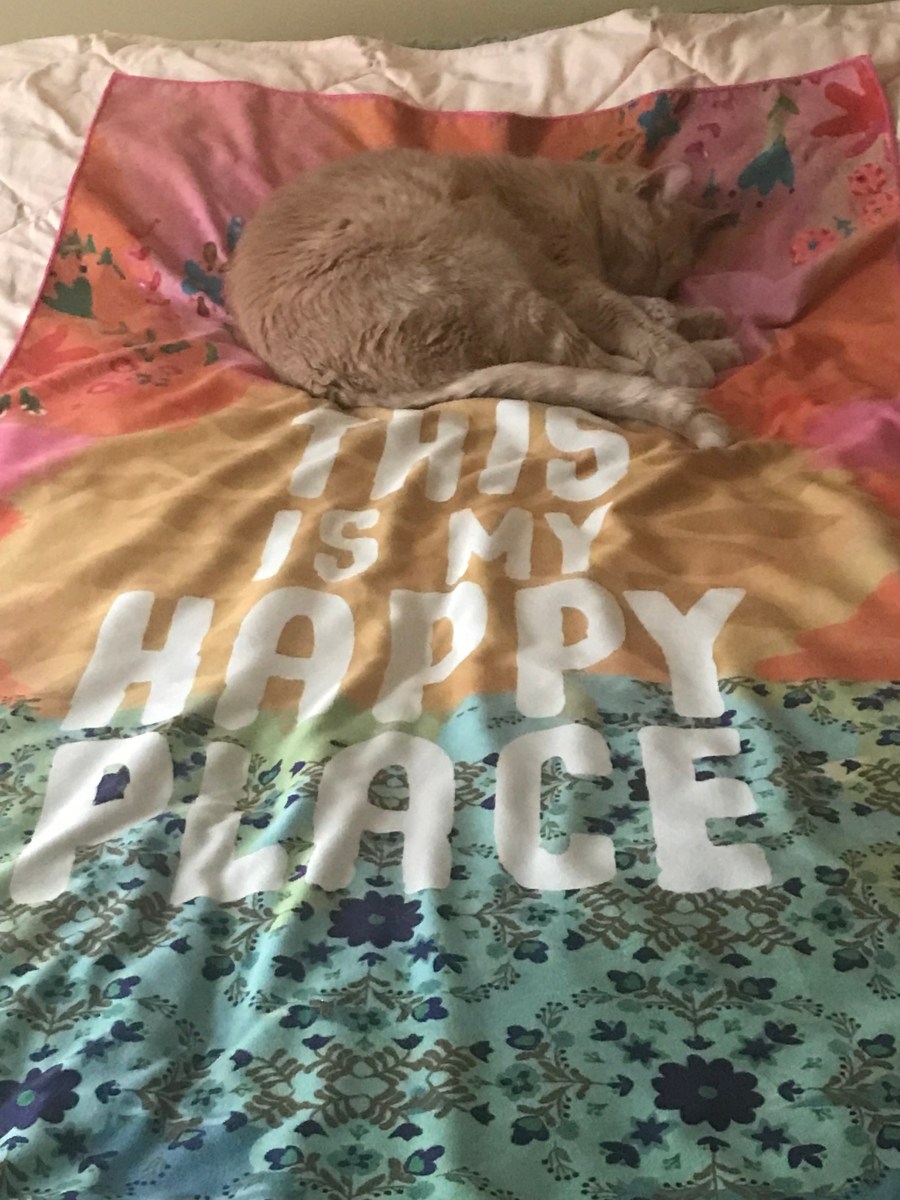
Photo: Butters in his happy place. If you have one, watch your cat or dog, they embody resilience!

Make my heart like your heart

Early this morning there was a beautiful frost on the ground. It wasn’t the first frost of the Fall but the scene stopped me and invited me pause and reflect on its beauty. As I sat to journal and do my Examen from Saturday, I watched the sun begin to grow higher and brighter in the sky, which then resulted in a slow and steady line of frost that was being melted by the sun. The patch of frost remaining, grew smaller and smaller. Eventually it was gone.

I thought about the human heart, the wounds we all hold and carry with us. The times we have been hurt and the times we have hurt others. Healing is a journey. It doesn’t happen overnight and I have learned I can’t do it on my own. In our human frailty, it’s not possible. We need the Love that always loves, always forgives, always desires what is best for us.

This past summer I developed a new interest and fondness to the devotion to the Sacred Heart of Jesus. As a Catholic I have grown up aware of the devotion but it’s never been a regular part of my prayer life. But I was praying for answers, for clarity and direction. Entering into prayer each day, using a novena prayer, I began a process of sharing all that was on my heart with Jesus. Then things got hard again and I stopped. (You can insert the game show buzzer at this point, “wrong answer!”)

When I learned that Pope Francis had written a new encyclical on the Sacred Heart of Jesus, I was excited, as if waiting for a gift on Christmas. I set my alarm this past Thursday, woke up early to visit Vatican News, and begin reading the encyclical, Dilexit Nos, a Latin expression that means “He has loved us”. I have had the time and space to spend more time reading it, and reflecting on the deep wisdom, this weekend. I already have my digital version marked up with favorite quotes and insights to ponder. It’s a beautiful treatise on the human and divine love of Jesus expressed through his Sacred Heart.

I have returned to one of the thoughts shared in the encyclical several times since reading it. Pope Francis says “If we devalue the heart, we also devalue what it means to speak from the heart, to act with the heart, to cultivate and heal the heart. If we fail to appreciate the specificity of the heart, we miss the messages that the mind alone cannot communicate; we miss out on the richness of our encounters with others; we miss out on poetry. We also lose track of history and our own past, since our real personal history is built with the heart. At the end of our lives, that alone will matter.” Later in that section, he says, “It could be said, then, that I am my heart, for my heart is what sets me apart, shapes my spiritual identity and puts me in communion with other people.”

My heart is what sets me apart.

Three times in his gospel, Luke writes that “Mary kept all these things, reflecting on them in her heart.” Over the past month or so, the idea of allowing myself to explore the deep desires and wounds in my heart has become stronger. I have begun to see an integral connection between my studies in counseling and the spiritual life. I want to dig in and study more about this relationship. I have heard Sr. Miriam James Heidland, SOLT, speak of this level of healing in many of her talks. She has said that “The past is the past unless it’s being lived out in the present”. We think we can mask the wounds and say “it doesn’t matter” or if we manage it well enough no one will notice, but can we? She speaks eloquently about the reasons for our behavior, that we are doing what we are doing because our hearts have been broken. We allow things to come out, in healing therapy or spiritual direction, so that we can heal them.

The best gift we can give ourselves is to take those wounds or concerns and bring them, open handed, and give them over to the wounded heart of Jesus who knows all the same hurts, betrayals, abandonment that we experience. But the difference is that Jesus is centered in love and his relationship with the Father. He will not judge, he will not condemn, he will only offer love and an invitation to come closer. “The heart of Jesus is ‘the natural sign and symbol of his boundless love.'”

The more we grow in trust of that Love, the more we are able to offer that love to others.

Jesus, meek and humble of heart, make my heart like your own.

Wishing you abundant peace, Deena

Photo: A stained glass window of the Sacred Heart, St Scholastica and St. Gertrude at St. Scholastica Monastery in Fort Smith, Arkansas

Link to Dilexit Nos: https://www.vaticannews.va/en/pope/news/2024-10/he-loved-us-the-pope-s-encyclical-on-the-sacred-heart.html