Featured

Pray for peace

I begin by stating that I understand and support the notion that we create internal peace by staying out of negative and political social media posts, staying away from the news except to remain informed, or worrying about a war that we have absolutely no control over.

I get it, I really do. I am trying hard to create peace internally and in my small sphere of influence. I continue to write in my journal, as I have for months, that each day is going to be my peaceful day and I focus on that goal each day.

But when I see a little boy crying in a Lebanese hospital because he was bombed and saw his father in pieces before him, I also know we cannot hide from the reality of what this evil war is doing to innocent people. There are times we must speak out and defy what is happening. It is not making our country safer, richer or better off. I don’t need to share all the information about what is happening each day and how much it is costing our country. You can read that on your own.

I join Pope Leo XIV appealing to “those responsible for this conflict: cease fire!” I join him in asking each of us to look at what is happening with the eyes of Jesus. In today’s gospel for the Fourth Sunday of Lent Jesus cures the blind man. We can open our eyes or keep them shut. Pope Leo also said, “It takes a vigilant, careful and prophetic faith to open eyes to the darkness of the world and bring the light of the Gospel to them through commitment to peace, justice and solidarity.”

Speak up when you can. Support those in need in whatever way you are able. Vote to make a difference.

Most importantly, let us pray for peace in our world.

Deena

Featured

Go sit in your cell

When asked for a word of wisdom, Abba Moses, one of the early desert fathers, told the seeker “Go sit in your cell, and your cell will teach you everything.” The journey of Lent is one of going within, engaging in disciplines that help us see, hear and respond more freely to the call of the Christ. This week I was called deeper into the desert.

After picking up the remains of my cat, Bela, on Tuesday, I felt a desire, and an inner call, to greater solitude. I needed space to process grief on many levels, not just losing Bela. I picked up some groceries, advised a couple people who needed to know that I wouldn’t be participating in “normal” activities for the remainder of the week. I turned within. I did have some text or phone conversations as needed, did some required social media posts on sites I post for, but spent the week reading, reflecting and journaling. I created a personal and private retreat in my home. Just like entering a silent retreat and questioning whether I would be able to gracefully encounter the time in silence, Wednesday morning I questioned what I was doing, I “should be…” Fortunately those temptations were met quickly and I easily fell in the rhythm of my self-created retreat.

When we set aside time and space for reflection, it’s amazing what shows up. Or perhaps, the quietude invites greater attention to the world as it always is around us, without a blur of motion, internal and external. For most of us the mind is a turbulent ocean, or sea, waves crashing and distracting us all of the time, but when the waves calm down we can see into the depth of the sea more clearly.

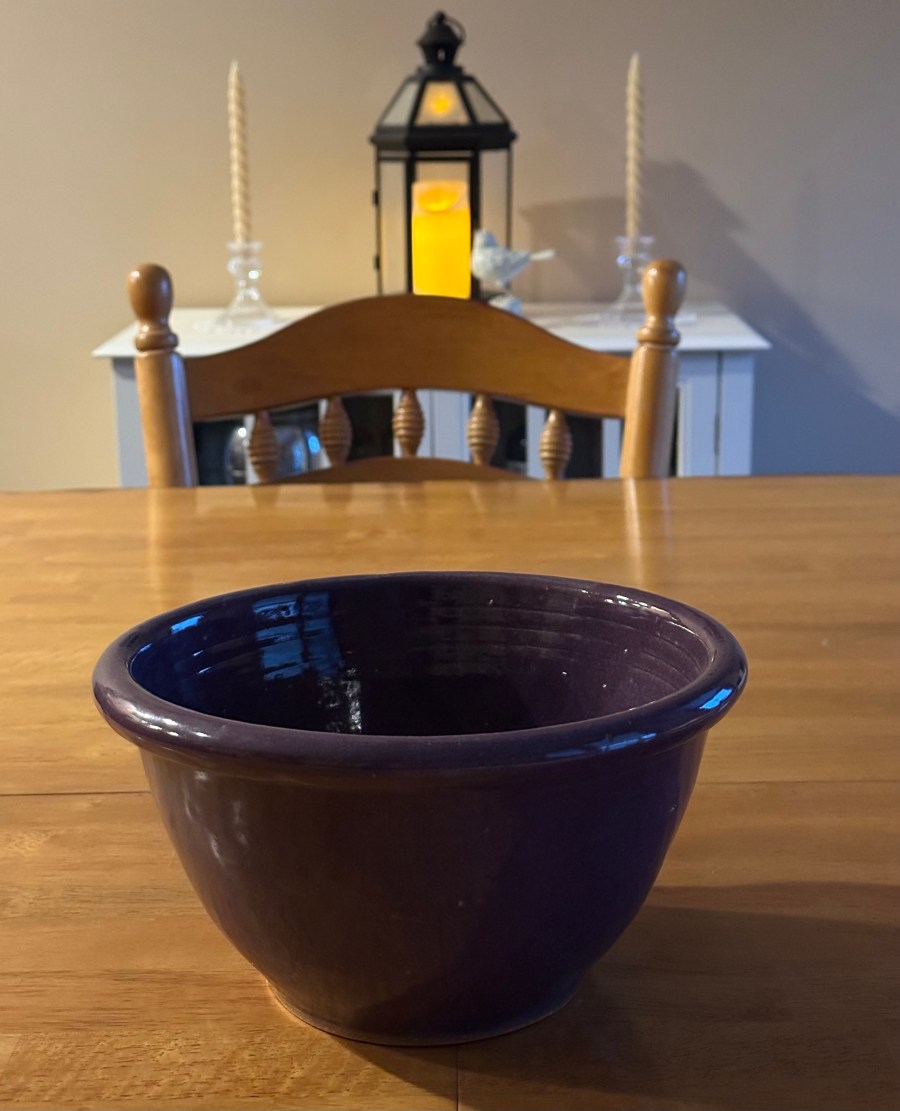
I was invited again this year to imagine receiving an empty clay bowl from Abba Arsenius, another of the early desert fathers, (Retreat: A Different Kind of Lent) as I had been given in the past. In the bowl we can visualize all the activities that fill up the bowl each day, distracting or addictive behavior, and then intentionally empty the bowl to create a spacious place to receive what is more life-giving.

Not everything I read or encountered was spiritual or faith reading. Most was. I also listened to a discussion by an author and life coach, Cheryl Richardson, who I followed more closely several years ago, but have been tuning into more frequently lately. She offered simple self-care wisdom during these challenging times we are experiencing. (These were offered in a quite humorous and sarcastic way, such as eat more sugar, make sure you always have your phone so you don’t miss a social media post, read every comment on them, and of course, stay up late each day!) I felt a longing for activities, or information, like that from my past. Things that were authentically me, things that inspired, shaped and formed me. Somehow they became “less spiritual”, a bogus assessment of where one is capable of experiencing God or Spirit.

I stitched – if you have stitched, crocheted, knitted or maybe even done puzzles or diamond art, you know it can become a method of quieting the mind. A stitch in, and a stitch out, can shape a slow pace for mindful breathing. It can become a way to let go, creating a framework for a quiet pause.

St John of the Cross said, which was often shared and made popular by Trappist monk, Thomas Keating, “Silence is God’s first language. Everything else is a poor translation.” In stillness we can hear what is more essential. Nothing I “heard” or read this week was an earth-shattering revelation, but I was awed, and grateful for, the insights that did form throughout the week. Like the Samaritan woman in today’s Third Sunday of Lent gospel, I have been at the well thirsting for a drink. This week, during my quiet pause, I was given a long, cool, refreshing drink.

It’s not practical for me to be able to retreat completely like that every week but I can certainly create more quiet spaces each day. I also want to continue to assess that my daily activities are done from a place of desire or service, not expectation. If any of this sounds inviting to you, perhaps you can consider some time in your day for a sacred pause to turn within and listen.

Wishing you abundant peace, Deena

Image: my purple bowl, a visual to remind myself to fill it more consciously and lovingly with things that matter.

Featured

A fragrant, pleasing offering

I have seen the cloud of incense, representing our prayers, burn and move in interesting ways around the altar in our church. During the incensation, after exposing the Blessed Sacrament, the incense rises to the great high ceilings, lifting our prayers. Impacted by heat or air conditioning, air coming into the sanctuary from opening doors, etc. it can often create a cloud around the altar and monstrance.

The other night, during Adoration, the incense took on a life of its own, and a symbolism, that was quite moving for me.

The cloud hovered around the altar and the monstrance, creating a thin veil, inviting me to see beyond the physical to the reality of what was present before me. It sanctified the space for the Divine Presence with us. It slowly moved to the ambo, the pulpit, where the Word of God is proclaimed, as if to say, as the apostles heard in today’s Gospel, Listen to him. Then, it turned and drifted to sanctify our presence there. The cloud drifted out toward the pews, at the perfect height of those of us present and kneeling in this sacred space. It moved slowly from the altar, over each of us, as it moved towards the back of the church.

The Jewish Tabernacle, or Mishkan (dwelling place), initially portable, moved to more permanent structures with the building of Jewish synagogues. The scrolls are now housed in the Ark, the Aron Kodesh, while the building itself can be viewed as the Mishkan. In Exodus, the Jewish people were instructed to build an altar of acacia wood in the Mishkan which would create a pleasing altar for the burning of incense. Everything in the Tabernacle, each piece of furniture and the way it was constructed, represented intimacy with God. The altar of incense then represented the prayers of the people rising, in intimacy with and love of God.

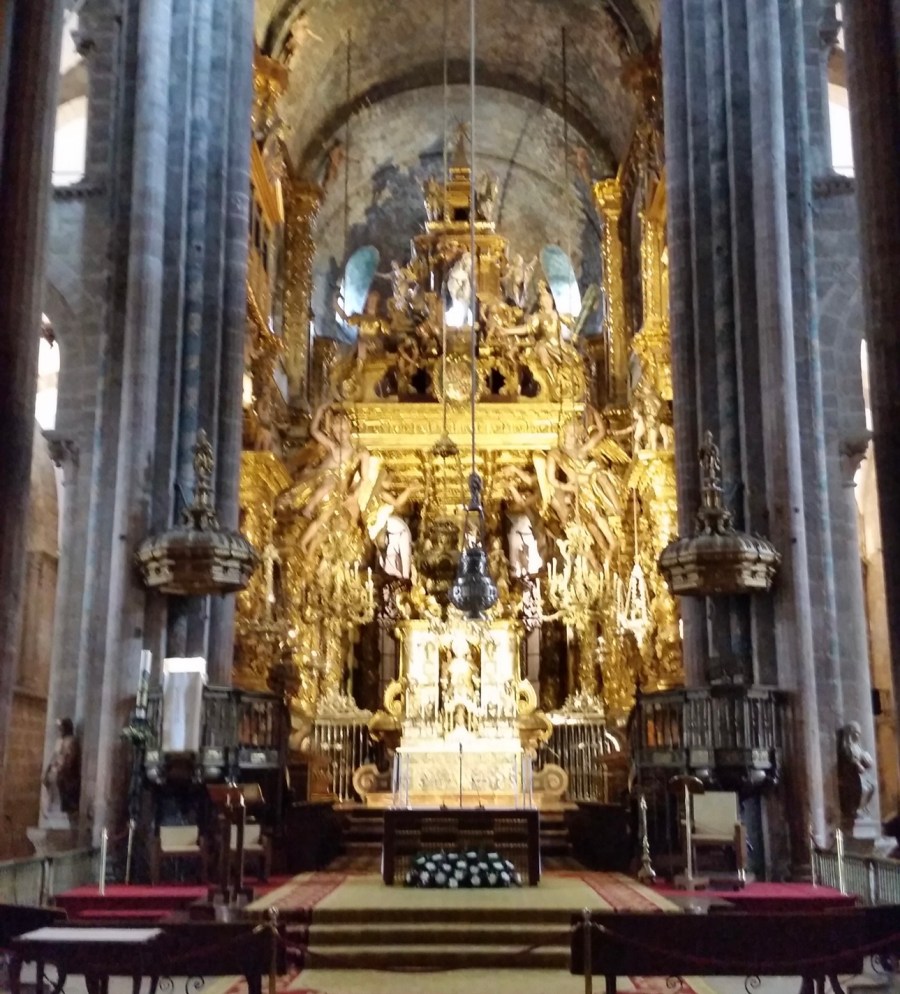
The large thurible, or Botafumeiro, at the Cathedral in Santiago de Compostela was not swung during my visit to Spain but I have seen videos of it during special liturgical feasts. It is swung to purify the air, participants and symbolize the prayers of the people rising to God. If pilgrims happen to arrive to the Cathedral on these special holy days, after walking the Camino, I envision the incense sanctifying their journeys, lifting and receiving all the intimate and personal prayers said during their pilgrimage.

In the book of Revelation we also hear of bowls of incense. The angel was “given much incense to offer with the prayers of all the saints on the golden altar before the throne and the smoke of the incense, with the prayers of the saints, rose before God from the hand of the angel.” It’s a beautiful image to consider the continual burning of incense, representing the prayers of the communion of the saints, small “s”, each person in the eternal presence of God.

As I reflected on the background of incense, and the scriptural references of our prayers like incense, I thought about our Lenten prayers and practices as fragrant and pleasing offerings to God. I pray to become a more pleasing “Mishkan”, a dwelling place, and enter into greater intimacy and union with God.

I pray that your journeys continue to be fruitful and meaningful as we begin this Second Week of Lent. Deena

Image: A picture I took of the great Botafumeiro in the Cathedral in Santiago de Compostela, Spain, visited during my pilgrimage.

Featured

Led into the desert

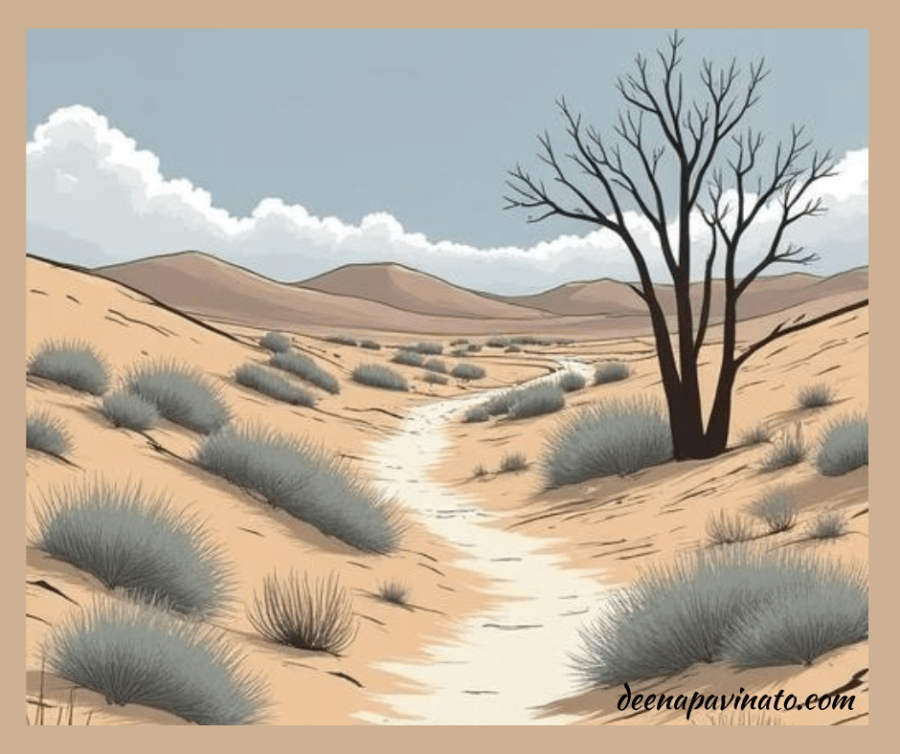
In life we are led to places we don’t want to go. I have struggled with a thousand questions this week, none of them with life-giving answers that help me in my grief. The desert provides a vast and stark landscape, with few distractions, so we have room for answers to emerge. I am learning that the answers will have to emerge, in their own time, they do not break through as a result of my willing it. Perhaps that is why we are given the symbolic period of 40 days in our own Lenten journeys to mirror the days that Jesus was led into the desert to pray, fast and be tempted. We need time to “rediscover what our hearts truly desire when the distractions fall away” as so beautifully stated in the opening of the Laudato Si’ reflection for the First Sunday of Lent.

What I desired for Lent was to enter a desert time to be free of the distractions that were filling my time with things other than prayer and reflection. Now the distraction of all my questions is consuming my time, impacting the desire for prayer and reflection, even more than going out for coffee would have done.

Given the temptation of changing this situation, just like a rock into a loaf of bread, I would probably say “yes”, change it. I would not be strong enough to resist the temptation. I want Lent to be different than it is.

If you are finding you have a similar mindset as you look at the distractions in your own life – wishing to change circumstances to be a person more centered in prayer and meditation, to be a person of peace and lovingkindness and more compassionate towards others, to want to give more of your time to those in need – you are not alone. I hope for each of us that the desire for these good works is in itself a grace. As also stated in the reflection by Laudato Si’, the distorted desire for the things (my add – of the world, more fleeting in nature) that are pleasing becomes a distraction, they fragment us, not free us.

This weekend in my journaling and reflection I read something written by Rainer Maria Rilke that I am trying to sit with. He invites us to “have patience with everything unresolved” in our hearts and to love the questions. “Don’t search for the answers, which could not be given now, because you would not be able to live them. The point is, to live everything.” I must have hope in that, to live with the questions so that the answers slowly emerge as part of living into them. Just as I have hoped by writing my “peaceful day” statement every day for months is a slow drip of water smoothing the jagged edges of my heart, I have hope in this guidance by Rilke.

Let each day be what it is. Lean into the questions. Hold hope that they are all part of a larger transformation taking place.

Wishing you a week of peace and hope, Deena

Image created in Canva

Featured

Lenten solitude

When I started this post last weekend I had decided that journeying to the desert, both spiritually, and physically was a way to grow closer to God. Spiritually Lent is full of images of the desert and of turning away from the temptations of the world. Physically I had decided to “stay in” during these 40 days, to not spend money on coffee or dinners out, in the hopes to clear more time and space for prayer. Never in my imagination did I think the beginning of Lent would also be an emotional journey of emptiness, exposure and piercing loneliness.

As I said goodbye to my sweet boy, Bela, yesterday, I have been in a place where the sun is scorching and there is no protection from the winds of grief as they stir up minute upon minute. There is no cover and no place to hide. The ashes this morning certainly had a different symbolism and reminder of how fleeting life can be. For some, the (almost) 18 years I have cared for Bela may not seem fleeting. For others, the grief may not be understandable for “just a pet”. But from the first moment Bela chose me and this home, he has been so much more. But that may be a story for a different day, when I can find the joy in telling it.

Preparing for Lent initially, I reflected on the Covid pandemic and how sheltering in place was like a journey to the desert. We had to leave behind our routines and stay home. We ordered judiciously, or ventured out rarely, to prevent unnecessary trips to the store or for delivery people. I helped set up our online parish evening litanies and live-streamed Masses. I attended other virtual retreats and prayer events. It became a time, for me, full of the richest spiritual blessings and graces, at a time of so much pain and fear for others. I was not blind to the difficulties for others, but as an introvert (yes, really!) I relished staying home and participating in virtual events. I had the cats for company. I had more time to contemplate life and my faith and I treasured the depth of experience that I was having.

Like the Desert Fathers and Mothers who opted out of normal activities and retreated outwardly to the desert so that they could retreat inwardly toward God, I desire the same kind of solitude during these 40 days of Lent. It’s not a complete withdrawal because I can and will attend Masses, Stations of the Cross, as well as other Lenten prayer and scripture groups in person. I will be facilitating a Lenten group discussion as we read and pray with Crux, by Ascension Press (see note below). But, what began as a desire to be more intentional in that quiet time changed dramatically yesterday. It is a different quiet time that I am receiving than what I desired. What remains though, is time for personal prayer and reflection, a space to lean into scripture searching for words of comfort, and to practice mindful breathing and being present to each moment, even if that moment is filled with grief and a call to surrender to the crashing waves of those feelings.

If you choose to be intentional about the experience of Lent, I would ask what one thing you would like to retreat from during these 40 days? Would it be possible to do that, by carving out the space for more personal time for prayer and reflection? How might you change Lent from simply focusing on the discipline of “giving something up” to a change in your relationship with the distractions of world? I would love to hear from you and how it goes for you during Lent.

Also, a word of thanks to all of you who took the time to reach out via text or to comment on my post about Bela this morning. I haven’t been able to read them yet, but just seeing the updates has brought comfort. I think I will be able to read them tomorrow, until then, I am so grateful!

Wishing you a holy Lent with time to be open and receptive to the voice of the Spirit, Deena

As a note, Crux is available on the Ascension Press app with a discounted rate of $4.99 for 90 days of access. There are daily videos with Fr. Columba Jordan, Lenten challenges, prayers and reflections.

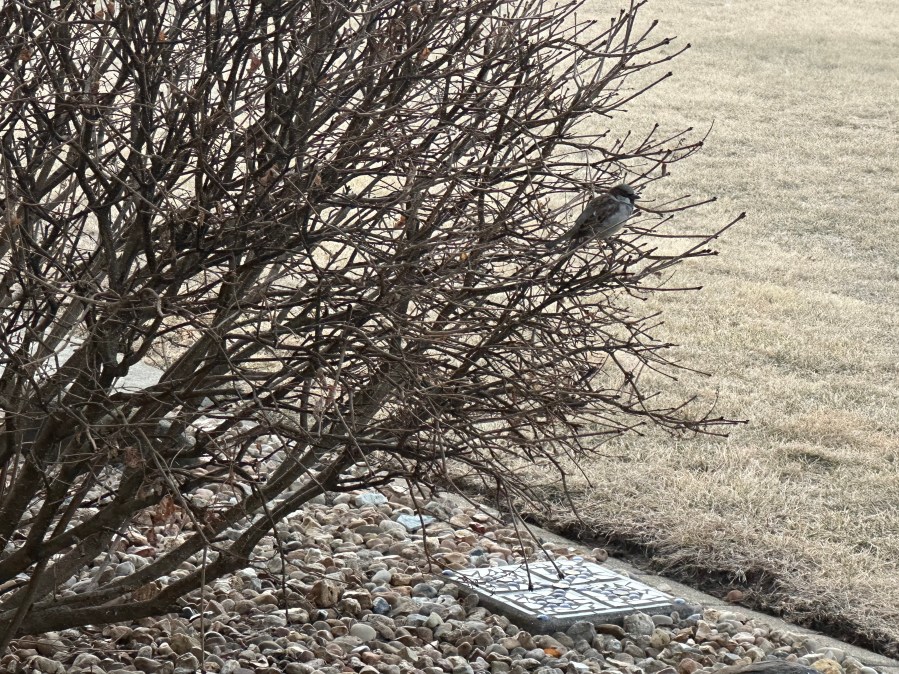
Image: a bird that Bela and I were watching from the window on Saturday. He seemed so peaceful by himself, a fitting image for my Lenten journey.

Featured

A pilgrim journey

Our Lenten journey has brought us to the glorious Feast of Easter, it is the Solemnity of all Solemnities, a joyful conclusion to our Lenten penances and the beginning of the Octave of Easter (Easter is eight days long!). I wish you and your loved ones a grace-filled Easter Season!

If you participated in the Triduum Services of the Lord’s Supper, Good Friday and Easter Vigil, there is so much to reflect on from the solemn liturgies we prayed with and today we celebrate the gift of God’s love in the Resurrection. A few thoughts came to mind as I reflected on my own journey through Lent.

Meditations written by Pope Francis for the Good Friday Way of the Cross in Rome’s Colosseum explained that the world we are faced with can be cold and calculating, that we become prisoners of ourselves when we focus on selfishness and indifference to those in need. Writing about and using the analogy of each of the Stations, Pope Francis explains our human journey and that only when we focus on the way of Christ, are we able to make sense in our lives, to bring about a restoration of joy and we feel as though we have come home.

Pope Francis’ meditation reminds me of the essence of a book I read during Lent, Jesus and the Jubilee; The Biblical Roots of the Year of God’s Favor by Dr. John Bergsma. It’s a deep and profound study of the history of the Jubilee Year in the Church and an invitation to reflect on this current Jubilee Year of Hope 2025, as a way of life, not a single, special event in the Church. He shares practical ways that we can bring the Spirit of Jubilee into our lives. We reflect on how we might make Jubilee a lifestyle and encounter the liberty that Jubilee offers us. If I approach the crosses of daily life with a heart of the Beatitudes and the “divine economy” of God, then we are able to experience the liberating grace of Jubilee.

I spent time on Holy Saturday reflecting on words written by Fr. James Martin, S.J. for America magazine on waiting. Fr. Martin wrote that most of our life is spent waiting. Our days waiting aren’t always “the unbearable pain of a Good Friday. Nor are they suffused with the unbelievable joy of an Easter.” Most days, Fr. Martin proposes, are “in between”. We wait for changes in circumstances, health, job, and relationships. I know I often think, “when this happens” (whatever “this” is), then I’ll be happier or find more peace, that my life will change or be better. But, our waiting becomes bearable when we change our approach to the outcome we desire and when we choose to wait with hope.

As I look back on this Lent, I’m a little sad it has ended. I have benefited from the extra prayers and practices. I have grown and changed in ways I hoped to, but desire so much more. That, I suppose, is our Easter pilgrimage, a journey that continues beyond this Lent and each day of our lives.

Wishing you abundant peace, Deena

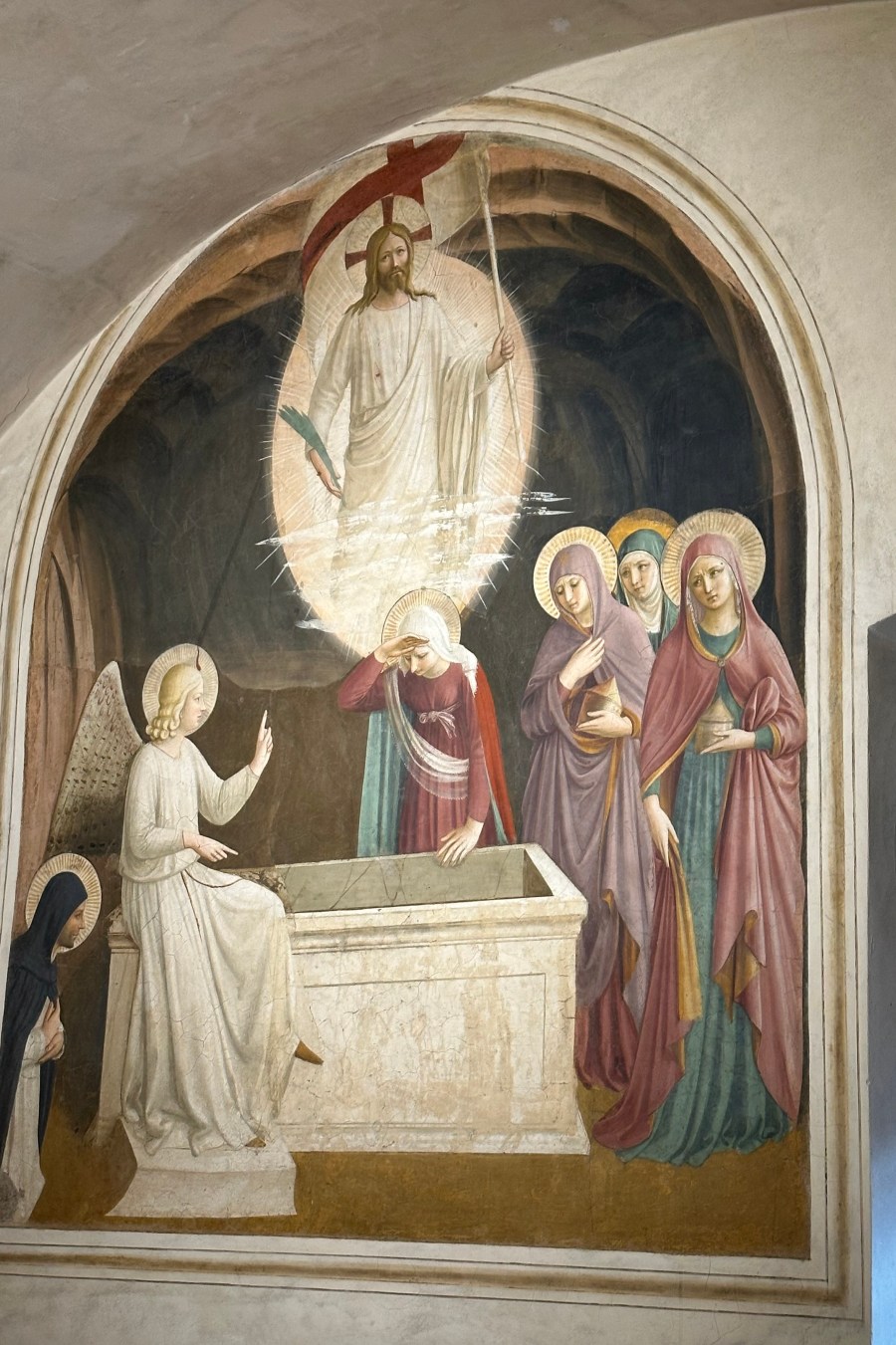
Image: A fresco of the women encountering the angel at the tomb of Jesus, painted by Fra Angelico viewed in the Museo di San Marco in Florence, Italy.

Walk slowly

When I am focused on a task I tend to power through it. It might take me a bit to get motivated but then once I am ready to take it on, I can be quite determined. That is a great quality for house cleaning, organizing or cleaning up the garden but perhaps not the best attitude for the season of Lent and preparing for Easter.

This past week I was reflecting on quotes by Catherine of Siena, regarding the endless abyss of love that God has for each of us, which seemed fitting the week before Holy Week. As a commentary I was challenged to consider, to be moved by this love, and to allow any ways that I have been indifferent or unaware of the depth of that love to come into my awareness. I reviewed the practices that I have taken on during the Lenten season and realized that as we got deeper in the season I was powering through the readings and daily reflections like I would a class assignment. It became a task to complete, an activity to mark done, and an accomplishment versus my original desire to create more space for intimacy in my relationship with Christ. My journal is full of moments of introspection and grace for sure, but my pride and perfectionism were also evident to me as I pondered the weeks leading up to today, Palm Sunday, and our entrance into Holy Week.

As I reflect on Lent and my desire for that intimacy with Christ, I can honestly say it has been one of the best Lent’s ever, my desire for liberation and change of heart, deepening in a way that I prayed for. But I know that, reflecting on my approach, there is a capacity for deeper intimacy this week.

It’s not too late.

So this week, if you participate in Triduum services, or as you reflect personally on the somber days of Holy Thursday, Good Friday and the silence of Easter Saturday, walk slowly and contemplate what is happening within you as you prepare for Easter Sunday. Each Easter, during Mass, the congregation is asked to renew baptismal promises. In one of my Lenten reflection books I was invited to consider how well I have fulfilled those commitments this past year. Preparing for that renewal again this year, how might I resurrect the promises of new life within me? Where am I being invited to seek renewal in my life? I offer those reflections and invitations to you as well.

I wish you an abundance of grace this Holy Week, as we contemplate the greatest sacrifice of love. Deena

Image: The Palm Sunday cross at my parish, Holy Family Church.

Cultivating beauty

On March 24, for the Third Week of Lent, I read the following quote by Joan Chittister, in her Reflection Resource, Cry Justice, Cry Hope, and I began implementing the practice of being, or at least attempting, to be more aware of beauty around me, with a strong desire to cultivate it more within me.

The purpose of life is to cultivate the sacred in ourselves so that we can come to know God before we see God. Goethe puts it this way: “A person should hear a little music, read a little poetry, and see a fine picture every day in order that worldly cares may not obliterate the sense of the beautiful that God has implanted in the human soul. ” This week, follow Goethe’s advice. Every day this week, list one way that you tried to “cultivate beauty in the human soul. ” In your own life … in your neighborhood … in the world.

––from Cry Justice, Cry Hope by Joan Chittister

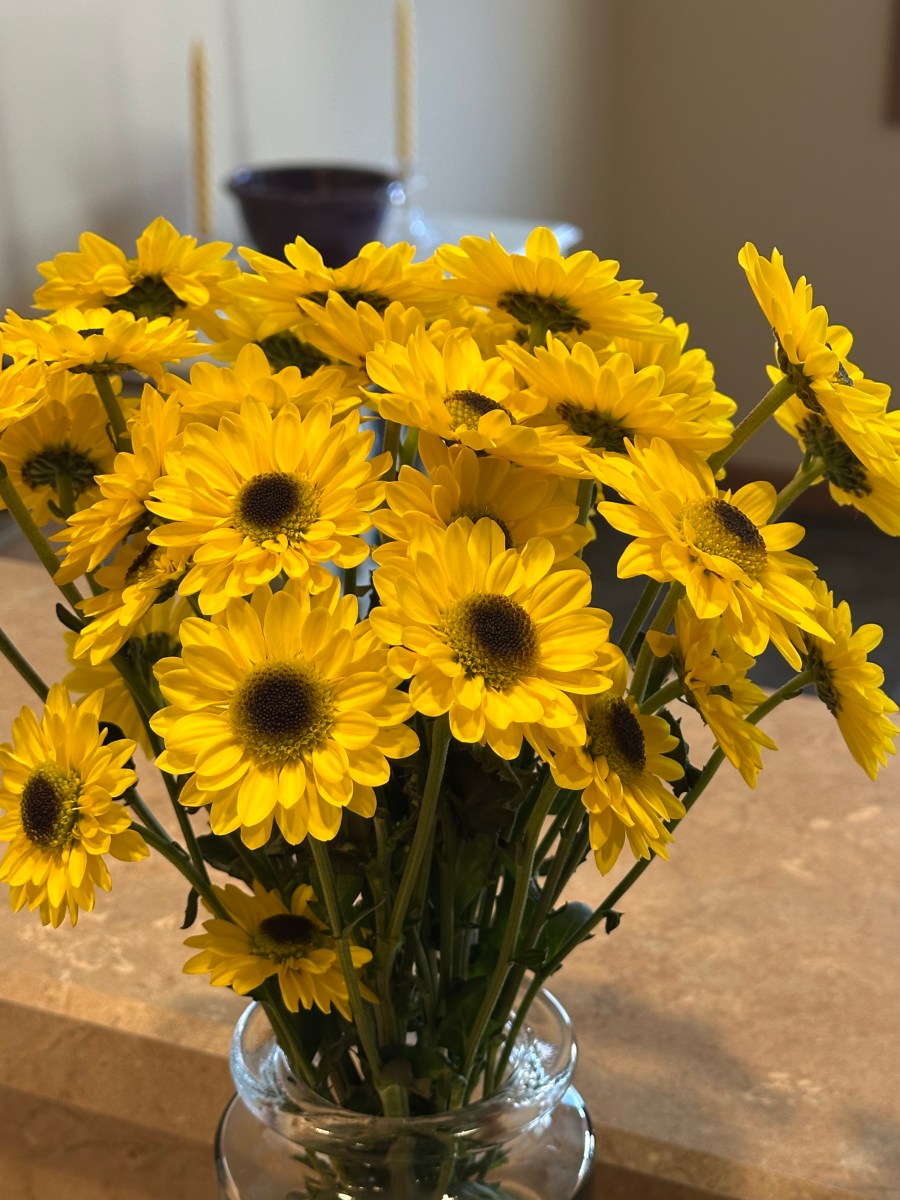
I think that is why I love having a garden, keeping fresh flowers on my kitchen counter each week, like the daisies in my blog photo, or creating little vignettes of objects in my home. Looking at something beautiful uplifts and inspires me. It does as Sr. Joan suggests, help me see God in the world around me. After reading Sr. Joan’s quote, I want to raise my awareness of the beauty I see around me in the world. I want to make a conscious effort of cultivating beauty in my life so that I might create more beauty in the world. It’s going to be a work in progress for sure!

This weekend I was blessed to be a participant, virtually, in a retreat being given by my friend, author Judith Valente for the Associates of the Sisters of Charity of Nazareth in Kentucky. The presentations by Judith and by Brother Paul Quenon, her friend, co-author of books and a Trappist monk at the Abbey of Gethsemani, were wonderful but perhaps my favorite was Judith’s talk on Saturday evening, “What can we learn from Italians this Lent about living more mindfully”. So many of the practices, la dolce vita (living the sweet life), that Judith discussed are practices I grew up with or still make part of my life. Sunday meals at my Italian grandmother’s home while growing up, the art of sitting and engaging in conversation over coffee, as well as visiting our family cemetery plots to clean up and remember our beloved deceased.

My return to Italy in the Fall of 2023 rekindled a passion for living and savoring the good life. My friend Kelly’s visit to Italy this past week, and pictures she shared of a family dinner gathering, reminded me of the graces of sitting down together for aperitivo, good food, wine and conversation. I tend to rush through dinner, if I even make it, instead of savoring the slowing down of the day before the quiet time of evening.

As a note, you will be able to read more of Judith’s reflections on life in Italy in her new book, The Italian Soul: How to Savor the Full Joys of Life, which will be released on May 5. (Click on the link to preorder it.) Judith’s book will help us learn to look more deeply for beauty in life and experience the grace of the present moment, the life we are living. It is not only an Italian way of life, but a spiritual lifestyle. It is the same awareness that Goethe and Sr. Joan Chittister are encouraging us to have.

So this week, I invite you to look for and instill more beauty in your life, just as Sr. Joan and Judith have excited in me a desire to look for more awe-inspiring moments in the everyday. Look for, and pause to savor, these moments when you encounter them. Create them in your daily living and the way you express yourself in the world, with your family and in your home.

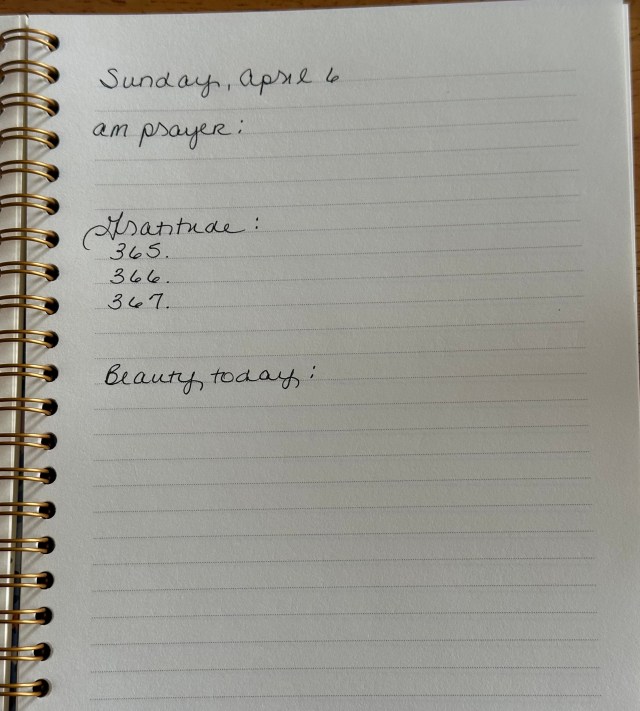
In a previous blog post I mentioned a new practice of keeping an ongoing list of my daily gratitude, tracking the sequential numbers versus jotting down three new entries each day. To this practice I have added an area to reflect on beauty that crossed my path each day. Besides my daily spiritual and creative reflections, I write in my daily Examen journal the consolations or graces and desolations each day. Before those movements of the Spirit, I note my reflections of gratitude and beauty. I have included a sample of today’s page, in this blog post, before writing in it later today. Try it and let me know what you think.

Wishing you abundant peace and this week, la dolce vita! Deena

My daily Examen journal image:

A story to tell

You’ve probably heard or used the phrase, “what’s their story”, when someone is inquiring about another person. It suggests that the person in question has a backstory or anthropology that will help us understand them more deeply. This week was a wonderful lesson in being open to learning more about others and being open to what might be going on behind the scenes of the exterior I am seeing. I have two examples that touched me and a captivating discussion I would like to share. They have radically changed my outlook and I hope you find them helpful as well.

This week in spiritual direction I was sharing my need to grow in compassion and patience with others, especially when out driving and doing errands. I try to be courteous and mindful of others but darn, there are days I feel like I am the only one. I am working on stopping a negative or condemnatory response before it explodes in my mind. My director shared a video, made by Cleveland Clinic, that she has used when working with others. It is helpful when trying to be more compassionate and understanding about what might be going on in another person’s life. Wow! Tears flowed. The video, Empathy: The Human Connection to Patient Care, was made in a hospital setting sharing thoughts of various individuals working at or experiencing treatment at a hospital. It’s only slightly over 4 minutes. I highly recommend it!

After watching that video, I am trying to look at others differently, with more openness. As I walked around a grocery store yesterday, I felt the desire to be more tenderhearted. Later in the day I found an interesting new page to follow on Instagram (but also on Facebook), a_mug_of_life. A young filmmaker in England began posting his encounters with others by offering them a cup of tea and asking them to share their story and letting them know he was going to film their discussion. He only has 8 posts so far this year and every single person captivated me. Ordinary looking people with amazing stories of courage, perseverance, love and tenderness. Stories that I wouldn’t know if Will hadn’t offered them a cup to tea and asked them a few simple questions about their life. I look forward to new videos! I was grateful for the timely reminder, after watching the Cleveland Clinic video, of the stories that people are walking around with.

Earlier in the week I watched an interview of Padraig O Tuama, a poet, theologian and conflict mediator that I read and follow. The interview was done by, author and podcaster, Kate Bowler. If Kate sounds familiar, I’ve shared her writing in the past, but last week shared parts of her interview with retired Duke basketball coach, “Coach K”, regarding leadership. I like Kate but I was very curious because this wasn’t an interview pairing I would ever have imagined. Padraig was brilliant as usual, especially talking about his experience with conflicts in Ireland and his perspective on ways to see political conflict differently. He shared some precious examples of leading retreats with children and allowing them space to encounter Jesus in their imaginations, highlighting in a different way, what can happen when we nurture openness and creative thinking. Finally he shared how he approaches groups when doing conflict mediation, using the Johari Window concept of the fourth quadrant, what is unknown to the self and unknown to others. He explained that it is useful to begin by saying, I don’t know why any of those gathered are there and that, initially, what holds the group together is just the physical space of being there. He said it is fruitful to begin with an openness and willingness to nurture that space without expectations. It might allow for the imagination and curiosity to occur. Kate acknowledged that this might be helpful when we are afraid that division will “take us all apart”. Padraig replied, “Division is everywhere, the question is what we do with it.” His perspective was refreshing.

I might not be able to impact a lot of people by implementing these simple things I was reminded of this week. But I certainly can try to be more open and curious when listening to others and a little more compassionate about what others might have going on in their lives when I encounter them. I dare to say that this perspective would do us all a bit of good.

I’d love to hear from you if you have the opportunity to watch the videos or visit Will’s social media page.

Wishing you abundant peace this week, Deena

Photo: A piazza in Assisi where I enjoyed an expresso during my 2023 pilgrimage.

Tilling the soil

It’s March Madness time. I don’t really follow NCAA basketball all season but I love watching during tournament time. Anything can happen. Players rise above challenges they may have been having all year, determination and drive kick in. I’m looking forward to seeing if some of my favorite teams advance in each round. I have a variety of reasons that teams are favorites, not always because of the team or it’s location but rather the character of school and leadership, like Loyola University’s team chaplain Sr. Jean Schmidt. Another favorite has always been Duke University, because of the legendary coaching style of “Coach K”, Mike Krzyzewski. Coach K coached Duke basketball for 42 seasons, having the most winning seasons in college basketball, and was also a six-time gold medalist head coach of the US Olympic Men’s Basketball Team. Coach K is no longer the coach at Duke, but his influence remains.

I recently watched an interview of Coach K by Kate Bowler, an author that I have quoted here before, and associate professor at Duke Divinity School. The interview, available on YouTube, was called “Love in Winning, Love in Losing”. Kate began the interview by stating that one of Coach K’s qualities is bringing out the greatness in others, and asked if it is hard, because many of us don’t look inside and see that level of greatness. Coach K responded that, as a coach, the team leaders looked for individuals that were talented with character, talented individuals who were willing to do the work to improve, and not talented characters, who see themselves as better than they are. Throughout the interview, he shared examples of believing in his players, asking them to step up, being honest and building trust within the team, being willing to hear the good things when things are going well, but also to receive honest feedback and work through the tough times. He shared his four A’s of Leadership; Agility, Adaptability, Accountability, and Attitude. They are great characteristics in life as well! He also spoke of his parents and their mentorship in his life. He said “if they didn’t till the ground, till the soil the right way”, his decision to go to West Point, and the influence of others, all as aspects that led him to be who he is, develop his leadership style and allow him to accomplish what he has. It’s an outstanding interview, I would highly recommend watching it.

In today’s Gospel, Luke 13: 1-9, there is a story of a fig tree that isn’t producing fruit. The owner instructs the gardener to cut it down. The gardener responds that he will cultivate and fertilize the soil and requests another year to see if the fruit will produce fruit. This morning I read a reflection by a monk at Conception Abbey that explained the fig tree as an ancient symbol of fruitfulness in the Bible and provided several scripture passages as examples. Br. Michael goes on to say that the Gardener is the Lord who loves each of us, lavishes mercy on us and continues to prune and fertilize our lives so that we can grow in love and continue to make a return to the Lord with our hearts and lives.

Spend some time this week reflecting on the teachers in your life? Who believed in you when you didn’t see your own capability and worthiness? What is the fig tree in your life that is dormant and needs some attention and nourishment? Lent is the perfect time to till the soil so that we bring forth new life at Easter and beyond.

Wishing you abundant peace, Deena

By the way, there is an adorable three minute video of Kate preparing for her interview with Coach K. Check it out here.

Photo: Taken during a prior year early Spring visit to Hornabaker’s Gardens in Princeton, IL.