Featured

Dawn of a new day

One of the things that I have realized in dealing with, and recently writing about, issues around mental health and well-being is that things always feel worse at night. The darkness, heavy with shadows and devoid of light, seems to forbid seeing possibility. Gloom settles in easily. In January I cancelled all streaming channels and was content to read or work on art projects. The past couple of months required noise from the TV or from YouTube videos, even if they were positive or spiritual talks, as a constant companion, reminding me I wasn’t alone. This week that noise has become a distraction and annoying, TV, especially the news, was intensifying the anxiety instead of calming it. That was a sign, for me, that things are beginning to change. I am beginning to find my way back to peace.

The darkness became a metaphor for the things that I didn’t want to face or deal with. Whatever flaw popped up in my mind became ten times worse when I refused to look at and acknowledge it. As I heard Fr. Ambrose Criste of St. Michael’s Abbey say this weekend as he began the St. Michael the Archangel Novena (preparing for St. Michael’s Sept 29th Feast Day), we need to acknowledge how far we have drifted from the light. We have to recognize and name the darkness, not to be discouraged by it, but rather to be healed. He remarked that only what is named and brought into the light can be healed. “Only what is seen can be surrendered.”

During the Healing the Whole Person Retreat that I attended at the beginning of August, Sr. Miriam Heidland invited us to engage our healing journeys with curiosity and kindness instead of judgment. We were reminded during the retreat that “suffering that is not transformed is transmuted.”

It requires humility to face those areas of our lives that we are not living to our full potential. Qualities that we have been gifted by God to live and express in our being but have been ignoring. To do so, for whatever reason whether doubt and lack of confidence, or due to some harm or damage inflicted by someone, is to ignore what God is calling us to do or be. It’s as if we are saying, I know better than God and my choice to live in fear and lack of trust is more important than trusting that God is leading me to live a certain way. It may also be the divisive voices of the world, the enemy, or the “false spirit” as I prefer to call it. One of those faulty messages is doubt.

Doubt, whether real or imagined, is harmful to our emotional well-being. It can lead us to self-isolate and avoid situations so we don’t have to pretend to act in a way that we aren’t feeling. It can result in procrastination and indecision because we don’t trust that we can make the right decision. We begin to use negative self-talk and criticism about the things we are doing and how capable we feel. We begin to compare ourselves to others, and if we do so through the lens of social media, we will never measure up because the standards we set become unrealistic. Doubt increases stress, anxiety and depression.

When we welcome the light of hope and truth, we can see the flaws as they really are, something to surrender to the grace of change. Then we move forward, yearning to live in trust and peace. We can cast doubt aside, even in difficult situations, and trust that we are not walking alone. I lean in to the words of Psalm 34, “The Lord is close to the brokenhearted”, the Lord delivers us from our troubles.

On Saturday, Pope Leo XIV spoke a message to those suffering with ALS, acknowledging the difficult burden they bear but offering an insight, and reminder, that the disease offers an opportunity to see that the quality of human life is more than achievements, it is dependent on love. He encouraged them to grow in gratefulness, especially for those who care for them, and for the “beauty of creation, of life in this world, and of the mystery of love.” I think this is a message we can all take to heart, no matter what we might be facing in life.

Wishing you abundant peace and hope this week, Deena

Image: Sunlight streaming through the trees and Anderson Japanese Gardens

Featured

A stronghold

This weekend our local area Oblate group met and began our 2025-2026 reading and discussion of Sr. Joan Chittister’s The Rule of St. Benedict: A Spirituality for the 21st Century. Many of us have studied it in our Oblate groups before but it’s a wonderful commentary of The Rule to revisit for anyone desiring to follow this spiritual guidance in our secular world. As we began our study for this month, we read the chapters of The Rule on guidelines and order of praying the psalms in the monastery. Each monastery creates a breviary, or guidebook, for the praying of the 150 psalms. It is similar to the order of praying the psalms in the Liturgy of the Hours, or Divine Office, prayed by clergy and lay people each day in a sequence of four “weeks”. St. Benedict in his Rule said that how and when the psalms are prayed could vary but it was required that monastics pray all 150 psalms. I don’t have a copy of the breviary used by the Monastery that I am an Oblate, so I pray the traditional “Office”. Over the course of 30 years since it was recommended, and that I have tried (my discipline and commitment have varied over the years, so don’t be too impressed!), to pray the Liturgy of the Hours each day, for Morning and Evening Prayer, certain psalms have become favorites. They become like a healing balm or a familiar friend on days that it feels difficult to pray or that nothing I pray or read seems to help.

There have been plenty of those days in recent weeks. The violence seen in our national news and the continued atrocities of war in other countries are hard to ignore, even if we don’t watch the news. I shared with my chiropractor this week that I am worried for the emotional well-being of young people who are bombarded on social media with these images and opinions. We pondered the impact these stories are having or wondered if they are becoming desensitized to it all. As a child of the 60’s I recall the impact of watching the violence of the Vietnam War on evening news, but it was only on the nightly news or in newspapers, we didn’t have constant images thrust upon us on cell phones and computers.

In this week’s blog I would like to continue the discussion about depression and anxiety and ways to deal with it. I am grateful for the abundance of information on social media in September for Suicide Prevention Month. These sites or pages are dedicated to raising awareness and breaking the stigma around mental health issues. It has not only raised my awareness of statistics regarding suicide and depression but helped me feel understood. Symptoms of depression are varied and we may not even associate them with our depression. It’s easy to try to convince ourselves to ‘just snap out of it’ or “get over it”, whatever the “it” is that perhaps we haven’t really identified anyway!

What can compound the stress is adding the belief that, as a Catholic Christian or person of faith, we should be able to pray our way out of it. The internal dialogue of “if I was holy enough,” “if I was faithful enough,” or “if God really loves me” suggest that if I was any of those things, then all of the anxious feelings would magically disappear. But that isn’t the way that it works! I am not saying that prayer isn’t helpful or that even if we don’t feel like it is working that we should give up on it. We have a wonderful model in St Teresa of Calcutta whose writing revealed 40 years of spiritual dryness, desolation and feeling abandoned. But in all of that, she remained faithful to prayer, to service of the poor and to leading her community.

This week I received and began reading a wonderful 30-day guidebook, Anchored in Peace, by the founders of the social media page, Mindful Christianity. The father and son writing duo begin the book by reminding us that our fear and anxiety do not disqualify our faith. The book is a combination of scripture passages, reflection questions, mindful Christian practices and prayers to help us navigate the difficult times we are experiencing. They suggest that we don’t want to hide the anxiety and pretend it doesn’t exist but bring it into the light and presence of God to be there with us. The authors counsel that we can let our guard down, present the honest feelings we are having, and let God be our refuge, anchor and peace, a day at a time.

After our Oblate discussion this weekend, I reflected that there are many psalms that can be prayed during times of anxiety and depression, psalms that can bring comfort and reassurance. I recalled one of those healing psalms for me. Psalm 144 is prayed on Tuesday of Week II, it is a prayer for victory and for peace. In the psalm King David is praying to God as a fellow warrior, defender and protector. As I pray that psalm I pray for the help of a God who can strengthen me in the daily battles I face, whether emotional or spiritual. I offer a few lines as comfort in the battles you may face in life.

Blessed be the Lord, my rock,

who trains my arms for battle,

who prepares my hands for war.

He is my love, my fortress;

he is my stronghold, my savior,

my shield, my place of refuge.

Wishing you abundant peace this week. Deena

Image: the medieval castle walls in the city of Avila, Spain

Featured

Ora et labora

I have been blessed to work a variety of interesting jobs in my life. I have learned new things in each, which were always helpful for the next adventure in my career. I rarely until more recently in life, viewed the work I did as holy.

The Rule of St. Benedict advises the monks of the abbey (or Oblates like me who choose to follow The Rule in life) that “Idleness is the enemy of the soul. Therefore, the monastics should have specified periods for manual labor as well as for prayerful reading.” (Chapter 48 of the RB) During the time of St. Benedict the monastery did not have slaves to do the work of the monastery as was true during this time in history. Work was part of the basic life of the monastery. Benedict believed that the monastics should not benefit or taken advantage of the labor of others or to be a burden on others. It was a privilege to contribute to the life of the monastery, it was purposeful and valuable to the lives of those living there.

We often hear Ora et Labora, pray and work, as I used in my title for today’s blog, associated with The Rule of St. Benedict. While not actually words written in The Rule, it is a motto that represents the orderliness of prayer and work that St. Benedict believed led to a balanced spiritual life. I also like Esther de Waal’s statement in her book, A Life-Giving Way, that “ora, labora, lege (prayer, work, read) would be preferable” to describe life in the monastery. Monks had assigned tasks, non too burdensome for the person doing the work, their designated times of community prayer during the day, but also the times of prayerful reading (lectio divina) and study so that the mind and heart were engaged in growing too.

For St. Benedict, all work done by monastics was valuable. It was a necessary part of life in the monastery but it was also a way of serving others and serving Christ. In the book, A Little Rule for Beginners, Sr. Joan Chittister reflects on the “American Mind”, suggesting that God “leaves the co-creation of the world to us” and says “Our work is not a “job,” it is a contribution to the good of humankind and each of us must find our own.”

On this Labor Day weekend, let us reflect on the work we do, whether paid, volunteer or within our households, as part of the ongoing work of creation. What are we contributing to the world and to those around us? Are we glorifying being busy? Do we have a balanced approach to the time we spend working and the time we spend in prayer and reflection? Perhaps we can take this day of rest from our labors and reflect on how we view our work, or even ourselves in relation to our work.

Wishing you abundant peace and hope. Deena

Image: A photo of St. Benedict from one of my monastery visits in Arkansas (can’t recall which one) with the words Opus Labor (work, labor) on his Rule.

Featured

Toolkit for your spirit

Friday evening I was listening to a YouTube recording of a conference talk by Monsignor James Shea of Bismarck, North Dakota. He began his talk sharing an experience he had during a flight delay, hotel layover and then subsequent flight back to North Dakota. To sum up his (humorous) introduction, he was having a bad day! He was honest about his attitude during the various events as they unfolded. While very funny, and a great introduction to the theme of his talk, I have to admit being very surprised. I had this ridiculous notion of this very intelligent and pious man living a life without the many reactions he voiced. The kinds of reactions I experience daily. I was surprised, but also relieved.

We all have those days, or perhaps weeks, when things just aren’t going the way we hoped they would or we find ourselves facing feelings we would rather ignore and stuff down, and away, out of sight and mind. But I am wise enough to know that, in the long run, that isn’t the right approach! We have to walk through those days and, leaning on support when needed, and look at the source of the feelings so that we can move through and beyond them.

Sometimes the light shines through and creates an opening when least expected.

I was reminded of this on Saturday morning by reading “Midmorning Blessing Prayer”, one of my favorites, by Sr. Macrina Wiederkehr (dec’d 2020) from her book, Seven Sacred Pauses. I can’t describe what happened except to say that the clouds parted and hope streamed in.

What is a blessing but a rain of grace falling generously into the lives of those in need; and who among us is without need?

Sr. Macrina’s writing has always been that glimmer of hope for me. Why did I forget picking up a favorite book of poems or blessing prayers, these past two weeks? Why didn’t I turn to the things that bring light to dark places? I reflected on those questions and realized I had a couple of answers.

First, in moments of desolation, it’s hard to remember to get up and seek a healing remedy. We don’t have the energy to seek out the very thing that might help us. St. Ignatius of Loyola would call “desolation” those times when we are feeling restless and in a state of dis-ease, when we feel hopeless or discouraged, when we might even sense that God feels far away.

I have been reminded this week, reading Experience Jesus, Really by John Eldredge and his premise that as “Disciples of the Internet” we expect immediate answers. We can Google and find out a solution to anything that might be going on in our lives. It might be true, I can find a supplement or exercise routine to feel better, but what is more likely is that I will participate in endless scrolling to distract myself. We’re “told” that prayer and mystery aren’t necessary (or desired). We also don’t see, or realize, that there is a darkness and evil at work that we need to protect ourselves from. We might not be comfortable calling that darkness “the devil” or a demon. “False spirit” or “enemy” might be easier words to use and grasp. Whatever we call it, it is a real force in the world. It’s a force we need to protect ourselves from. For another blog, but so I don’t leave you wondering, John’s book offers insight on prayer, provides several specific prayers, and suggests that the practice of being an “ordinary mystic” can bring us closer to Jesus and the refuge he offers us in a broken world.

I also reflected back to the three years, and the Ignatian wisdom I learned, while working at Ignatian Ministries. Becky’s (the founder) class series Going Past the Shallows, (GPTS) on the Ignatian Rules of Discernment, gave me a lot of insight on desolation and the false spirit, how to recognize and deal with times of desolation, and the concept of Agere Contra, meaning to fight against. (A new version of the first in the GPTS series, Ignatian Prayer Methods, is being offered this Fall.)

My pondering of my “stuckness” and desolation of the past two weeks reminded me that I need to have some things at the ready during times like this, a Toolkit so to speak, that I can turn to. All of the things I will mention were right here, alongside me, but I didn’t think to turn to them. Perhaps a list would have helped. Imagine having a list in preparation for a vacation, or young expectant parents anticipating the sudden trip to the hospital, the list makes sure we don’t forget the essential things we need to have with us.

  • Reading Sr. Macrina’s, or a variety of other authors that inspire and lift me up, with a cup of tea in a quiet spot.
  • Turning to a special prayer, like the St. Michael the Archangel prayer, or Litany to the Sacred Heart of Jesus, the Divine Mercy Chaplet or a favorite mystery of the Rosary.
  • Contemplating a prayer card, a favorite image of Jesus, Mary or the saints.
  • Knowing who we can turn to, a trusted friend or spiritual guide to walk with during the difficult times.
  • Setting aside times of prayer for daily Mass or Adoration of the Blessed Sacrament.
  • Using a journal for writing, drawing or expressing yourself in some way.

What would be on your list? What do you turn to in times of need? How might they help you and how might you turn to them more quickly in the future when feeling the world weighing heavy upon you?

Wishing you abundant peace and hope, Deena

Image: My photo in the prayer chapel of Benet House, the retreat house at St Mary’s Monastery in Rock Island, where I am a Benedictine Oblate.

Featured

Pulling out all the stops

Last week I mentioned that I enjoy watching YouTube videos for entertainment, instruction and reflection. I shared that I enjoy watching Paul Fey and his playing the great organs around the world. If you use technology you know that the algorithms see what you watch and then show more of that type of content to your feed in the way of posts or ads. Sometimes it’s helpful and sometimes it is just plain annoying.

The other night I opened YouTube to watch a video and saw an organ short titled “Pulling out all the stops”. I laughed out loud, not realizing the source of that idiom. I watched as the organist pulled out all the knobs on the side of the organ and how the sound of the organ changed and amplified.

My post photo today is our organ at Holy Family Church. You will see the stops on the side, we have about 30 or so stop knobs on our beautiful organ. On the large organ at Holy Name Cathedral in Chicago, built by Flentrop Orgelbouw, (image from my recent visit to Holy Name pasted at the bottom of this blog) there are 71 stops and 5,558 pipes. The stops are the primary way that an organist controls and shapes the sound that is produced by the organ. They produce the pitch and tone of the sound and allows the air to flow through the pipes on the organ.

The use of the phrase, “pulling out all the stops”, suggests that we are going to do everything in our power to make something happen or to succeed. I paused to think about this with regard to our faith life. What if we pulled out all the stops in our daily prayer and living of the Gospel message? What if I lived “full out” in my belief that I am a beloved daughter of the Father and a disciple and friend of Christ? Am I living my life in a world of “just okay” when God has something greater in store for me and my life? To use the organ analogy, by pulling out all the stops, can I get the loudest, fullest, deepest expression of what I am meant to be in life?

The Gospel message this weekend for the Seventeenth Sunday in Ordinary time encourages us in persistent prayer. Jesus, in Luke’s version, assures us to be confident in our prayer, to be bold and persistent. In our Old Testament reading, Abraham is bold in convincing God to spare Sodom if there are at least 10 faithful individuals who remain in the city destined for destruction. Jesus guides us to approach God, as our loving Father, confident and trusting.

That’s what I want in my faith life! Deep, rich, vibrant spirituality lived with passion and confident trust that God knows all I need and desire to live my best life giving glory to him! Are you living in a world of “just okay” or are you willing to place your trust in God and pull out all the stops in living that faith?

Wishing you abundant peace, trust, and hope this week, Deena

The organ at Holy Name Cathedral from the nave, or main seating area, of the Cathedral.

Featured

Playing your hand

I love YouTube videos! I can find something to satisfy every mood – videos to learn a crafting technique, Paul Fey visiting and playing organs in various churches and countries around the world, news reports (especially when I stopped streaming TV and wanted to catch up on events) and listening to and reflecting on various spiritual talks and discussions.

Last night, Saturday evening, was one of those nights when I wanted to listen to something inspirational. I had a strong desire to further reflect on my week and some of the things that came up in prayer and journaling, trying to make sense of what action might be next for me. A video by Fr. Gregory Pine, a very popular Dominican priest and conference speaker, popped up in my YouTube feed so I followed the serendipity of the moment and watched his talk at SEEK25. I’ve watched many of his talks in the past so I knew it would be worth the time to listen.

During the conference talk, Fr. Gregory, said that in life we need to play the hand we have been dealt. He said that the journey is to honestly reflect on the cards we have. We can look at others and say yes, there are others who are more talented or more gifted, but how are we going to play our hand? The goal is to “play the game beautifully even if you don’t have the best cards.” As we look at our lives we might not love what we find or where we are, but that’s ok because it is a starting point, the “Lord made you good, and he loves you, and he loves your destiny more than you do, and he is excited about the prospect of conducting you hence, strongly and sweetly.”

If you have been reading this blog over the past (almost) three years, you know well that I am always looking for ways to grow spiritually and improve my life. It has become more clear in the past year that I also want to discern the ways that I can help others do that. The past week or so has been a time of intense questioning of that desire and how that might come to life. I have to be honest and admit that in assessing thoughts about the “how” I have gotten dragged down and was melancholy about when it was going to become clear to me.

A couple of things happened this week that reminded me, as Fr. Gregory did, to slow down and trust the process and divine timing. Wednesday during my weekly two hour of prayer before the Blessed Sacrament, during our parish Adoration time, I read a reflection by Christina Leano (on the staff of the Laudato Si Movement) in my Give Us This Day prayer guide that invited me to lean into curiosity and just show up in prayer, to simply ask “God, how do you want me to be with you right now?” and “rest knowing that the answer is secondary”. It was powerful and while letting go of the answer I might have been looking for, I was gifted with an insightful time of conversation with Christ. I was loved and beheld as simply who I am.

The next day I happened upon a seminar that might be helpful to me as I seek to use my gifts to help others. Then later in the week I listened to podcast that introduced me to some new concepts that are used in spiritual counseling. I was so excited about learning new ways that are being used to combine faith and spirituality in the realm of counseling, psychology, and brain science. I look forward to reading more about it, and my guess is, that in some way, it’s also a preparation and foundation for the healing work that will be experienced during my week long retreat the first week of August.

So Saturday evening, after listening to Fr. Gregory, I smiled in awe and gratitude in the ways that God might be aligning things in my path to pay attention to. I am also reminded today, in Luke’s Gospel for the Sixteenth Sunday in Ordinary Time, in the familiar story of Martha and Mary, that it is important to take the time to listen in prayer. Being busy, always doing, distracts from seeing those hints from God as they show up. It’s essential to be still and to be watchful for the guidance as it appears. But before all of that happens, it’s also important to know what it is I am seeking, to ask for the grace to be guided.

What grace do you seek this week? How might you just “show up” and sit in curiosity, watchful for the signs of God’s grace as they appear? Can you find time in your day to just sit and be held in the loving gaze and presence of God? You don’t need an agenda, or things to discuss, just show up and simply BE.

Wishing you abundant peace and hope, Deena

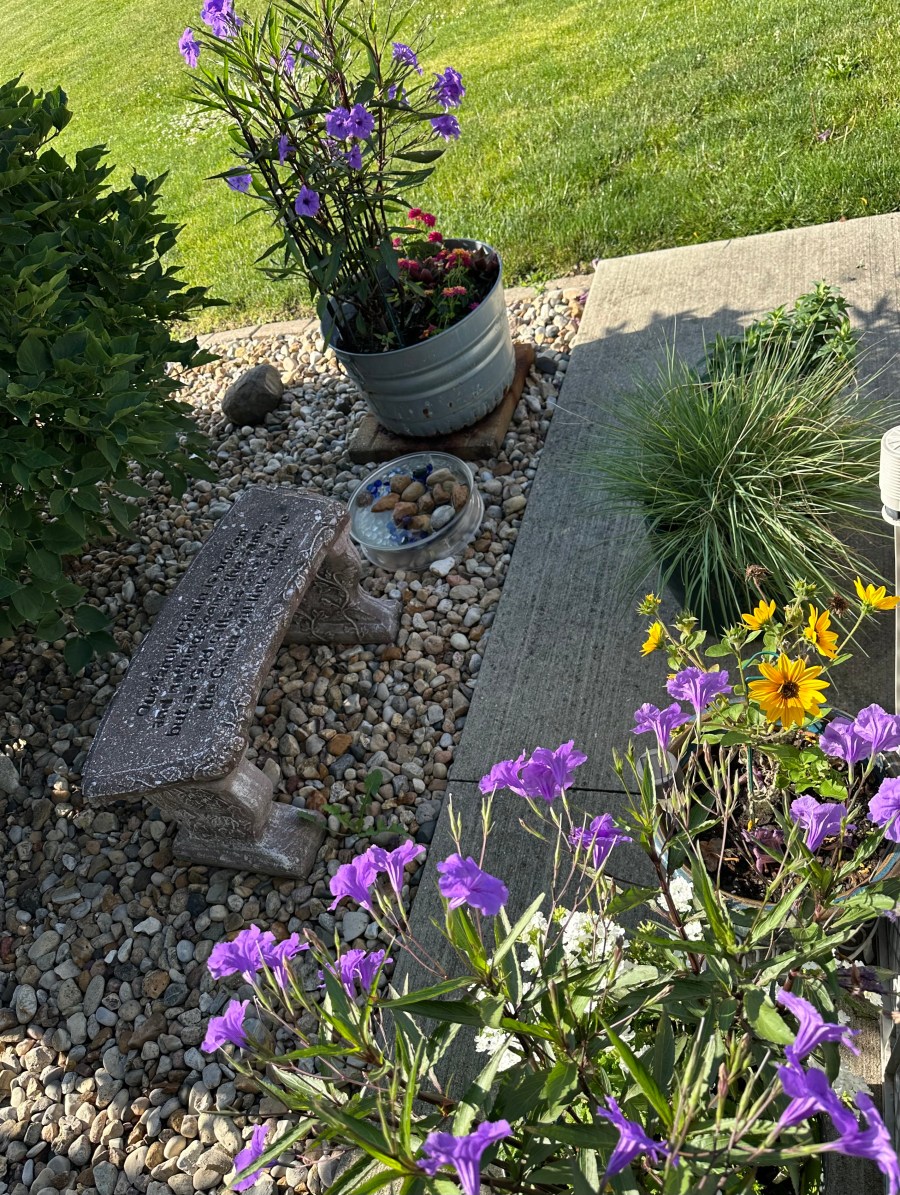
Image: Flowers and a bench on my patio

Featured

Still learning

Did you know that a typical Jewish Torah scroll is 86 feet long? I didn’t! They are handwritten and if a mistake is made during the creation of the scroll it is discarded and process begun again.

This past week I went on a bus trip to three places of worship in Chicago – Holy Name Cathedral, the Chicago Loop Synagogue, and the Baha’i House of Worship in suburban Wilmette. It was a fascinating day and I loved learning new things about other faith traditions, as well as sharing some things about our Catholic faith and tradition at the Cathedral with those on the trip who pulled me aside to ask questions.

While we were at the synagogue I noticed a lamp burning above the Ark, where the Torah scrolls are kept, and asked about it because of the similarity to a sanctuary candle in every Catholic Church by the Tabernacle. The assistant director of the synagogue praised my question and acknowledged that the Ner Tamid, or Eternal Light, always burns above or near the Ark representing God’s eternal presence. In a Catholic Church we have the red sanctuary light burning at all times (except after Holy Thursday Mass until Easter Vigil because Jesus is no longer present in the Tabernacle) by the Tabernacle in the Church indicating the presence of the Blessed Sacrament.

I admit to being enthralled with studying and learning new things. When people ask what I am reading they might expect a current bestseller or fiction book but it is almost always a book on spirituality, self-improvement, or a biography of someone I admire. As a matter of fact I could probably stop buying books and still read new books for the next 5 years! I’ll catch up one of these days.

The Catechism of the Catholic Church (CCC) encourages our study and ongoing learning. In Article 6 regarding Moral Conscience, the CCC tells us that it is the voice that calls us to love, do good and avoid evil. It guides us to behavior that we view as just and right for ourselves and those we encounter. But it goes on to say that our conscience must be informed and enlightened. We can’t expect that we learned everything that we need to act with an informed conscience, or to act in accord with the teachings of the Church, or whatever faith we practice, when we were instructed as young children. Education of our conscience is a lifelong and ongoing task, according to the Catechism.

Many of us, in Catholic and Protestant services, listened to the scripture of the Good Samaritan this weekend. Jesus teaches with this parable to encourage unconditional love and fair treatment to all regardless of our differences. An insightful Benedictine reflection that I read this Sunday morning reminded us that “we aren’t there yet. We need to keep re-tuning our ear and correcting our vision with the lens of charity, humility, and truth.” That is exactly the reason we continue to listen and be transformed by the Living Word of God (and hopefully by homilies and sermons that encourage the kind of behavior that Jesus challenges us to).

This desire for ongoing learning is the reason that I love the Wednesday Papal Audience and Angelus addresses given by our Popes. They are a brief catechesis on current topics of the day, how we should treat each other and live our lives. I want to keep my mind and heart open to seeing things a new way and changing those aspects of my thoughts and behavior that are not aligned with the heart of Christ.

Whether it is your faith life, or an area you desire to grow deeper in understanding and knowledge, keep learning! I offer these reminders for us to consider this week:

“I am still learning.” – Michelangelo (aged 87)

“Wisdom is not a product of schooling but of the lifelong attempt to acquire it.” – Albert Einstein

“Therefore we intend to establish a school for God’s service. In drawing up its regulations, we hope to set down nothing harsh, nothing burdensome…But as we progress in this way of life and in faith, we shall run on the path of God’s commandments, our hearts overflowing with the inexpressible delight of love.” – The Prologue of the Rule of St. Benedict

Wishing you abundant peace and hope this week, Deena

Image: Torah scrolls in the Ark at the Chicago Loop Synagogue