Featured

Dawn of a new day

One of the things that I have realized in dealing with, and recently writing about, issues around mental health and well-being is that things always feel worse at night. The darkness, heavy with shadows and devoid of light, seems to forbid seeing possibility. Gloom settles in easily. In January I cancelled all streaming channels and was content to read or work on art projects. The past couple of months required noise from the TV or from YouTube videos, even if they were positive or spiritual talks, as a constant companion, reminding me I wasn’t alone. This week that noise has become a distraction and annoying, TV, especially the news, was intensifying the anxiety instead of calming it. That was a sign, for me, that things are beginning to change. I am beginning to find my way back to peace.

The darkness became a metaphor for the things that I didn’t want to face or deal with. Whatever flaw popped up in my mind became ten times worse when I refused to look at and acknowledge it. As I heard Fr. Ambrose Criste of St. Michael’s Abbey say this weekend as he began the St. Michael the Archangel Novena (preparing for St. Michael’s Sept 29th Feast Day), we need to acknowledge how far we have drifted from the light. We have to recognize and name the darkness, not to be discouraged by it, but rather to be healed. He remarked that only what is named and brought into the light can be healed. “Only what is seen can be surrendered.”

During the Healing the Whole Person Retreat that I attended at the beginning of August, Sr. Miriam Heidland invited us to engage our healing journeys with curiosity and kindness instead of judgment. We were reminded during the retreat that “suffering that is not transformed is transmuted.”

It requires humility to face those areas of our lives that we are not living to our full potential. Qualities that we have been gifted by God to live and express in our being but have been ignoring. To do so, for whatever reason whether doubt and lack of confidence, or due to some harm or damage inflicted by someone, is to ignore what God is calling us to do or be. It’s as if we are saying, I know better than God and my choice to live in fear and lack of trust is more important than trusting that God is leading me to live a certain way. It may also be the divisive voices of the world, the enemy, or the “false spirit” as I prefer to call it. One of those faulty messages is doubt.

Doubt, whether real or imagined, is harmful to our emotional well-being. It can lead us to self-isolate and avoid situations so we don’t have to pretend to act in a way that we aren’t feeling. It can result in procrastination and indecision because we don’t trust that we can make the right decision. We begin to use negative self-talk and criticism about the things we are doing and how capable we feel. We begin to compare ourselves to others, and if we do so through the lens of social media, we will never measure up because the standards we set become unrealistic. Doubt increases stress, anxiety and depression.

When we welcome the light of hope and truth, we can see the flaws as they really are, something to surrender to the grace of change. Then we move forward, yearning to live in trust and peace. We can cast doubt aside, even in difficult situations, and trust that we are not walking alone. I lean in to the words of Psalm 34, “The Lord is close to the brokenhearted”, the Lord delivers us from our troubles.

On Saturday, Pope Leo XIV spoke a message to those suffering with ALS, acknowledging the difficult burden they bear but offering an insight, and reminder, that the disease offers an opportunity to see that the quality of human life is more than achievements, it is dependent on love. He encouraged them to grow in gratefulness, especially for those who care for them, and for the “beauty of creation, of life in this world, and of the mystery of love.” I think this is a message we can all take to heart, no matter what we might be facing in life.

Wishing you abundant peace and hope this week, Deena

Image: Sunlight streaming through the trees and Anderson Japanese Gardens

Featured

A stronghold

This weekend our local area Oblate group met and began our 2025-2026 reading and discussion of Sr. Joan Chittister’s The Rule of St. Benedict: A Spirituality for the 21st Century. Many of us have studied it in our Oblate groups before but it’s a wonderful commentary of The Rule to revisit for anyone desiring to follow this spiritual guidance in our secular world. As we began our study for this month, we read the chapters of The Rule on guidelines and order of praying the psalms in the monastery. Each monastery creates a breviary, or guidebook, for the praying of the 150 psalms. It is similar to the order of praying the psalms in the Liturgy of the Hours, or Divine Office, prayed by clergy and lay people each day in a sequence of four “weeks”. St. Benedict in his Rule said that how and when the psalms are prayed could vary but it was required that monastics pray all 150 psalms. I don’t have a copy of the breviary used by the Monastery that I am an Oblate, so I pray the traditional “Office”. Over the course of 30 years since it was recommended, and that I have tried (my discipline and commitment have varied over the years, so don’t be too impressed!), to pray the Liturgy of the Hours each day, for Morning and Evening Prayer, certain psalms have become favorites. They become like a healing balm or a familiar friend on days that it feels difficult to pray or that nothing I pray or read seems to help.

There have been plenty of those days in recent weeks. The violence seen in our national news and the continued atrocities of war in other countries are hard to ignore, even if we don’t watch the news. I shared with my chiropractor this week that I am worried for the emotional well-being of young people who are bombarded on social media with these images and opinions. We pondered the impact these stories are having or wondered if they are becoming desensitized to it all. As a child of the 60’s I recall the impact of watching the violence of the Vietnam War on evening news, but it was only on the nightly news or in newspapers, we didn’t have constant images thrust upon us on cell phones and computers.

In this week’s blog I would like to continue the discussion about depression and anxiety and ways to deal with it. I am grateful for the abundance of information on social media in September for Suicide Prevention Month. These sites or pages are dedicated to raising awareness and breaking the stigma around mental health issues. It has not only raised my awareness of statistics regarding suicide and depression but helped me feel understood. Symptoms of depression are varied and we may not even associate them with our depression. It’s easy to try to convince ourselves to ‘just snap out of it’ or “get over it”, whatever the “it” is that perhaps we haven’t really identified anyway!

What can compound the stress is adding the belief that, as a Catholic Christian or person of faith, we should be able to pray our way out of it. The internal dialogue of “if I was holy enough,” “if I was faithful enough,” or “if God really loves me” suggest that if I was any of those things, then all of the anxious feelings would magically disappear. But that isn’t the way that it works! I am not saying that prayer isn’t helpful or that even if we don’t feel like it is working that we should give up on it. We have a wonderful model in St Teresa of Calcutta whose writing revealed 40 years of spiritual dryness, desolation and feeling abandoned. But in all of that, she remained faithful to prayer, to service of the poor and to leading her community.

This week I received and began reading a wonderful 30-day guidebook, Anchored in Peace, by the founders of the social media page, Mindful Christianity. The father and son writing duo begin the book by reminding us that our fear and anxiety do not disqualify our faith. The book is a combination of scripture passages, reflection questions, mindful Christian practices and prayers to help us navigate the difficult times we are experiencing. They suggest that we don’t want to hide the anxiety and pretend it doesn’t exist but bring it into the light and presence of God to be there with us. The authors counsel that we can let our guard down, present the honest feelings we are having, and let God be our refuge, anchor and peace, a day at a time.

After our Oblate discussion this weekend, I reflected that there are many psalms that can be prayed during times of anxiety and depression, psalms that can bring comfort and reassurance. I recalled one of those healing psalms for me. Psalm 144 is prayed on Tuesday of Week II, it is a prayer for victory and for peace. In the psalm King David is praying to God as a fellow warrior, defender and protector. As I pray that psalm I pray for the help of a God who can strengthen me in the daily battles I face, whether emotional or spiritual. I offer a few lines as comfort in the battles you may face in life.

Blessed be the Lord, my rock,

who trains my arms for battle,

who prepares my hands for war.

He is my love, my fortress;

he is my stronghold, my savior,

my shield, my place of refuge.

Wishing you abundant peace this week. Deena

Image: the medieval castle walls in the city of Avila, Spain

Featured

A season of change

Saturday morning I was motivated to get moving early and left for the gym by 7 a.m. While driving I saw a flock of geese flying from a body of water to their morning destination. I smiled wide and wished that I had been parked somewhere to hear their loud and noisy morning conversation, likely discussing the best field to descend upon. Seeing them in their large wedge reminded me that fall is on the way.

The past few days have been glorious with the arrival of cooler temperatures; chilly mornings, lovely sunlight days and crisp evenings. I have even seen a few orange leaves on trees as well as the subtle hint of change to come in the green leaves still lush on the trees. I am ready for more days like this and all of that change. It is absolutely my favorite season.

To be cliche, Autumn reminds us that change can be beautiful.

However, we can fear, resist and even struggle with change, whether it is internal and emotional or external and situational. That fear, resistance or struggle can bring on feelings of depression or anxiety. I’ve been battling with this for the past month or so. Things are getting better, but I want to share some thoughts and ideas over the next couple of blog posts in the event that you struggle with this at times. We all have a “bad day” now and then, but more serious, or clinical, depression is when it lasts for a longer period of time, such as a couple of weeks.

I saw an insightful post this weekend on happiness, Mental Health in America and Suicide Prevention Month. It reported that over 800,000 people die by suicide each year, one death every 40 seconds. They suggested that we destigmatize mental health and let others know that talking about mental health is not attention seeking. People die in silence every day due to the judgments of others. I know, for myself, it’s easier to hide behind “I’m fine” when asked how we are doing. In a world in which we are so constantly connected and “talking” to others, it is amazing that we can feel so alone and isolated. In 2024 a Gallup survey reported that 30% of adults experience weekly loneliness with single adults being more greatly impacted and young adults (15-24) feeling lonelier than any other age group. Yet, seeing any group of young people at a table or gathering, chances are you will see them with heads in their phones, staying “connected”.

I have been utilizing a variety of tools and resources to help deal with the feelings I have been having. Things like talking to my doctor, meeting with a counselor, seeking spiritual guidance, spending time in prayer and meditation, reading books and poetry, taking supplements to help with mood and relaxation, and exploring a variety of creative projects have all provided some assistance. Friends that are able to listen and provide genuine care and compassion are essential so seek them out and let them know how you have been feeling. Go slow and make sure you are sharing with a friend that will truly hear you so that you don’t feel worse after opening your heart. It isn’t the words that they say in response, but the care you feel that will make the difference. However, if you feel alone and that no one will understand, please know that there are places to turn. Reach out to your pastor/priest, deacon, or other resources in your communities of faith, such as a spiritual director or faith companion, or by exploring mental health resources in your community. I also hope that some of the ideas that I will share in upcoming blogs will be of some assistance.

In addition to any of those resources, we have to be willing to look at things in a new way and to be open to the grace that comes to us as we pray for change. Friday’s Gospel reading of the day, from Luke chapter 5, regarding the old and new wine skins is a great reminder. We need new wineskins for new wine. Jesus says new wine in old wineskins will cause them to break. He also says that the person that has been drinking the old wine doesn’t want the new wine, saying that the old wine is good enough. Change is hard. It’s risky. We have to put on new ways of seeing, thinking and being. If we just consider the struggle, we won’t want to change. But if we look for the opportunities, we just might see the situation in a new way.

I was reminded of the Autumn – Season of Surrender section of the book, The Circle of Life; The Heart’s Journey Through the Seasons, by Joyce Rupp and Macrina Wiederkehr. In one of the chapters in that section, Joyce Rupp writes “If you look at a sunset, you might see only the disappearance of daylight. If you look beneath, you may see darkness opening the splendor of stars… If you look at lost dreams, you might see only disappointment and doubt. If you look beneath, you may see the stuff that new dreams contain… If you look at yourself, you might see only tarnished unfinishedness. If you look beneath, you may see your basic goodness shining there.”

Let’s be willing to “look beneath”.

Today I conclude with a few lines from a favorite Mary Oliver poem, Wild Geese:

Meanwhile the wild geese, high in the clean blue air,
are heading home again.
Whoever you are, no matter how lonely,
the world offers itself to your imagination,
calls to you like the wild geese, harsh and exciting–
over and over announcing your place
in the family of things.

Wishing you abundant hope, peace and the assurance of knowing you have a place in this world and that you are not alone, Deena

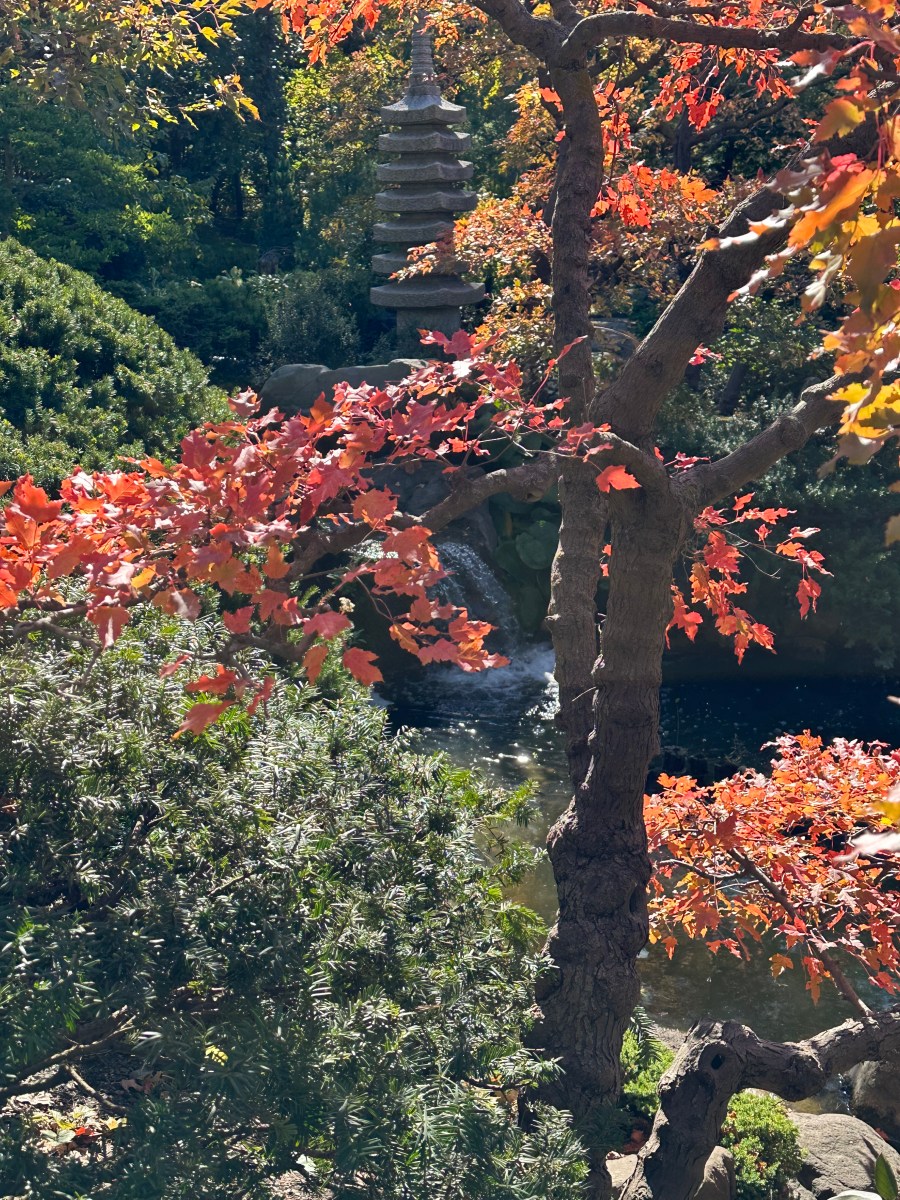
Photo: Tree colors from my visit to Anderson Gardens in Rockford last fall.