Featured

Embrace joy

Joy and happiness are emotional states that are often used interchangeably but actually joy is very different. Happiness might be found in response to life circumstances such as setting and completing a goal. Joy, science is telling us, may be experienced even amidst life hardships or uncertain times. I might not be happy all of the time, but I can experience joy regardless of what is going on in my life by being intentional about certain things in life. For me, my faith and prayer life, are huge contributors to my experience of joy.

An article published by the National Institute of Health in May of this year said that lots of attention is given, in popular psychology, to positive emotions and finding happiness while joy is still an area that would benefit from further study. A study cited, of adults ages 28-59 from the United Kingdom, reported “fostering positive relationships, engaging with nature, and cultivating self-awareness were identified as key strategies for sustaining joy.”

A study of 7000 individuals, reported by National Public Radio in 2023 as part of the BIG JOY Project, reported that “people who commit daily “micro-acts” of joy experience about a 25% increase in emotional well-being over the course of a week.” Emotional well-being was described as attributes such as better coping, less stress, quality relationships, and feelings of hope, optimism and even fun. Examples of the micro-acts of joy included gratitude journaling, doing a random act of kindness, visiting a sick neighbor, celebrating a friend’s joy, or engaging in self-reflection. The researchers asked whether doing these small acts of joy can make a difference and referred to “the ideas of the Dalai Lama and Archbishop Desmond Tutu, who both spoke about how it’s possible to feel joy even in the midst of suffering, and to use that feeling to help do good.” Our joy, it seems, help us not only enhance our own well-being but contribute to the lives of others when we use our joy as a motivation to share with and help others in the world. I am sure we can think of others in our personal circle, or the wider circle of our communities, that could use a bit more joy these days.

Randy Taran, founder of Project Happiness, wrote in her daily email update that “joy isn’t something you wait for. It’s something you choose, amidst the struggle and in life’s tender moments, that make life worth living. Embrace the people and the things that bring your heart healthy doses of joy.” Things like buying yourself flowers, watching the sunset (or I would add, stepping out to experience the Northern Lights this past week), dancing in the kitchen or taking a long route home are some of the suggestions she offered.

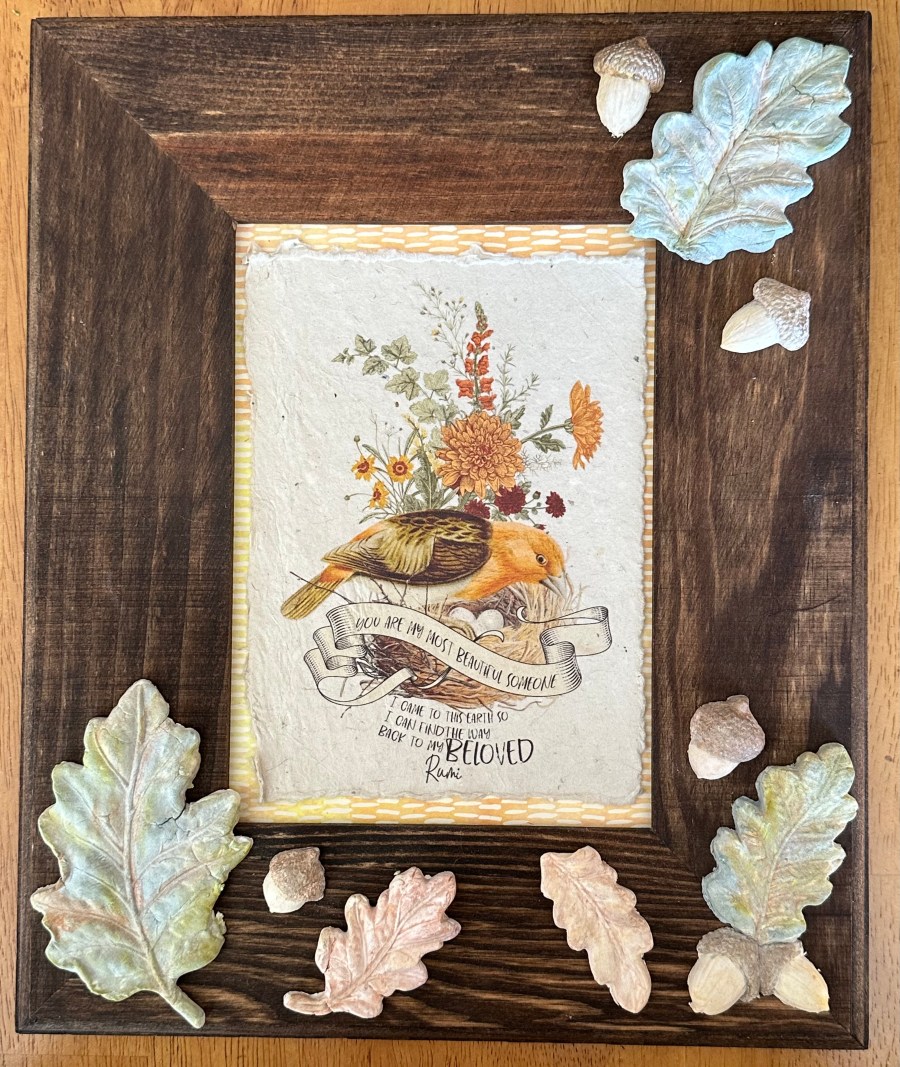
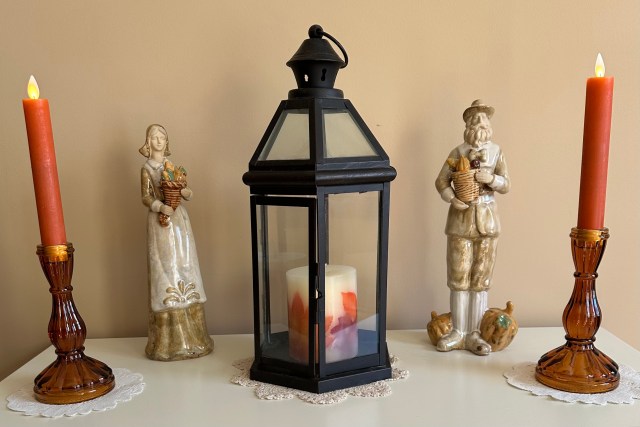
Exploring the world of creativity, the impact of expressing myself in creative acts, is also a way to increase joy and mindfulness, while decreasing stress and anxiety. Creativity becomes a means to tap into my own wisdom, gain clarity in difficult situations and decrease stress, either personal situations or response to societal events. Perhaps painting, knitting or crocheting, making handmade cards, or frames like the one I posted as the featured photo, are ways that you might express yourself. A friend, Joan, on Facebook shares her creativity by posting her table settings. They are always expressions of beauty, care and love by the way she has displayed her table. I love creating little vignettes with decorations, like a Thanksgiving display, photo included on blog site, or setting out favorite seasonal items. Some of those items may evoke an emotional response, to a family member or celebrations in the past. It may just be the way the colors you choose make you feel when you look at them. All of these are ways of expressing your inner artist and creative soul.

As we move into preparing for the holidays, days that can be stressful or frantic, how might you engage in a daily micro-act of joy. What can you do each day to reconnect with inner joy or creativity, so that regardless of how holiday planning is going, you find more peace and tranquility? As we find and experience more joy, it will likely spread to those around us!

Wishing you a week of abundant joy and hope, Deena

Featured

How you start your day

Are your morning routines defined and predictable? Do you have things you do each morning that help you get ready for the day ahead? I have been reading lately that how you start your day, sets your day. I have a pretty reliable and set routine each morning but lately I have been questioning the effectiveness of each morning and also why I am not getting some of the reflection time in that I used to. I miss it and want to find a way to incorporate that quiet morning time back in my schedule.

I listened to Dr. Arthur Brooks, “the Happiness professor, best-selling author and Harvard professor, on YouTube a couple of weeks ago. He described his 6-step protocol each morning that he suggests will create a better day. He begins by getting up at 4:30 a.m. (Dr. Brooks cited a study that showed higher levels of productivity and creativity in those who began their day before dawn), after starting with an early bedtime the night before, exercising first thing (he has a gym in his home or when traveling only selects hotels with 24 hour gyms on premise), having time each morning to spend in spiritual reflection (he goes to daily Mass), delaying his morning coffee (saying that it improves focus and energy throughout the day) and has a high protein breakfast. Then he gets on with his day and makes sure his time is productive time by ignoring emails, the newspaper and social media until later, or checking hourly.

I enjoy listening to Dr. Brooks and his thoughts on happiness, reducing stress and anxiety, and spirituality. But I listened to these six points and felt like such an under-achiever! But to his credit, toward the end of the video, he said try it and adapt it to yourself, even inviting viewer response on how we might have changed it for our lifestyle.

Another routine I read was similar; plan the night before, get enough sleep, limit phone and technology use before bed, practice gratitude, hydrate in the morning, eat a healthy breakfast, move your body or exercise, and practice mindfulness or journaling.

Last week, in an online class, we talked about morning routines and setting daily intentions. Our discussion was about finding a routine that works for us and being aware, or conscious, as we completed all the tasks each morning that feel like an obligation or perhaps even prevent us from doing these things I have listed above. The main point was changing our attitude about those duties that feel as though they are hinder us from doing things we would prefer to do, in my case, my quiet reflection and journaling time.

I tend to get up at 4 or 4:30, feed the cats but don’t always stay up and begin the day at that time. That might be a good place to start, but that also means I have to do a better job of getting to bed early so that I am ready to stay awake at 4:30 a.m. I love watching the sunrise, so I am usually up by then, especially recently as the mornings are darker longer (well, at least until next week). Before daily Mass I do the social media posts for my parish, then get ready for Mass. When I get home the cats usually want more attention, or food if they ate at 4 a.m., and I want my coffee! I do a terrible time with a healthy protein-rich breakfast. At one point I thought about a protein smoothie first thing, but read one natural health practitioner say not to have anything cold first thing in the morning. I hate eggs and don’t eat meat, or very little, so that rules out lots of morning breakfast options. Maybe the better choice is still selecting the smoothie, even though it’s cold, because I would begin the day with protein and fruit.

I have been, over the past few months, working as a social media assistant for two different entrepreneurs, one an independent training and holistic practitioner and the other a retail establishment. I have noticed I get drawn into social media more than I did in prior months by checking out posts and techniques used, which then leads down a rabbit hole of viewing other posts and updates. I would like to discipline myself enough to come home from Mass, make the smoothie (or find a better alternative), make my coffee and sit down to journal before I begin my online work activities. A half hour or so isn’t going to make or break the day for daily sales at the store or online enrollments! Based on Dr. Brooks video, it might make me even more productive and focused.

If you are a pet parent, you also know that you have to be flexible for changes in routine. The cats love the patio as soon as I get home and I am happy to open the doors and windows to get fresh air in the house. The holistic practitioner I mentioned above, regarding the cold breakfast, suggested getting 10 minutes of sunshine early in the day, so it would be nice to step outside with the cats for a bit. That would add 10 more minutes to a routine before beginning work. But seriously, 10 minutes isn’t going to prevent me from getting things done and might even help, by standing outside, taking some deep breaths and reflecting on the day ahead before I sit down to journal.

The gym usually gets delayed until afternoon, if I get there, because I prefer to go when fewer people are there and I can’t imagine adding one more thing to the morning before doing my online work. But that works for me and I guess that is the point of this discussion. My recommendation is take in all the ideas and suggestions about creating a great day and then do what works for you. By all means be flexible and spontaneous too. This Sunday morning I was asked to “play the organ” (i.e., hit the buttons at the right time) on our amazing organ at church, that Fr. Carlson programmed with the music for Mass. I wasn’t in the mood to begin this blog on Saturday evening, my normal writing time is early Sunday morning, but I also wanted to help and relished the idea of attending Mass again this morning after attending Vigil Mass on Saturday. So I am posting it later than normal today. The world isn’t falling apart as a result. Often, on Wednesday mornings after Mass, the ladies invite me to join them for breakfast or a friend might reach out and suggest meeting for coffee. Being social and spending time with people I enjoy is also important to me and my well-being, even if it means other morning activities are delayed a bit. I think the most important thing is that we feel that we are choosing versus reacting to the activities in our day, having a positive attitude and making the most of the time we have been given.

I’d love to hear your thoughts on starting the day in a way that sets you up for a happier, more joyful, day. What routine has been most impactful for you? Do any of these ideas sound like ones you would like to incorporate?

As always, I wish you a week abundant in hope and peace, Deena

Blog image: Bela deciding that he needed to be a part of my morning routine a few years ago.

Featured

Grounded in faith

I started reading Brene Brown’s new book, Strong Ground: The Lessons of Daring Leadership, The Tenacity of Paradox, and The Wisdom of the Human Spirit, the past few days. I have to admit that it is always her personal reflections and application of her work with the Dare To Lead program that I find most thought provoking in my own life. We’re all leaders in some way; family, church or social organizations, the way we interact and care in relationships, but having stepped away from corporate work I am less interested in leadership qualities at that level. Still, I was intrigued with Brown’s new book and thoughts she might have on the current state of our societal relationships and leadership. I am glad I followed the hunch to purchase her book.

She began with a personal story about recovering from a pickleball injury and how her coach helped her find and work from her core, engage her body and mind in the healing process, and connect to her “strong ground.” She suggests that many of us are struggling to find our ground. She proposes that individually, and collectively in our country and in organizations, “we need to push into the source of our strength and sturdiness so we can navigate the world. We need the ground to steady us and at the same time to propel us into purposeful action.”

Brown writes quite a bit about her study of, and personal journey with, the mindfulness work of Jon Kabat-Zinn in relation to finding our center and being grounded. Citing research she did for another book, Brown says that both anxiety and calm are contagious. She reminds us that staying calm is an intention. When we consider those we encounter each day, “Do we want to infect people with more anxiety or heal ourselves and the people around us with calm?” We need to pay attention; to our breath, to what’s going on within as we speak and make decisions. I NEED to reflect on the attitude I have as I leave the house, am I going to contribute to the day that others are having or am I going to be a tornado of worry, concern and anxious thoughts as I venture out? Some days it just might be better to stay in until the calm returns and I feel grounded in the truth of who I am.

So far, my favorite sections of the book have been on transformation and “grounded confidence”. I tend to read the first couple of chapters of a new book, then browse and read selectively to get an idea of the entire book I am reading, then go back and read more slowly and thoughtfully. In writing about transformation, and summarizing her reflections throughout the book, Brown examines the false notion that learning and change are only about effort one applies. She suggests that real change happens when we focus and build our foundation, and operate from that place of being grounded, instead of reacting to a current situation or perhaps even worse, being so set in our ways that we think that the problem is with everyone else, thinking they are the ones that need to change, not us!

Personally, one place that I build my foundation and center myself is in my daily prayer, reflection and journaling. Daily Liturgy of the Hours, Lectio Divina, or scripture reflection remind me of God’s love and presence, no matter what seems to be going on around, or within, me. The Letter of 2 Timothy caution us that there will be people around us that deceive us and will go “from bad to worse”. But remaining faithful to what we have learned and believed, from Christ, we will remain “competent and equipped for every good work.” (2 Timothy: 3)

Remaining faithful to the daily practice of reflecting on the truth of our faith, we will be “strengthened with power through his Spirit in the inner self, and that Christ may dwell in your hearts through faith; that you, rooted and grounded in love, may have strength to comprehend with all the holy ones what is the breadth and length and height and depth, and to know the love of Christ that surpasses knowledge, so that you may be filled with all the fullness of God.” (Ephesians 3: 16-19)

With that as the source of my strength, I am grounded, more capable and willing, to engage with the world with hope and joy.

Wishing you abundant hope and peace this week, Deena

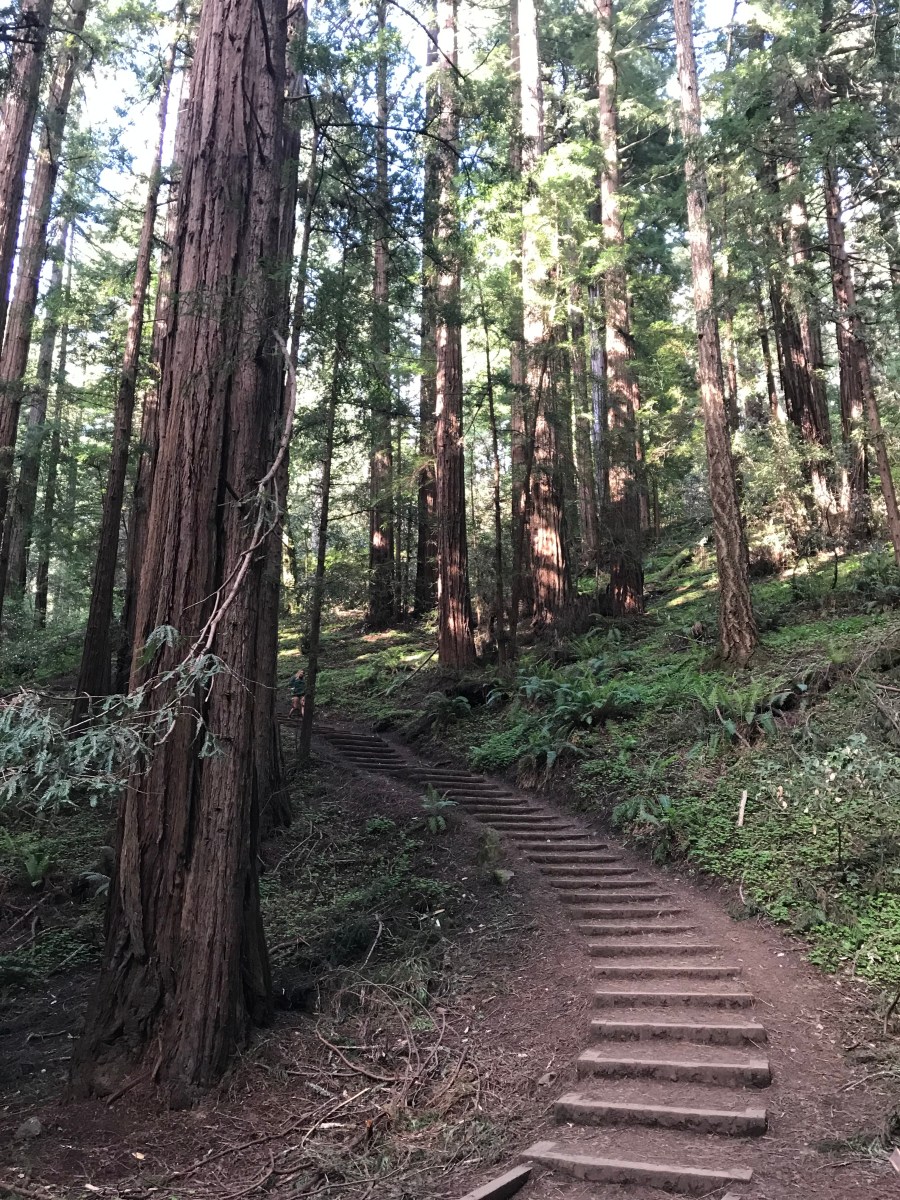
Photo: Taken during a visit to Muir Woods, California

Featured

Whisper of the soul

A few weeks ago an opportunity to apply for a position that 10, maybe even 5, years ago would have been a dream come true, presented itself to me. At that point in my life I would have considered moving to be sure that I would be as available as the position would require. I applied but as I reflected upon it, and listened to the voice within, I just knew it wasn’t the right time or role for me as I wind down my 60’s this year. I emailed and withdrew my name. Once I made that decision, in God’s timing and providence, I was asked to be a social media coordinator for a second client. It’s with a business that is very appealing to me and my personal interests. They carry products that inspire me and my creativity. Both of my part time clients are in the business of things that I enjoy. I feel that I am contributing, but am also challenged to learn and grow.

Saturday was the Memorial of St. Pope John XXIII, the Pope who convened the Second Vatican Council, to bring a breath of fresh air to the church, which resulted in changes to the liturgy (such as praying in English instead of Latin for those of us in the US, and the altar facing forward) and church structure. He was a humble servant, a humanitarian, and was an advocate for human rights and for peace.

I read a quote on a social media page reflecting on his papacy, which I fell in love with, so I wanted to learn more about it. The quote: “Consult not your fears, but your hopes and dreams. Think not about your frustrations, but about your unfulfilled potential. Concern yourself not with what you have tried and failed in, but with what it is still possible for you to do.” Pope St. John XXIII

I found the quote in a Papal Artifacts site that documented St. John XXIII and his accomplishments. But Google indicated that the quote is not cited in any specific papal document but seems very much in style of his Daily 10 Point Plan. The Pope’s “Daily Decalogue” was shared in a memorial Mass in 2006 by Cardinal Tarcisio Bertone. It includes daily resolutions such as living with a positive attitude, reading and creating a daily plan, and believing that he was created to be happy, believing in the Providence of God in his life and to do good in life each and every day. So I think the quote is still a good one to share and that that it represents the spirit of how St. John XXIII approached life.

This week grab a notebook or piece of paper and write down your hopes and dreams. Create your own personal “daily decalogue”, ways you would like to approach each day. I have a series of things I do each day, but not always in the morning. I have been reflecting that I would prefer to challenge myself to get up earlier each morning (or if I wake up at 4:30, which happens a lot these days, stay up) and begin my prayer and journaling. It is with focused attention and reflection that we get clear about what is important to us and what we desire in life. I have always believed that the desires we hold in our heart are calling us to use the gifts that God has given us in life, as long as they bring us closer to God and serve others in a life-giving way.

This past week was also the memorial of St. John Henry Cardinal Newman. One of his prayers, which I learned during Lay Ministry training in our Diocese in the 1990’s, has remained a favorite over the years. It also speaks of our soul’s purpose. I’ve shared it before but would like to share here again. I hope as you read, and pray with this, you are reminded that there is something specific you are on this earth to do. Listen and then follow that desire.

God has created me to do Him some definite service. He has committed some work to me which He has not committed to another. I have my mission. I may never know it in this life, but I shall be told it in the next. I am a link in a chain, a bond of connection between persons. He has not created me for naught. I shall do good; I shall do His work. I shall be an angel of peace, a preacher of truth in my own place, while not intending it if I do but keep His commandments. Therefore, I will trust Him, whatever I am, I can never be thrown away. If I am in sickness, my sickness may serve Him, in perplexity, my perplexity may serve Him. If I am in sorrow, my sorrow may serve Him. He does nothing in vain. He knows what He is about. He may take away my friends. He may throw me among strangers. He may make me feel desolate, make my spirits sink, hide my future from me. Still, He knows what He is about. (St. John Henry Newman)

Wishing you abundant peace this week, Deena

Image: Some plants, and an adorable sign, in my raised bed.

Featured

Ora et labora

I have been blessed to work a variety of interesting jobs in my life. I have learned new things in each, which were always helpful for the next adventure in my career. I rarely until more recently in life, viewed the work I did as holy.

The Rule of St. Benedict advises the monks of the abbey (or Oblates like me who choose to follow The Rule in life) that “Idleness is the enemy of the soul. Therefore, the monastics should have specified periods for manual labor as well as for prayerful reading.” (Chapter 48 of the RB) During the time of St. Benedict the monastery did not have slaves to do the work of the monastery as was true during this time in history. Work was part of the basic life of the monastery. Benedict believed that the monastics should not benefit or taken advantage of the labor of others or to be a burden on others. It was a privilege to contribute to the life of the monastery, it was purposeful and valuable to the lives of those living there.

We often hear Ora et Labora, pray and work, as I used in my title for today’s blog, associated with The Rule of St. Benedict. While not actually words written in The Rule, it is a motto that represents the orderliness of prayer and work that St. Benedict believed led to a balanced spiritual life. I also like Esther de Waal’s statement in her book, A Life-Giving Way, that “ora, labora, lege (prayer, work, read) would be preferable” to describe life in the monastery. Monks had assigned tasks, non too burdensome for the person doing the work, their designated times of community prayer during the day, but also the times of prayerful reading (lectio divina) and study so that the mind and heart were engaged in growing too.

For St. Benedict, all work done by monastics was valuable. It was a necessary part of life in the monastery but it was also a way of serving others and serving Christ. In the book, A Little Rule for Beginners, Sr. Joan Chittister reflects on the “American Mind”, suggesting that God “leaves the co-creation of the world to us” and says “Our work is not a “job,” it is a contribution to the good of humankind and each of us must find our own.”

On this Labor Day weekend, let us reflect on the work we do, whether paid, volunteer or within our households, as part of the ongoing work of creation. What are we contributing to the world and to those around us? Are we glorifying being busy? Do we have a balanced approach to the time we spend working and the time we spend in prayer and reflection? Perhaps we can take this day of rest from our labors and reflect on how we view our work, or even ourselves in relation to our work.

Wishing you abundant peace and hope. Deena

Image: A photo of St. Benedict from one of my monastery visits in Arkansas (can’t recall which one) with the words Opus Labor (work, labor) on his Rule.

Featured

Visionary faith

I met with a Catholic counselor/coach this past month to explore a prayer technique I was interested in learning more about and discuss experiences I had during a recent retreat. One of the most helpful aspects of the meetings was a recommendation to explore a couple of personal assessments and then meet again if interested to discuss them. One of the assessments explored life experiences, or achievements, and what they reveal about the truest expression of ourselves. The summary stated that we change over time but “What remains constant are the God-given motivations that fuel your decisions and behavior.” This reminded me of the Spiritual Exercises of St. Ignatius of Loyola, that I have written about in previous blogs. The Spiritual Exercises help us name desires and motivations and in doing so, discover ways that we can serve God, in our own unique and personal way, and lead us toward God’s deepening life within us.

The assessment summary provides a person’s top 5 motivations and top motivational dimension. My top motivational dimension was Visionary. Each of the motivations and this top motivational dimension make perfect sense and I can see why I am drawn to certain activities and relationships in life and why they fill me up or make me feel purposeful and alive. I think it will be helpful as I continue to discern what’s ahead for me in life.

As I thought about the dimension of Visionary, someone who loves to envision possibilities and ideas and find practical ways to bring them to life or to inspire others to bring things to being in their lives, I thought about life with God and visionary faith. To be a Catholic Christian in today’s world requires visionary faith. While this was not what the assessment was talking about, I reflected that to live and share our faith with others requires a visionary approach. We live with a faith that hopes in the promises of God, that looks beyond what we see in our current reality, and looks to the spiritual realities to direct and guide our choices. When we look to those in scripture that heard and acted on God’s voice and guidance, they hoped in a life beyond current circumstances, they lived and acted, on God’s promises. With visionary faith we are able to move forward in life based on hope not fear.

But we are called to live differently as a result of our faith. Pope Leo XIV challenged us in today’s Angelus message saying that God doesn’t want a church full of those who only offer prayers and sacrifices. He says that our faith should lead us to practicing justice and loving our brothers and sisters in this world. Pope Leo went on to say that it isn’t an easy path, that our choices in life may be unpopular, that we must fight “against our selfishness, giving ourselves for the sake of others, and persevering in doing good even when the logic of evil seems to prevail.” That is visionary faith!

So, let us choose this “narrow path” (today’s Gospel, Luke 13:22-30), believing in the life that Jesus invited us to, discerning God’s will in our lives, and acting with courage and hope in pursuit of a joy that comes from living more deeply in God’s love.

Wishing you abundant peace and hope, Deena

Photo: I selected this image of St. Bartholomew and St. Lawrence from the Museo de San Marco in Florence, Italy, because today, August 24, is the Feast Day of St. Bartholomew. St. Bartholomew was one of the 12 Apostles and was recognized by Jesus for his pure heart and acknowledgement of Jesus as the promised one of God.

Featured

Before the bloom

This week I happened upon an article about pruning lantana plants. I have a few plants in pots and didn’t realize to get the most proficient blooms that it is best to prune them when the weather is hot and sunny, then as things begin to cool down you stop pruning. So, I will have to see, with warm days still in the forecast, if I can revive them a bit.

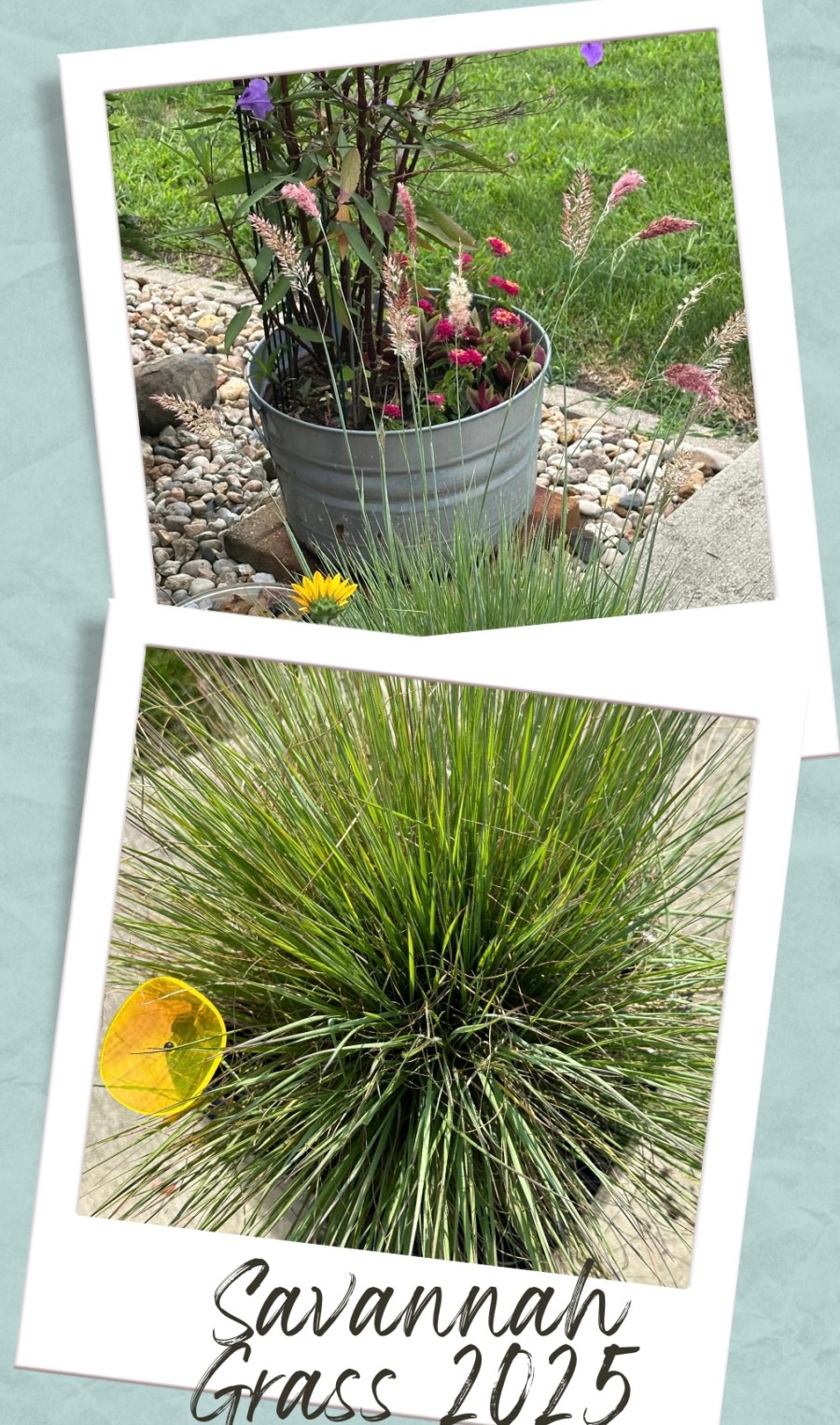
As a result I began reflecting on my Savannah Grass blooms. It’s a lovely grass that my friend Kathy introduced me to three or four years ago. I learned after the first year, one plant in front of the house and one on the patio in back, that they prefer a longer day of sunlight. So the past couple of years, and this, I have had two plants on the patio that has a full day of sun exposure. They produce a lovely, delicate, pink plume that gently sways in the breeze like the one we have this Sunday morning. The cats actually love a piece of the grass each morning, they sit and wait for me, not so patiently, to find the perfect blade for them. As you see in the blog photo for today, one of my plants has produced the anticipated blooms but one has not.

I began reflecting on why one plant produced plumes and the other didn’t. I water them at the same time and the same amount. I feed them on the same days. They are only seven feet apart and get the same amount of sunlight. Then I remembered that after buying the plants, both started from seed at the same nursery, that I repotted one in a larger ceramic pot with new potting soil, and the other I left in the large container from the nursery and just dropped it inside a very tall ceramic pot. The first year I bought that particular pot I filled it with soil (a lot of soil!) which made it difficult to move. The next year I emptied it, filled with bricks so that my Savannah grass can sit nicely on top the bricks inside the pot and cascade over the sides. The difference it seems is the soil that I planted, or did not plant, each of the grasses in.

As I reflected on my plant situation I recalled a recent Gospel reading, Matthew 13: 24-30, regarding the Kingdom of heaven being likened to a man who sowed good seed in his field. While I don’t have any weeds, like the parable, my plant didn’t produce the desired blooms.

If you aren’t seeing the desired “blooms” in your life, or desired fruit, using another Gospel and garden analogy, I invite you to reflect with me on the following questions. I would like to continue with my garden metaphor and ponder whether I have been seeing the fruits of the Spirit such as love, joy, peace, gentleness, patience, etc.

Has your “soil” been properly prepared so that you are seeing these fruits? If not, or if in some way someone or something was detrimental to that growth, what can you do to amend the soil? Are you watering your plants each day with prayerful reflection? Are you nourishing the soil with the support of a faith community? Are you watching for “weeds” or other harmful influences, that might choke growth and inspired living? Are you monitoring your growth or just hoping for the best?

As we enjoy these final weeks of summer, I hope you will use the opportunity to look at your flowers or gardens as an inspiration for your life, supporting and sustaining each day just as we would our precious plants.

Wishing you abundant peace and hope, Deena

Featured

Playing your hand

I love YouTube videos! I can find something to satisfy every mood – videos to learn a crafting technique, Paul Fey visiting and playing organs in various churches and countries around the world, news reports (especially when I stopped streaming TV and wanted to catch up on events) and listening to and reflecting on various spiritual talks and discussions.

Last night, Saturday evening, was one of those nights when I wanted to listen to something inspirational. I had a strong desire to further reflect on my week and some of the things that came up in prayer and journaling, trying to make sense of what action might be next for me. A video by Fr. Gregory Pine, a very popular Dominican priest and conference speaker, popped up in my YouTube feed so I followed the serendipity of the moment and watched his talk at SEEK25. I’ve watched many of his talks in the past so I knew it would be worth the time to listen.

During the conference talk, Fr. Gregory, said that in life we need to play the hand we have been dealt. He said that the journey is to honestly reflect on the cards we have. We can look at others and say yes, there are others who are more talented or more gifted, but how are we going to play our hand? The goal is to “play the game beautifully even if you don’t have the best cards.” As we look at our lives we might not love what we find or where we are, but that’s ok because it is a starting point, the “Lord made you good, and he loves you, and he loves your destiny more than you do, and he is excited about the prospect of conducting you hence, strongly and sweetly.”

If you have been reading this blog over the past (almost) three years, you know well that I am always looking for ways to grow spiritually and improve my life. It has become more clear in the past year that I also want to discern the ways that I can help others do that. The past week or so has been a time of intense questioning of that desire and how that might come to life. I have to be honest and admit that in assessing thoughts about the “how” I have gotten dragged down and was melancholy about when it was going to become clear to me.

A couple of things happened this week that reminded me, as Fr. Gregory did, to slow down and trust the process and divine timing. Wednesday during my weekly two hour of prayer before the Blessed Sacrament, during our parish Adoration time, I read a reflection by Christina Leano (on the staff of the Laudato Si Movement) in my Give Us This Day prayer guide that invited me to lean into curiosity and just show up in prayer, to simply ask “God, how do you want me to be with you right now?” and “rest knowing that the answer is secondary”. It was powerful and while letting go of the answer I might have been looking for, I was gifted with an insightful time of conversation with Christ. I was loved and beheld as simply who I am.

The next day I happened upon a seminar that might be helpful to me as I seek to use my gifts to help others. Then later in the week I listened to podcast that introduced me to some new concepts that are used in spiritual counseling. I was so excited about learning new ways that are being used to combine faith and spirituality in the realm of counseling, psychology, and brain science. I look forward to reading more about it, and my guess is, that in some way, it’s also a preparation and foundation for the healing work that will be experienced during my week long retreat the first week of August.

So Saturday evening, after listening to Fr. Gregory, I smiled in awe and gratitude in the ways that God might be aligning things in my path to pay attention to. I am also reminded today, in Luke’s Gospel for the Sixteenth Sunday in Ordinary Time, in the familiar story of Martha and Mary, that it is important to take the time to listen in prayer. Being busy, always doing, distracts from seeing those hints from God as they show up. It’s essential to be still and to be watchful for the guidance as it appears. But before all of that happens, it’s also important to know what it is I am seeking, to ask for the grace to be guided.

What grace do you seek this week? How might you just “show up” and sit in curiosity, watchful for the signs of God’s grace as they appear? Can you find time in your day to just sit and be held in the loving gaze and presence of God? You don’t need an agenda, or things to discuss, just show up and simply BE.

Wishing you abundant peace and hope, Deena

Image: Flowers and a bench on my patio

Featured

Still learning

Did you know that a typical Jewish Torah scroll is 86 feet long? I didn’t! They are handwritten and if a mistake is made during the creation of the scroll it is discarded and process begun again.

This past week I went on a bus trip to three places of worship in Chicago – Holy Name Cathedral, the Chicago Loop Synagogue, and the Baha’i House of Worship in suburban Wilmette. It was a fascinating day and I loved learning new things about other faith traditions, as well as sharing some things about our Catholic faith and tradition at the Cathedral with those on the trip who pulled me aside to ask questions.

While we were at the synagogue I noticed a lamp burning above the Ark, where the Torah scrolls are kept, and asked about it because of the similarity to a sanctuary candle in every Catholic Church by the Tabernacle. The assistant director of the synagogue praised my question and acknowledged that the Ner Tamid, or Eternal Light, always burns above or near the Ark representing God’s eternal presence. In a Catholic Church we have the red sanctuary light burning at all times (except after Holy Thursday Mass until Easter Vigil because Jesus is no longer present in the Tabernacle) by the Tabernacle in the Church indicating the presence of the Blessed Sacrament.

I admit to being enthralled with studying and learning new things. When people ask what I am reading they might expect a current bestseller or fiction book but it is almost always a book on spirituality, self-improvement, or a biography of someone I admire. As a matter of fact I could probably stop buying books and still read new books for the next 5 years! I’ll catch up one of these days.

The Catechism of the Catholic Church (CCC) encourages our study and ongoing learning. In Article 6 regarding Moral Conscience, the CCC tells us that it is the voice that calls us to love, do good and avoid evil. It guides us to behavior that we view as just and right for ourselves and those we encounter. But it goes on to say that our conscience must be informed and enlightened. We can’t expect that we learned everything that we need to act with an informed conscience, or to act in accord with the teachings of the Church, or whatever faith we practice, when we were instructed as young children. Education of our conscience is a lifelong and ongoing task, according to the Catechism.

Many of us, in Catholic and Protestant services, listened to the scripture of the Good Samaritan this weekend. Jesus teaches with this parable to encourage unconditional love and fair treatment to all regardless of our differences. An insightful Benedictine reflection that I read this Sunday morning reminded us that “we aren’t there yet. We need to keep re-tuning our ear and correcting our vision with the lens of charity, humility, and truth.” That is exactly the reason we continue to listen and be transformed by the Living Word of God (and hopefully by homilies and sermons that encourage the kind of behavior that Jesus challenges us to).

This desire for ongoing learning is the reason that I love the Wednesday Papal Audience and Angelus addresses given by our Popes. They are a brief catechesis on current topics of the day, how we should treat each other and live our lives. I want to keep my mind and heart open to seeing things a new way and changing those aspects of my thoughts and behavior that are not aligned with the heart of Christ.

Whether it is your faith life, or an area you desire to grow deeper in understanding and knowledge, keep learning! I offer these reminders for us to consider this week:

“I am still learning.” – Michelangelo (aged 87)

“Wisdom is not a product of schooling but of the lifelong attempt to acquire it.” – Albert Einstein

“Therefore we intend to establish a school for God’s service. In drawing up its regulations, we hope to set down nothing harsh, nothing burdensome…But as we progress in this way of life and in faith, we shall run on the path of God’s commandments, our hearts overflowing with the inexpressible delight of love.” – The Prologue of the Rule of St. Benedict

Wishing you abundant peace and hope this week, Deena

Image: Torah scrolls in the Ark at the Chicago Loop Synagogue

Featured

An ever-present call

I laughed out loud this morning when I read Kate Bowler’s Blessing for today on social media (“A Blessing and a Curse for your best life now”). “I am a project with a thousand open tabs. A walking checklist, forever waiting for the satisfying ding of completion. And this much is true: I am incomplete. But no one ever promised we’d get to feel whole.”

I LOVE THAT!

I often have this sense (and maybe you do too) of some magical finish line to cross. We think we will finally get all the insights, knowledge, tasks complete, big picture finally clear, etc. Then everything will be fine.

Nope! It doesn’t happen that way. It’s an ongoing, ever-evolving journey. (That’s exactly why I titled my weekly blog “Journeys”!)

We have to listen to the calls and invitations in life but then shape it to our own way of being in the world. One of my favorite craft makers and designers constantly reminds us, “You do you!” It doesn’t work to copy someone else or expect our “projects in life” to come out the same as their version. As a matter of fact, that would likely be pretty boring. Yes, I certainly look to others to inspire me but then have to do it my way, go “rogue” and make it my version of being.

Just the other day I was sharing a new project idea with a friend and thought it might be a great idea for her too. My project looked one way and the idea I had for her was something that would be unique to her and what she shares with the world. We both love to teach and help people grow in self-awareness and being their best selves, but we have two unique ways of sharing it. And that is just perfect! Neither of us could, or would want to, present our ideas the way the other one does. We support and encourage each other in our unique ways of being.

I’ve shared in previous blogs that this uniqueness of call is one of the things I love most about Ignatian Spirituality. Discernment, whether to our vocation in life, or the every day decisions we have to make, advise us to look at our desires, our unique gifts and aspirations, the needs of those around us and in the world, and most importantly, our dialogue with God and the guidance of the Holy Spirit. God wants to use the things we love to do, and that we have been given the ability to do, to do God’s work in the world.

I love the quote by Blaise Pascal, “The heart has its reasons which reason knows nothing of… We know the truth not only by the reason, but by the heart.” We have to listen to the desires of our heart, in union with our intellect and the Spirit, as we respond to the “call” in front of us each day.

June 29 is the Solemnity of the Saints Peter and Paul, a great Feast Day in the church. Peter, despite his lack of education and constant faults, and even betrayal, was entrusted with the initial guidance of the Church. Paul, a persecutor and enemy of the early followers of Jesus, became the most distinguished and esteemed writer of the scriptures that serve as a roadmap for Christian living and offer instruction and guidance to the Church. Both died as martyrs for the faith.

I would venture to say that when Jesus said to Simon, “You are Peter, and upon this rock I will build my Church”, or when St. Paul was knocked off his horse, blinded by light and led to the home of an early Christian that he would have been known for persecuting, that neither of them had a clear vision and goal, the perfect five-year plan, and knew what lied ahead for them. They only knew to respond “yes” to the call. God used who they were, and what they were in life, to call them to something more.

So, this week I propose we give ourselves a little grace to having it all figured out. Most certainly, I want to stop comparing and expecting to have all the answers that I perceive others to have. I hope to have a little bit more trust this week than last in the guidance I receive in prayer. I desire to be a better version of “just being me” this week than I was last. That seems like it would be wonderful progress to make!

Wishing you abundant hope and peace this week, Deena

Photo for this week: The San Damiano Cross, taken during my pilgrimage to Italy, in the Basilica of St. Clare in Assisi. It is said St. Francis was praying before this cross when the received the commission to the Lord to “go rebuild the Church”.