Featured

Holding space for hard truths

Being honest about the thoughts we have, and the beliefs they represent within, can be challenging. It’s probably easier to ignore them with other thoughts like – it’s just a bad day or I’m not that different than everybody else. But if we really want to grow spiritually, personally or emotionally, it’s not a good idea to ignore looking at thoughts and reactions as they come up.

This week I’ve had some challenging invitations to go a little deeper.

Earlier this week I took a seminar with Reform Wellness and one of the introductory comments was “If Christ isn’t the center of your life, something else is.” There can be a million “something else’s” for each of us. It can be other people, jobs, opinions, status, fear or anxiety, money… I am sure you can think of some that are, or have been, true in your life. I definitely had to spend some time thinking about all the things I let guide my decisions or reactions that are not my relationship with God. Instead of looking outside for answers, we were invited to take those concerns we have and sit down for an honest conversation with the Lord. Seems simple, right? But am I willing to hear the answer that may come?

There were scripture passages that challenged me this week as well – Simon and his judgement of the woman with the alabaster jar, the parable of the sower and the seed that falls among the thorns and is choked by anxieties, riches and pleasures in life, and finally, today’s Sunday’s gospel parable of the harvest workers being paid, by the landowner, the wage for an hour of work as the workers who toiled all day.

Diana Butler Bass wrote an insightful article, in her Sunday Musings, regarding envy versus jealousy. She wrote “Envy is a murderer — of our own souls, of others, and of the possibility of communion and community. Envy drives us to have more, to take what we think we deserve, to beat others at the game.” I looked at my own reactions to others or events, desiring to be honest about them. But what surprised me even more was what it brought up about my feelings about injustice I see in our country and my constant, daily, plea, “Why are they getting away with this? God, when are you going to do something about it?” Sure, I have my vote (and that’s important), but how else might I be called to look at, and deal with, those feelings of anger and disgust?

There were a long list of items I would have preferred to write about today. I read emails and commentaries that responded and reacted so much better than I could, so I will leave that to more proficient writers than me. As a quick note, if you haven’t read Maria Shriver’s Sunday Paper post, How We Fight, I would encourage you to do so. I think it might be my favorite article of all her articles that I have read. Maria has great insights on approaching the battles we fight, personally or as a society. I agree and want to try harder to implement this approach.

Besides being open and vulnerable, as Shriver suggests, I think it is also important to look for the wondrous moments that present themselves each day – the rain, the moments in between the rain, the cooler temps… simple, little moments can become moments to pause and be grateful.

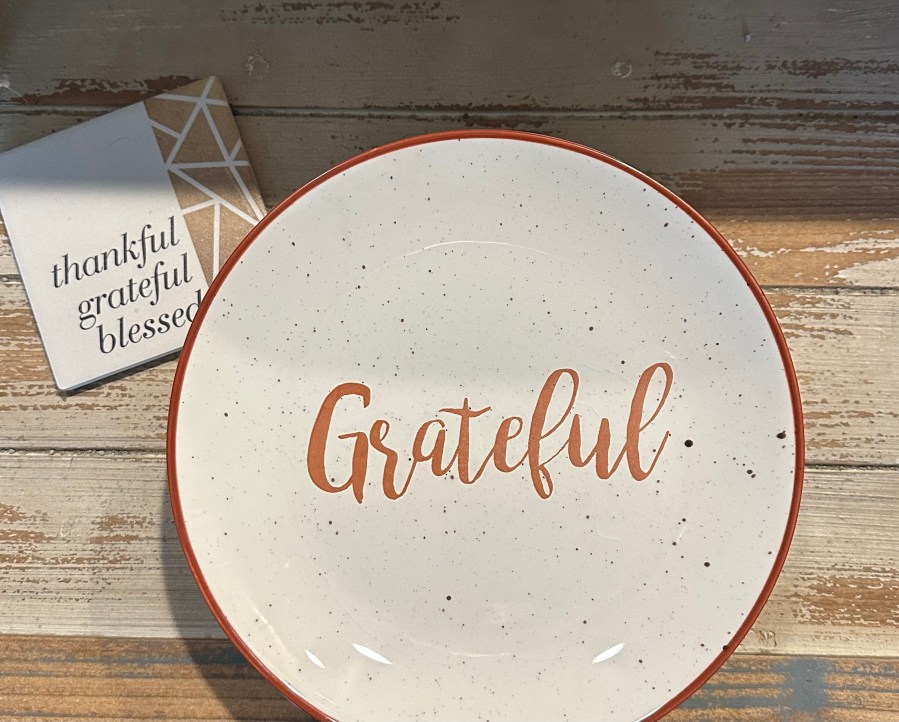
Today’s photo image is a “grateful” plate I set out this time of year. I purposely left the dark shadow in the photo as I took it, because I think worry, stress, judgement, etc can be an “opposition voice” that gets in the way of our gratitude if we let it.

This week, if moments to look within and be honest arise, approach them gently and then look for ways to be grateful for the insights they are providing.

Wishing you abundant peace, Deena
Featured

On the lookout for peace

During the Covid pandemic years I took several online classes, retreats and programs. One of those was a Women’s Mystics School offered by Spiritual Wanderlust, an online community supporting aspects of the interior life and exploring wisdom teachers in the contemplative tradition, modern psychology, philosophy and spirituality. It was always my favorite Saturday of the month to listen to and learn from the speakers invited to present to us. In 2022, we looked at the life and writings of modern mystic, Etty Hillesum.

Etty was a Dutch Jewish woman killed in the concentration camps in 1943. Etty was a well-educated woman who suffered from severe depression and sought help from her analyst, Julius Spier, who became her mentor, friend and lover. Spier encouraged her to keep a journal or diary. Those writings were published after her death in “An Interrupted Life and Letters from Westerbork.” Etty wrote reflections on things she read by Carl Jung and Rainer Maria Rilke. She wrote about her relationship with Spier. She wrote of her inner world. During the German occupation, Etty refused to go into hiding. She was forced to go to Westerbork, one of the transition camps, for Dutch Jews. From June to September 1943 she writes from Westerbork before being transferred herself to Auschwitz before being killed in November at the age of 29 years old.

What I found striking during our study of Etty’s writing was how she attempted to look at the situation she was facing, the trains and the faces of those being boarded on them, the German guards, and her own perspective and relationship to a God who dwelled deep within her. She tried to find and give love, build community, in the little ways she could while helping others in the transition camp. She focused on living fully, holding suffering and beauty simultaneously, despite the conditions she was facing. She didn’t focus on a God, external, in the midst of the turmoil in her country and the world. Rather, she experienced God in the deepest, richest parts of her being, and found rest and shelter there.

I was reminded of this study a couple of weeks ago, reading an article on Hillesum by Richard Rohr and the Center for Action and Contemplation. Rohr shared several of Etty’s writing in his reflection. They seem relevant for me today.

Etty reflects on the war she is seeing around her and writes, “Why is there war?… Because I and my neighbor and everyone else do not have enough love. Yet we could fight war and all the excrescences by releasing, each day, the love that is shackled inside of us, and giving it a chance to live.” We don’t have to look to war torn countries. All we need do is look to our current government and how our legislative representatives interact with each other and those they disagree with.

In today’s Gospel for the Eighteenth Sunday in Ordinary Time, (Matthew 14: 14-21) Jesus is “moved with pity” seeing the crowds following him, seeking guidance and his teaching. In the famous scene, the apostles are concerned for the thousands gathering around them, needing food, and asks Jesus to spend them away. Jesus initially responds to their request by saying that the apostles don’t need to send them away, but to feed them. They, of course, resist and say what they have is not enough. Jesus then feeds the crowds and abundant leftovers are gathered.

How often do we resist and say that we are just one person, we don’t have enough (time, resources, confidence) to make a difference in the world?

Even on a smaller, more personal level, Hillesum writes that we fight so many small battles, within, each day, that sap our energy. She offers instead that we must “not allow ourselves to become infested with thousands of petty fears and worries, so many motions of no confidence in God…. Ultimately, we have just one moral duty: to reclaim large areas of peace in ourselves, more and more peace, and reflect it towards others. And the more peace there is in us, the more peace there will also be in our troubled world.”

Silencing those small voices that insist on promoting unrest within can be challenging. Add social media to the mix and the voices seeking to drown out peace get louder and louder. So, I might be missing out on an update from a friend, or local area news, but reducing the amount of time I spend on social media, or on the news, saves the little bit of peace I can control.

Hillesum writes, speaking to God, “One thing is becoming increasingly clear to me: that You cannot help us, that we must help You to help ourselves. And that is all we can manage these days and also all that really matters: that we safeguard that little piece of You, God, in ourselves. And perhaps in others as well… You cannot help us, but we must help You and defend your dwelling place inside us to the last.”

This week I choose to be more on the lookout for peace than unrest and for small ways that I can make a difference with my humble fish and loaves.

Wishing you abundant peace, Deena

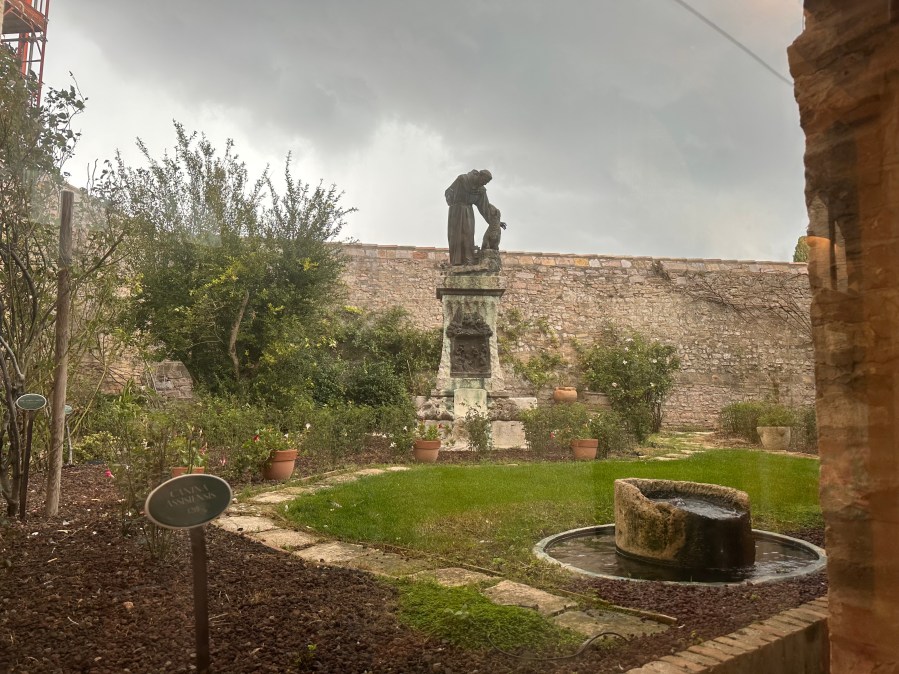
Image: St. Francis statue, a garden in Assisi.