Featured

Go by another way

I sat down this morning to do social media work I have been hired to do, before starting this blog, and I heard a bird calling. It wasn’t the typical wrens or sparrows of the morning. It was clearly not cardinals or blue jays I hear in adjacent neighborhood trees. It’s too early for robins. It was distinct, different. I immediately got up to find it, in the front yard, or in my backyard tree. I couldn’t find it but I kept looking as it kept calling out. It stopped me from doing anything else, I couldn’t resist the invitation.

I wonder, as I reflect on the wise men in today’s Epiphany story, if these magi had the same urgency to respond to the unique star they were seeing, seeking the important event it was foretelling. It’s easy to ignore those inner promptings, whether as simple as the little bird I heard, or as illuminating as a distant star. We pass them off as impractical ideas or a passing flights of fancy.

Sometimes the way will find you, even if you go another way.

This Fall I listened to a talk, either by Fr. Bonafice Hicks or Sr. Miriam Heidland (my journal notes weren’t clear as I looked back), and a reference to a new book by Bishop Eric Varden on Chastity and how chastity, and Bishop Varden’s description of chastity, speak of a reconciliation of senses and a love of beauty. I had listened to Bishop Varden online in the past, and enjoy his teaching, so I ordered it immediately. Once it arrived, and I attempted reading, I quickly realized I was in over my head. I set it aside. I picked it up again at a later date and came to the same conclusion, I was not going to get the point so easily captured by the review I listened to.

During a recent homily, my pastor spoke of Bishop Varden, so Friday I dropped off the book, thinking he might enjoy reading it and would certainly be a better student of the concepts than I was. I consider myself fairly adept at spiritual literature and theological teaching. Not an intellectual, but also not completely amateur to spiritual reading. After all, St. Teresa of Avila, St. Catherine of Siena, St. John of the Cross aren’t kindergarten reading and I enjoy spending time with their writings. I handed over the book as well as any hope of being able to understand it.

Friday night I was listening to a daily session of Minute Monk on the Hallow app, led by John Cannon, founder of Monk Mindset (a website but also a paid app released in 2025). The reflection was given by Fr. John on the Feast of Saints Basil and Gregory. He began talking about the Tools of Good Works in the Rule of St. Benedict and the love of chastity. He described chastity, not as an absence of sin, but as a good desire, a virtue, a mark of a human being fully alive. He then referenced Bishop Varden’s book on Chastity. I literally laughed out loud given that I handed over the book earlier in the day.

Ok, God I am listening, I exclaimed. Where are you leading me?

The summary was an excellent one, much like the one that led me to order the book in the Fall. Fr. John continued to describe chastity not as a list of do’s and don’ts but as an re-establishment of wholeness. It restores our senses to see and truly love, is a marker of integrity and allows us to see the world in truth, to have a contemplative spirit. It leads us to be more clearly attuned to our ultimate purpose of loving God and others.

For clarification for those who might be confused about chastity versus celibacy (a vow or state of being to remain unmarried and chaste), chastity is a broader virtue of having fidelity, sexually, to one’s state in life, whether being married or unmarried.

The instance wasn’t for me a reminder of living a chaste life, but instead was a reminder of living a contemplative life, focused on love and compassion for others (Compassion is my chosen “word” for 2026). It was a reminder that being free of other responsibilities, I have desired a life dedicated to prayer, contemplation and monastic virtues. But lately I have questioned how I have been living that commitment. How deep is my love of others when I react harshly, with judgment, to those I encounter? Am I seeing Christ in the other?

This morning, the USCCB social media pages, released a reflection on the Feast of the Epiphany by the Most Rev. Ronald Hicks, Archbishop-designate of New York and Bishop of Joliet. Even though he is Bishop in the nearby Diocese of Joliet, I have learned more about him recently as he has been introduced to the people of New York. He talked about how his experience of living in Central America transformed him, his experience of the people and the culture, changed him. He said that when he encounter Jesus and his word, in scripture, and the sacraments, when we care for others, we go home by another way. We are changed and we are challenged to carry that Light, that we have experienced, out to others.

Let it be so.

Wishing you a week of abundant hope and joy, Deena

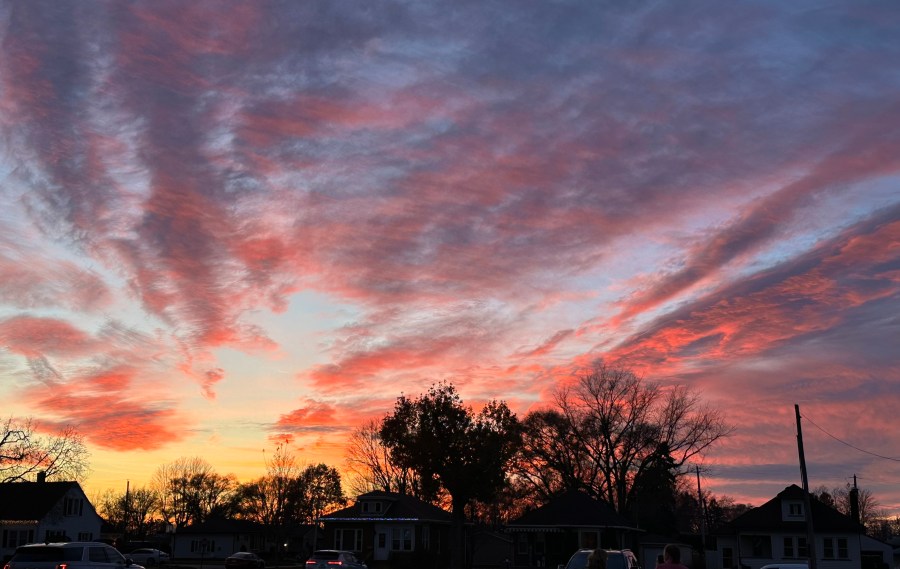
Image: a photo of a sunset, a moment of beauty.

Featured

Embrace joy

Joy and happiness are emotional states that are often used interchangeably but actually joy is very different. Happiness might be found in response to life circumstances such as setting and completing a goal. Joy, science is telling us, may be experienced even amidst life hardships or uncertain times. I might not be happy all of the time, but I can experience joy regardless of what is going on in my life by being intentional about certain things in life. For me, my faith and prayer life, are huge contributors to my experience of joy.

An article published by the National Institute of Health in May of this year said that lots of attention is given, in popular psychology, to positive emotions and finding happiness while joy is still an area that would benefit from further study. A study cited, of adults ages 28-59 from the United Kingdom, reported “fostering positive relationships, engaging with nature, and cultivating self-awareness were identified as key strategies for sustaining joy.”

A study of 7000 individuals, reported by National Public Radio in 2023 as part of the BIG JOY Project, reported that “people who commit daily “micro-acts” of joy experience about a 25% increase in emotional well-being over the course of a week.” Emotional well-being was described as attributes such as better coping, less stress, quality relationships, and feelings of hope, optimism and even fun. Examples of the micro-acts of joy included gratitude journaling, doing a random act of kindness, visiting a sick neighbor, celebrating a friend’s joy, or engaging in self-reflection. The researchers asked whether doing these small acts of joy can make a difference and referred to “the ideas of the Dalai Lama and Archbishop Desmond Tutu, who both spoke about how it’s possible to feel joy even in the midst of suffering, and to use that feeling to help do good.” Our joy, it seems, help us not only enhance our own well-being but contribute to the lives of others when we use our joy as a motivation to share with and help others in the world. I am sure we can think of others in our personal circle, or the wider circle of our communities, that could use a bit more joy these days.

Randy Taran, founder of Project Happiness, wrote in her daily email update that “joy isn’t something you wait for. It’s something you choose, amidst the struggle and in life’s tender moments, that make life worth living. Embrace the people and the things that bring your heart healthy doses of joy.” Things like buying yourself flowers, watching the sunset (or I would add, stepping out to experience the Northern Lights this past week), dancing in the kitchen or taking a long route home are some of the suggestions she offered.

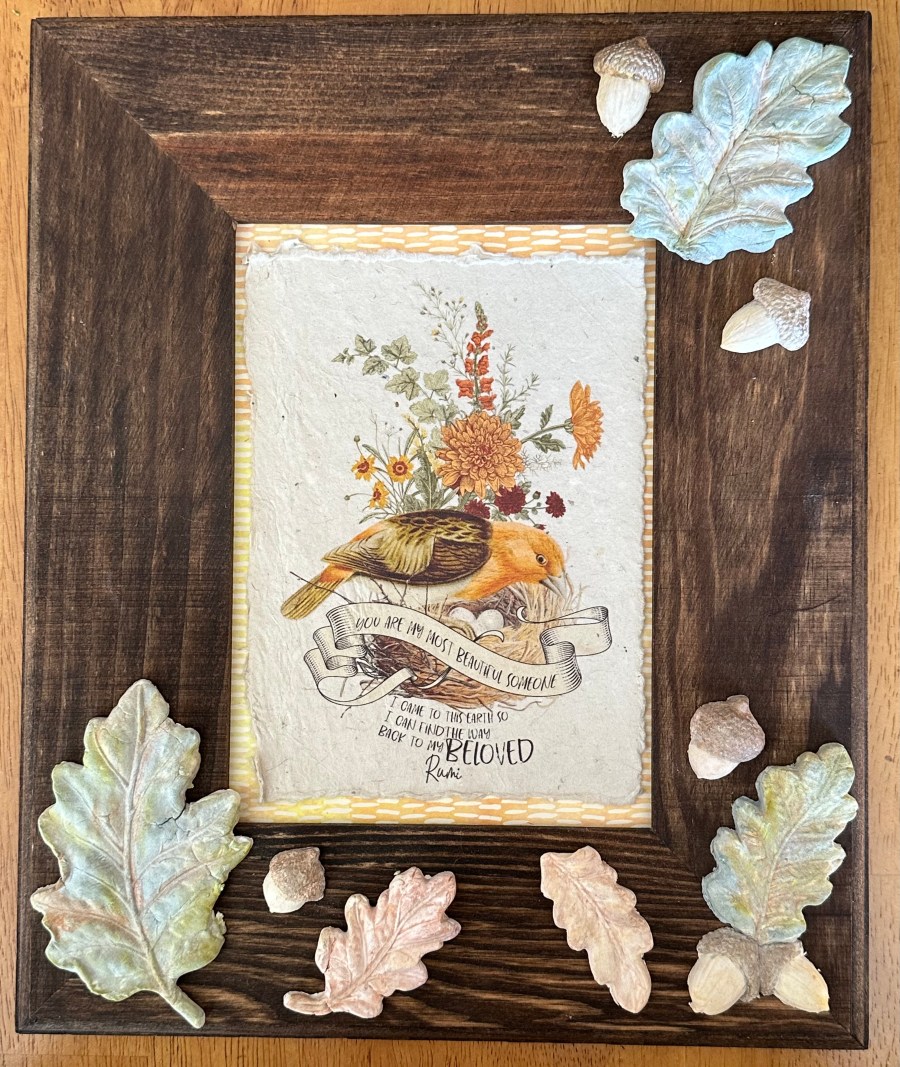
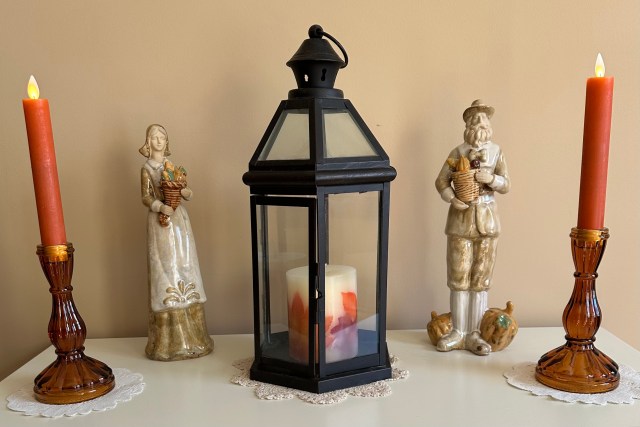
Exploring the world of creativity, the impact of expressing myself in creative acts, is also a way to increase joy and mindfulness, while decreasing stress and anxiety. Creativity becomes a means to tap into my own wisdom, gain clarity in difficult situations and decrease stress, either personal situations or response to societal events. Perhaps painting, knitting or crocheting, making handmade cards, or frames like the one I posted as the featured photo, are ways that you might express yourself. A friend, Joan, on Facebook shares her creativity by posting her table settings. They are always expressions of beauty, care and love by the way she has displayed her table. I love creating little vignettes with decorations, like a Thanksgiving display, photo included on blog site, or setting out favorite seasonal items. Some of those items may evoke an emotional response, to a family member or celebrations in the past. It may just be the way the colors you choose make you feel when you look at them. All of these are ways of expressing your inner artist and creative soul.

As we move into preparing for the holidays, days that can be stressful or frantic, how might you engage in a daily micro-act of joy. What can you do each day to reconnect with inner joy or creativity, so that regardless of how holiday planning is going, you find more peace and tranquility? As we find and experience more joy, it will likely spread to those around us!

Wishing you a week of abundant joy and hope, Deena

Featured

Savor these days

I watched one of my cats, Butters, this morning after he finished eating and was ready to settle down for a morning nap. He walked the house and looked at all of his favorite spots before settling on his blanket on the couch. I will likely join him with a blanket later today and a steaming cafe latte. It’s a good day to stay warm and cozy after the rain and snow last night and, now, the chill and cold in the air this morning.

Friday I was beginning to feel the panic of the season set in – busy days with work, church activities and errands to get done. I cleaned up the cemetery, thinking ahead to Saturday and knowing that I should clean up a variety of pots at home too. I had some bulbs to get in the ground and transplant a plant from a pot to the ground before the cold. I started thinking about the Christmas cards and shopping that I haven’t started yet. I will be helping with a pop up ornament class at the unique shop that I do social media work for, as well as working two mornings a week. November has meetings and holiday events. In December and early January, I will facilitate an Advent book discussion for my parish. I found myself short of breath thinking about it all! I stopped and reminded myself that I didn’t want these next two months to be a blur of activity and stress but rather moments of prayer, worship, family, friendship, and celebration.

Yesterday I simply enjoyed the day. I went to the gym and coffee with my friend, Kelly. Then home to clean out the pots and get the plant and bulbs in the ground, with a heavy coat of mulch. I went to Mass and then dinner with Kelly and her husband, Mark. We laughed and enjoyed our dinner and each other’s company.

It all gets done. Whatever doesn’t, probably wasn’t that important. Or better yet, focusing on being grateful, celebrating Advent and Christmas, spending time with people and making memories is what truly matters. Stress and worry doesn’t help. It also prevents us from savoring the moments as they present themselves.

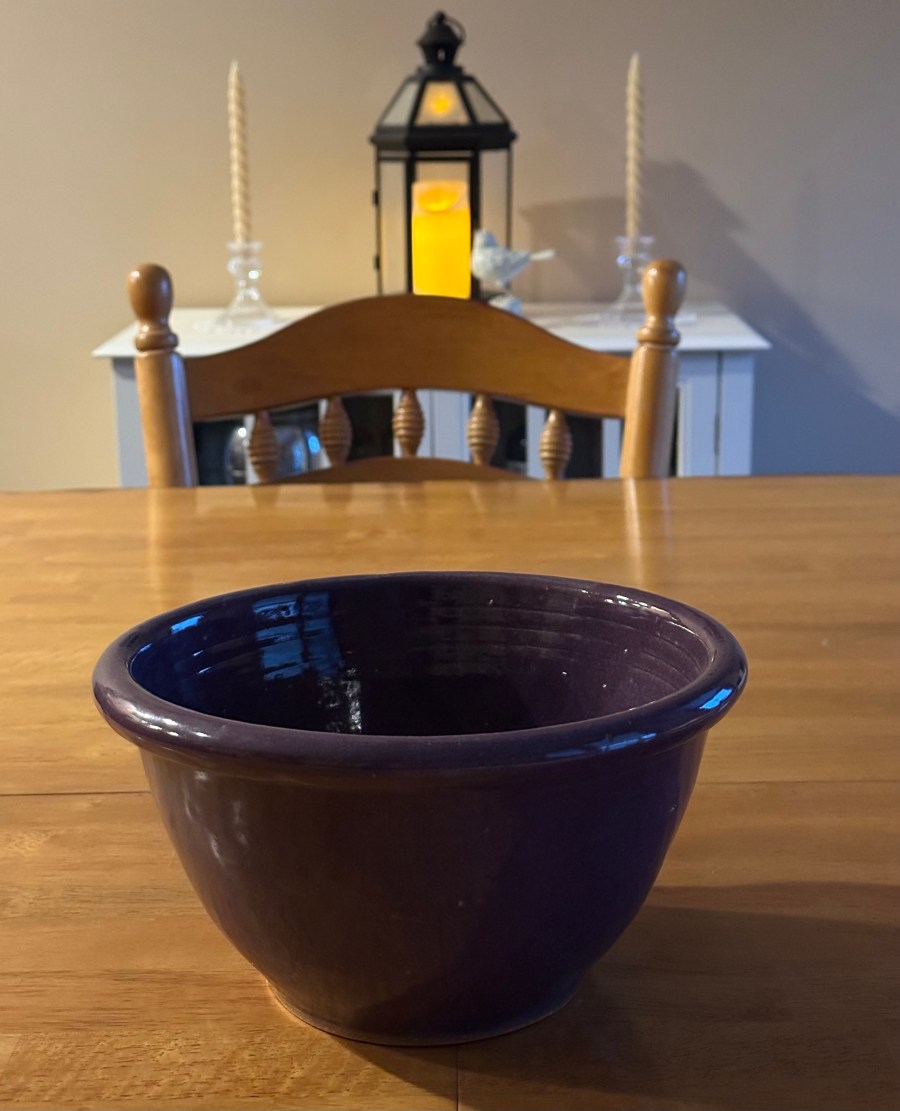
I am enjoying my Thanksgiving decorations before I move into Christmas. Each night, in the house, I light my candles, lanterns and sparkly pumpkin. When I decorate for Christmas, I leave those decorations up until at least Epiphany. Since it falls on January 4th this year, I will likely enjoy them until mid-January. The merry lights and decorations help with the darkness of winter. The decorations make me happy but also bring lovely family memories with many of them.

I want to move around and make the best decision for my spirit and my well-being, just as Butters did this morning. I want to pause and savor the moment just as I did as I watched this little bird, today’s post image, as it landed in my tree this morning, swaying with the moving branches in the wind.

Maybe you are like me though, and you have to remind yourself to slow down and savor the moments. I don’t want the days to be a blur of getting things done but not enjoying them. As we move into this busier time of year, I invite you to join me in taking intentional pauses to be present, aware of the people you are with and the things you are doing. I know it’s cliche but if today was your last day, would you be happy with how you spent it? Let’s step back from the rush and hectic pace and find ways to enjoy the things we are doing and the people we are with.

As Pope Leo XIV reminded us in today’s Angelus address, we are invited to walk in “the joy of being the holy People that God has chosen” to spread the Gospel message of love and mercy through our daily witness in life. I am pretty sure being stressed out and anxious isn’t the best way to share that message. So, let us be grateful to God for the lives and people we have been blessed with. Even with daily challenges, we can find something to pause and be grateful for. In doing so, we will likely be a bright light of hope to those around us.

I wish you abundant peace and hope this week, Deena

Featured

A whispering threshold

I visited the cemetery before Vigil Mass for All Souls Day yesterday (Saturday) afternoon to put small votive candles (as seen in today’s blog photo, I gave up on trying to keep real candles lit in the wind) on our family tombstones, a tradition on the evening of All Saints Day to light the path for souls and a symbol of love and remembrance. A few years ago there used to be groups praying as they visited each gravesite and many more candles. I only see a few now.

I love the tradition of Dia de los Muertos, Day of the Dead, altars with the many marigolds, pictures, food items and symbols decorating the ofrendas, altars, set up between October 27th and taken down shortly after All Souls Day. You can find many beautiful and elaborate pictures online if it is not celebrated in your area. At my parish, we have a lovely tradition of remembering our beloved dead with candles, many of us provide pictures to be placed by the candles, which will burn all month surrounding the altar. I love to reflect on the candles as all the souls that worship at the altar each Mass with us, Saints and saints, that join in our praise. I will add a photo of the candles this year, below, to the online version of this blog post.

There have been times during the year, or after the passing of someone dear, that I have experienced the thin veil between heaven and earth, the mist of time, more easily. Perhaps that is why I relish these days of All Hallows Eve, All Saints and All Souls so much. We can pause and reflect that it is literally a breath that binds us in our bodies and a more tangible realm. We take so many breaths each day for granted. If you have been with someone as they have breathed their last breath, you know how fragile and temporary life is.

This week, during my Wednesday Adoration time, Fr. Carlson played an organ piece, from the many he has downloaded and saved, that I hadn’t heard before. It was lovely, then dissonant like someone that might have hit the wrong note but it continued. It was jarring and unpleasant at times but then also hauntingly beautiful. I asked him about it afterwards but missed the name except that it was a Babylon meditation (if I get the full title this week, I will footnote it below). We reflected that it seemed a fitting reflection on the exile of Jews from Jerusalem to Babylonia. I later reflected on this symbolically for life. We are exiled, temporarily, from our true home, in Heaven. Life is full of those discordant moments, unsettling and disagreeable, in the middle of beautiful, soothing and joyful times. The next night I had a dream, full of symbolism about my life’s journey. I paused in the morning, journaled about it, not wanting to forget the details that I can reflect on and how they might be inspiration for areas of my life that need transformation. I viewed it as a thin, whispering insight between my conscious and subconscious being.

One of my favorite books, it is likely that I have written about it in the past, is Braving the Thin Places by Julianne Stanz. Early in the book she asks us to pause and take a deep breath, reminding us that “Our spirit did not generate itself; neither did we create it. It comes from a Divine Being who has breathed life into you and me, into all of us.” Stanz writes about her Irish heritage, Celtic wisdom and the beauty and symbolism of the “thin spaces and places” in Ireland. “Out of sight…does not mean out of soul.” The souls of those we love walk with us each day and remain close to us.

The Church asks us to pray for all those who have died, especially those who have no one to pray for them, this month of November. A lovely practice is to visit a cemetery and just pray the “Eternal rest grant unto them, O Lord…” Often as I am driving between the tombstones of my grandparents and my parents I recite that prayer over all the tombstones at the cemetery. In the older section there may no longer be family members to pray for them. Whether you are close to the burial places of your loved ones or not, or others you have known in life, take some time during this month of November to remember them and pray in a special way for their souls. They have gone before us with the sign of faith, and have fallen asleep in the hope of the resurrection (Eucharistic Prayer in the Roman Canon). We shall join them some day.

“…do not let our brothers and sisters be parted from you, but by your glorious power give them light, joy and peace in heaven where you live and reign forever…Eternal rest grant unto them, O Lord, and let perpetual light shine upon them. May they rest in peace. Amen” (Give Us This Day post for All Souls Day)

Wishing you abundant hope and peace, in the company of all the Saints, this month. Deena

Candles for our beloved dead at Holy Family Parish, Oglesby.

Featured

Grounded in faith

I started reading Brene Brown’s new book, Strong Ground: The Lessons of Daring Leadership, The Tenacity of Paradox, and The Wisdom of the Human Spirit, the past few days. I have to admit that it is always her personal reflections and application of her work with the Dare To Lead program that I find most thought provoking in my own life. We’re all leaders in some way; family, church or social organizations, the way we interact and care in relationships, but having stepped away from corporate work I am less interested in leadership qualities at that level. Still, I was intrigued with Brown’s new book and thoughts she might have on the current state of our societal relationships and leadership. I am glad I followed the hunch to purchase her book.

She began with a personal story about recovering from a pickleball injury and how her coach helped her find and work from her core, engage her body and mind in the healing process, and connect to her “strong ground.” She suggests that many of us are struggling to find our ground. She proposes that individually, and collectively in our country and in organizations, “we need to push into the source of our strength and sturdiness so we can navigate the world. We need the ground to steady us and at the same time to propel us into purposeful action.”

Brown writes quite a bit about her study of, and personal journey with, the mindfulness work of Jon Kabat-Zinn in relation to finding our center and being grounded. Citing research she did for another book, Brown says that both anxiety and calm are contagious. She reminds us that staying calm is an intention. When we consider those we encounter each day, “Do we want to infect people with more anxiety or heal ourselves and the people around us with calm?” We need to pay attention; to our breath, to what’s going on within as we speak and make decisions. I NEED to reflect on the attitude I have as I leave the house, am I going to contribute to the day that others are having or am I going to be a tornado of worry, concern and anxious thoughts as I venture out? Some days it just might be better to stay in until the calm returns and I feel grounded in the truth of who I am.

So far, my favorite sections of the book have been on transformation and “grounded confidence”. I tend to read the first couple of chapters of a new book, then browse and read selectively to get an idea of the entire book I am reading, then go back and read more slowly and thoughtfully. In writing about transformation, and summarizing her reflections throughout the book, Brown examines the false notion that learning and change are only about effort one applies. She suggests that real change happens when we focus and build our foundation, and operate from that place of being grounded, instead of reacting to a current situation or perhaps even worse, being so set in our ways that we think that the problem is with everyone else, thinking they are the ones that need to change, not us!

Personally, one place that I build my foundation and center myself is in my daily prayer, reflection and journaling. Daily Liturgy of the Hours, Lectio Divina, or scripture reflection remind me of God’s love and presence, no matter what seems to be going on around, or within, me. The Letter of 2 Timothy caution us that there will be people around us that deceive us and will go “from bad to worse”. But remaining faithful to what we have learned and believed, from Christ, we will remain “competent and equipped for every good work.” (2 Timothy: 3)

Remaining faithful to the daily practice of reflecting on the truth of our faith, we will be “strengthened with power through his Spirit in the inner self, and that Christ may dwell in your hearts through faith; that you, rooted and grounded in love, may have strength to comprehend with all the holy ones what is the breadth and length and height and depth, and to know the love of Christ that surpasses knowledge, so that you may be filled with all the fullness of God.” (Ephesians 3: 16-19)

With that as the source of my strength, I am grounded, more capable and willing, to engage with the world with hope and joy.

Wishing you abundant hope and peace this week, Deena

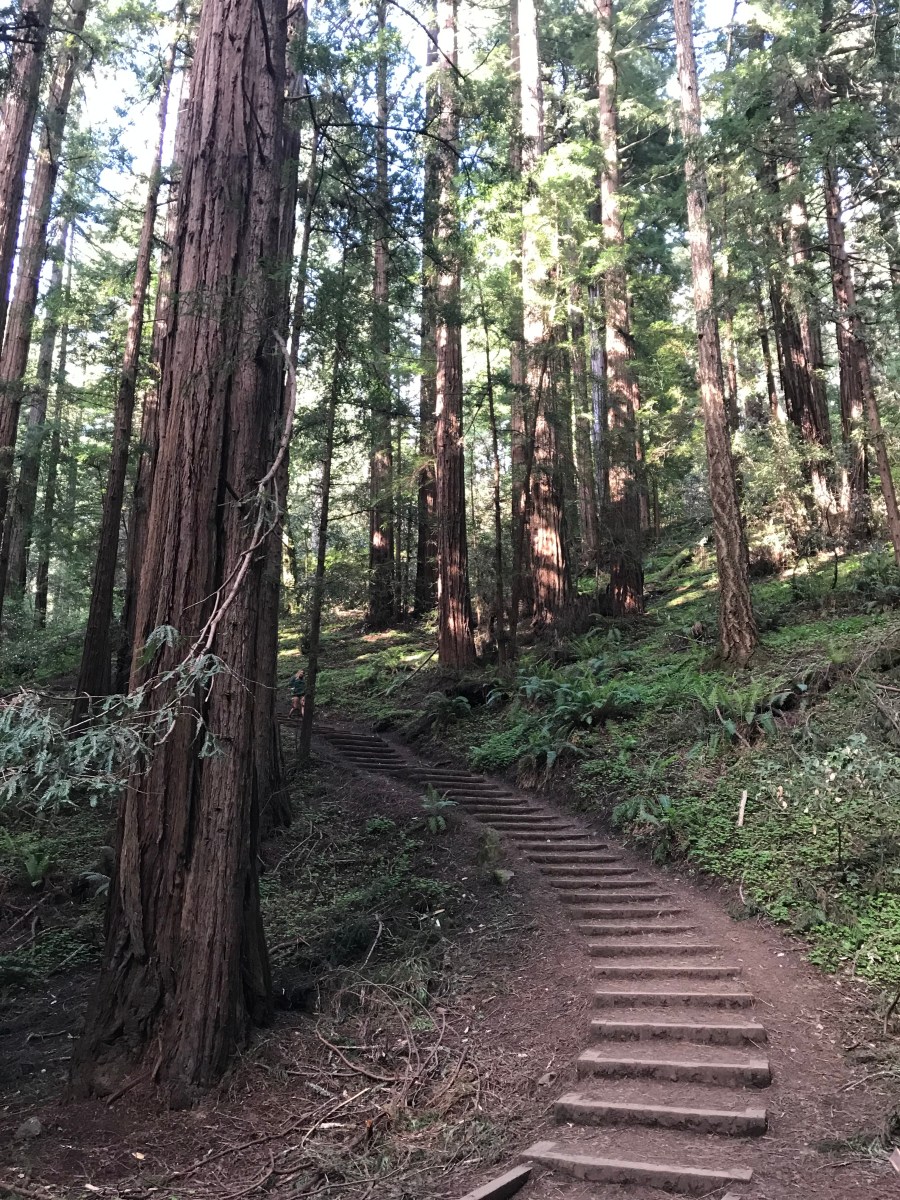
Photo: Taken during a visit to Muir Woods, California

Featured

Whisper of the soul

A few weeks ago an opportunity to apply for a position that 10, maybe even 5, years ago would have been a dream come true, presented itself to me. At that point in my life I would have considered moving to be sure that I would be as available as the position would require. I applied but as I reflected upon it, and listened to the voice within, I just knew it wasn’t the right time or role for me as I wind down my 60’s this year. I emailed and withdrew my name. Once I made that decision, in God’s timing and providence, I was asked to be a social media coordinator for a second client. It’s with a business that is very appealing to me and my personal interests. They carry products that inspire me and my creativity. Both of my part time clients are in the business of things that I enjoy. I feel that I am contributing, but am also challenged to learn and grow.

Saturday was the Memorial of St. Pope John XXIII, the Pope who convened the Second Vatican Council, to bring a breath of fresh air to the church, which resulted in changes to the liturgy (such as praying in English instead of Latin for those of us in the US, and the altar facing forward) and church structure. He was a humble servant, a humanitarian, and was an advocate for human rights and for peace.

I read a quote on a social media page reflecting on his papacy, which I fell in love with, so I wanted to learn more about it. The quote: “Consult not your fears, but your hopes and dreams. Think not about your frustrations, but about your unfulfilled potential. Concern yourself not with what you have tried and failed in, but with what it is still possible for you to do.” Pope St. John XXIII

I found the quote in a Papal Artifacts site that documented St. John XXIII and his accomplishments. But Google indicated that the quote is not cited in any specific papal document but seems very much in style of his Daily 10 Point Plan. The Pope’s “Daily Decalogue” was shared in a memorial Mass in 2006 by Cardinal Tarcisio Bertone. It includes daily resolutions such as living with a positive attitude, reading and creating a daily plan, and believing that he was created to be happy, believing in the Providence of God in his life and to do good in life each and every day. So I think the quote is still a good one to share and that that it represents the spirit of how St. John XXIII approached life.

This week grab a notebook or piece of paper and write down your hopes and dreams. Create your own personal “daily decalogue”, ways you would like to approach each day. I have a series of things I do each day, but not always in the morning. I have been reflecting that I would prefer to challenge myself to get up earlier each morning (or if I wake up at 4:30, which happens a lot these days, stay up) and begin my prayer and journaling. It is with focused attention and reflection that we get clear about what is important to us and what we desire in life. I have always believed that the desires we hold in our heart are calling us to use the gifts that God has given us in life, as long as they bring us closer to God and serve others in a life-giving way.

This past week was also the memorial of St. John Henry Cardinal Newman. One of his prayers, which I learned during Lay Ministry training in our Diocese in the 1990’s, has remained a favorite over the years. It also speaks of our soul’s purpose. I’ve shared it before but would like to share here again. I hope as you read, and pray with this, you are reminded that there is something specific you are on this earth to do. Listen and then follow that desire.

God has created me to do Him some definite service. He has committed some work to me which He has not committed to another. I have my mission. I may never know it in this life, but I shall be told it in the next. I am a link in a chain, a bond of connection between persons. He has not created me for naught. I shall do good; I shall do His work. I shall be an angel of peace, a preacher of truth in my own place, while not intending it if I do but keep His commandments. Therefore, I will trust Him, whatever I am, I can never be thrown away. If I am in sickness, my sickness may serve Him, in perplexity, my perplexity may serve Him. If I am in sorrow, my sorrow may serve Him. He does nothing in vain. He knows what He is about. He may take away my friends. He may throw me among strangers. He may make me feel desolate, make my spirits sink, hide my future from me. Still, He knows what He is about. (St. John Henry Newman)

Wishing you abundant peace this week, Deena

Image: Some plants, and an adorable sign, in my raised bed.

Featured

Real life, real faith

Some days faith is hard. Life challenges us with the state of the world or the events of our own lives and families. We have constant updates from so many sources, so our minds are infiltrated with the news, close to home and beyond. The apostles following Jesus didn’t have iPhones or social media updates and still they said to the Lord, “Increase our faith.” (Luke 17: 5-10, Twenty-Seventh Sunday in Ordinary Time). I pray the same request on many days!

Earlier this week we celebrated the Memorial of our Guardian Angels. I recalled a night, many years ago, walking the dog late in the evening. It was very late, no one out and about, so I chose to walk him in the middle of the street so he would have plenty of room and could survey the neighborhood. We were halfway down the block, but in the still of the night I heard a car turning the corner, speeding with screeching tires, on the street perpendicular to the one I was walking on. My heart raced as I had a feeling the car would turn onto the street I was walking. But I was frozen. In a split second the car did turn and we faced it head on. Suddenly I felt a push on my left side and looking ahead at the dog saw him move in the same way, looking straight ahead but his body being pushed entirely to the right in the same way that I was being moved. The car sped by. I knew in an instant that I didn’t move us and that we had been spared from being hit. I can’t say I thought of my guardian angel much before that night, after giving up the youthful evening prayer of “Angel of God, my guardian dear…” My faith in the presence of my guardian angel grew on that evening and in the many instances I have been protected since.

I read a reflection by Br. Michael Marcotte, OSB, of Conception Abbey on the Gospel for today. He pondered how we continue to find, and grow in, faith when we can’t see the Lord as the apostles did. He quoted Fr. Jacque Philippe and St. Augustine with thoughts to help us grow in faith. He wrote: “Fr. Jacques Philippe maintains that it is through prayer—especially praying with the scriptures—that our faith increases. He wrote “Faith is the capacity of believers to act not according to impressions, preconceived ideas, or notions borrowed from other people, but according to what they are told by the Word of God, who cannot lie.” (Time for God, p. 9). As St. Augustine put it, “Believe in order to understand.” Faith is not a matter of acquiring the right kind of knowledge. It is about entering into a relationship of trust and love.”

Scripture shows us that God is faithful. If we look at our lives over a broader spectrum of time, I believe that we can see that as well. It can be challenging in the moment so I think that Br. Marcotte’s suggestion offers us a roadmap for the journey. He asked, at the end of his article, that we consider how we can deepen our relationship with Jesus and grow in faith.

I need to spend time on that question this week. Maybe you do too? Then perhaps it will begin with the faith of the mustard seed, and over time, grow into a strong and sturdy conviction and confidence.

Wishing you abundant peace and hope this week, Deena

Image: One of the memorials in Portugal where the Angel of Fatima, or the Angel of Peace, visited the shepherd children preparing them for their spiritual mission and teaching them prayers.

Featured

Live light

I don’t really remember what the discussion was the day my spiritual director asked me, during the 9 months of the Spiritual Exercises of St. Ignatius, what I would take if I had to leave my home immediately but I have never forgotten the question and my answer.

This week I read a daily reflection in Give Us This Day, by Maxwell Johnson in “Travel Lightly to the Kingdom” in which he asked “how easy would it be for any of us to pack up, pick up and go?” He was reflecting on the possibility of having to quickly pack, leave our homes the next day with the possibility of not being able to return, knowing we only had time to pack a few things. He asked us to consider what we would take, leave behind and then the ultimate question, “How much ‘stuff’ do we really need?” As I reflected on these questions I wondered if the things I possess are bringing me joy or are just a source of stress and anxiety. The questions are natural in later years, along with a desire to purge and live more simply, but they are good ones to ponder each day as well.

Certainly in areas impacted by weather threats like fire or hurricanes, the question has been a real one for many individuals in recent years. People being forced from their homes and their countries as a result of war have faced the same concern. I am sure they could tell us the weight of those decisions, whether given a day or an hour to choose. For them, it isn’t just a hypothetical question. It wasn’t a probing inquiry to reflect upon or a spiritual analogy for all the things that weigh us down and distract us on our journey toward eternal life. It was an impactful decision that forced them to consider what they really needed or wanted.

I wonder, what would I take with me?

This weekend, the Twenty-Sixth Sunday in Ordinary Time, the always disruptive parable, in the Gospel of Luke (Luke 16: 19-31) of the rich man and Lazarus, asks us to ponder the same soul-searching questions. Am I leading a life that brings me closer to God? Does my life reflect a love and concern for those around me? Or have I been living a self-centered life focused on more mundane and temporal concerns?

I invite you this week to consider the question in your own life. What would you pack today, knowing you have to leave your home tomorrow? Then, reflecting on your answer, what does that say about the other possessions that might consume your time, energy and financial resources?

Whatever the answer, I hope you find abundant peace and hope this week.

Deena

Image: A sketch of monks walking together I saw hanging in a monastery.

Featured

Dawn of a new day

One of the things that I have realized in dealing with, and recently writing about, issues around mental health and well-being is that things always feel worse at night. The darkness, heavy with shadows and devoid of light, seems to forbid seeing possibility. Gloom settles in easily. In January I cancelled all streaming channels and was content to read or work on art projects. The past couple of months required noise from the TV or from YouTube videos, even if they were positive or spiritual talks, as a constant companion, reminding me I wasn’t alone. This week that noise has become a distraction and annoying, TV, especially the news, was intensifying the anxiety instead of calming it. That was a sign, for me, that things are beginning to change. I am beginning to find my way back to peace.

The darkness became a metaphor for the things that I didn’t want to face or deal with. Whatever flaw popped up in my mind became ten times worse when I refused to look at and acknowledge it. As I heard Fr. Ambrose Criste of St. Michael’s Abbey say this weekend as he began the St. Michael the Archangel Novena (preparing for St. Michael’s Sept 29th Feast Day), we need to acknowledge how far we have drifted from the light. We have to recognize and name the darkness, not to be discouraged by it, but rather to be healed. He remarked that only what is named and brought into the light can be healed. “Only what is seen can be surrendered.”

During the Healing the Whole Person Retreat that I attended at the beginning of August, Sr. Miriam Heidland invited us to engage our healing journeys with curiosity and kindness instead of judgment. We were reminded during the retreat that “suffering that is not transformed is transmuted.”

It requires humility to face those areas of our lives that we are not living to our full potential. Qualities that we have been gifted by God to live and express in our being but have been ignoring. To do so, for whatever reason whether doubt and lack of confidence, or due to some harm or damage inflicted by someone, is to ignore what God is calling us to do or be. It’s as if we are saying, I know better than God and my choice to live in fear and lack of trust is more important than trusting that God is leading me to live a certain way. It may also be the divisive voices of the world, the enemy, or the “false spirit” as I prefer to call it. One of those faulty messages is doubt.

Doubt, whether real or imagined, is harmful to our emotional well-being. It can lead us to self-isolate and avoid situations so we don’t have to pretend to act in a way that we aren’t feeling. It can result in procrastination and indecision because we don’t trust that we can make the right decision. We begin to use negative self-talk and criticism about the things we are doing and how capable we feel. We begin to compare ourselves to others, and if we do so through the lens of social media, we will never measure up because the standards we set become unrealistic. Doubt increases stress, anxiety and depression.

When we welcome the light of hope and truth, we can see the flaws as they really are, something to surrender to the grace of change. Then we move forward, yearning to live in trust and peace. We can cast doubt aside, even in difficult situations, and trust that we are not walking alone. I lean in to the words of Psalm 34, “The Lord is close to the brokenhearted”, the Lord delivers us from our troubles.

On Saturday, Pope Leo XIV spoke a message to those suffering with ALS, acknowledging the difficult burden they bear but offering an insight, and reminder, that the disease offers an opportunity to see that the quality of human life is more than achievements, it is dependent on love. He encouraged them to grow in gratefulness, especially for those who care for them, and for the “beauty of creation, of life in this world, and of the mystery of love.” I think this is a message we can all take to heart, no matter what we might be facing in life.

Wishing you abundant peace and hope this week, Deena

Image: Sunlight streaming through the trees and Anderson Japanese Gardens

Featured

Visionary faith

I met with a Catholic counselor/coach this past month to explore a prayer technique I was interested in learning more about and discuss experiences I had during a recent retreat. One of the most helpful aspects of the meetings was a recommendation to explore a couple of personal assessments and then meet again if interested to discuss them. One of the assessments explored life experiences, or achievements, and what they reveal about the truest expression of ourselves. The summary stated that we change over time but “What remains constant are the God-given motivations that fuel your decisions and behavior.” This reminded me of the Spiritual Exercises of St. Ignatius of Loyola, that I have written about in previous blogs. The Spiritual Exercises help us name desires and motivations and in doing so, discover ways that we can serve God, in our own unique and personal way, and lead us toward God’s deepening life within us.

The assessment summary provides a person’s top 5 motivations and top motivational dimension. My top motivational dimension was Visionary. Each of the motivations and this top motivational dimension make perfect sense and I can see why I am drawn to certain activities and relationships in life and why they fill me up or make me feel purposeful and alive. I think it will be helpful as I continue to discern what’s ahead for me in life.

As I thought about the dimension of Visionary, someone who loves to envision possibilities and ideas and find practical ways to bring them to life or to inspire others to bring things to being in their lives, I thought about life with God and visionary faith. To be a Catholic Christian in today’s world requires visionary faith. While this was not what the assessment was talking about, I reflected that to live and share our faith with others requires a visionary approach. We live with a faith that hopes in the promises of God, that looks beyond what we see in our current reality, and looks to the spiritual realities to direct and guide our choices. When we look to those in scripture that heard and acted on God’s voice and guidance, they hoped in a life beyond current circumstances, they lived and acted, on God’s promises. With visionary faith we are able to move forward in life based on hope not fear.

But we are called to live differently as a result of our faith. Pope Leo XIV challenged us in today’s Angelus message saying that God doesn’t want a church full of those who only offer prayers and sacrifices. He says that our faith should lead us to practicing justice and loving our brothers and sisters in this world. Pope Leo went on to say that it isn’t an easy path, that our choices in life may be unpopular, that we must fight “against our selfishness, giving ourselves for the sake of others, and persevering in doing good even when the logic of evil seems to prevail.” That is visionary faith!

So, let us choose this “narrow path” (today’s Gospel, Luke 13:22-30), believing in the life that Jesus invited us to, discerning God’s will in our lives, and acting with courage and hope in pursuit of a joy that comes from living more deeply in God’s love.

Wishing you abundant peace and hope, Deena

Photo: I selected this image of St. Bartholomew and St. Lawrence from the Museo de San Marco in Florence, Italy, because today, August 24, is the Feast Day of St. Bartholomew. St. Bartholomew was one of the 12 Apostles and was recognized by Jesus for his pure heart and acknowledgement of Jesus as the promised one of God.